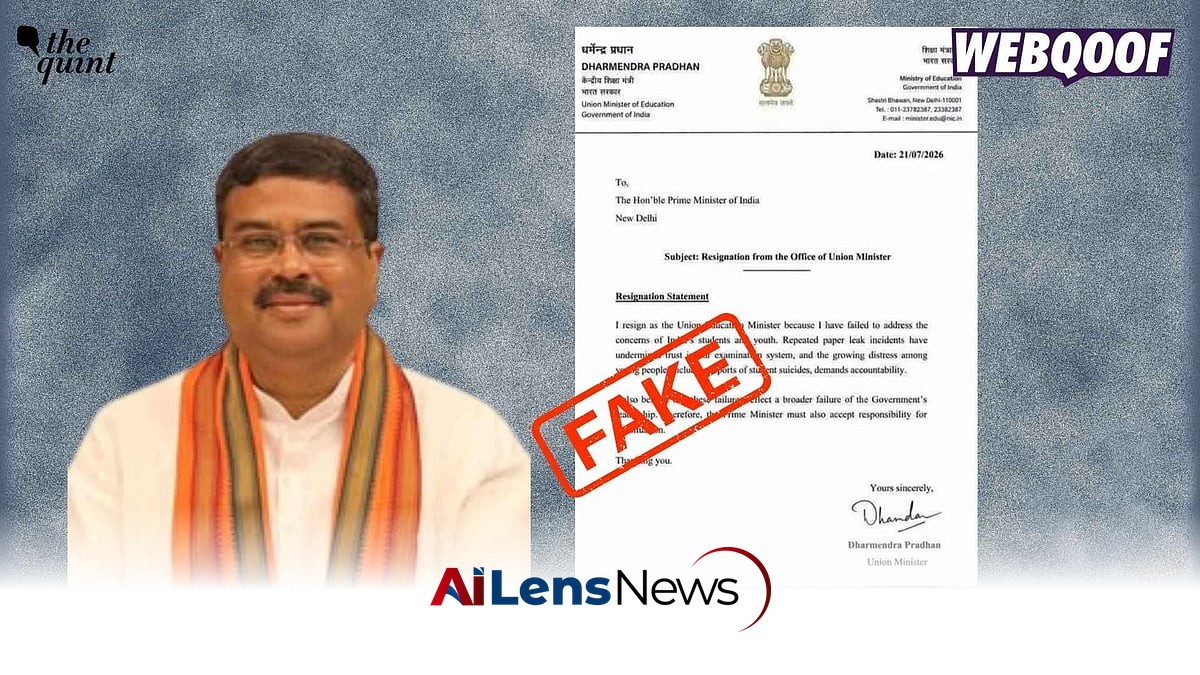


An image claiming to show Union Education Minister Dharmendra Pradhan's resignation letter is fake, as verified by our investigation.
New Delhi, India Jul 24, 2026 ALN: The political landscape in India has been marked by various protests and movements, with student activism playing a significant role in shaping public discourse. Recently, an image claiming to be the resignation letter of Union Education Minister Dharmendra Pradhan has circulated widely on social media. This claim has gained traction particularly in the context of ongoing student protests led by a group known as the Cockroach Janta Party (CJP), which is demanding Pradhan's resignation.
Understanding the context of this situation requires a closer look at the current political climate and the role of education in India. The education sector in India has been under scrutiny for various reasons, including policy changes, the quality of education, and the handling of student grievances. The CJP, a student-led organization, has emerged as a vocal critic of the government's education policies, arguing that they have failed to address the needs and concerns of students across the country. The group's name, which may seem humorous or absurd to outsiders, is indicative of their approach to political commentary, using satire and parody to challenge the status quo.
As the protests intensified, the image of the purported resignation letter began to circulate, leading many to question the authenticity of the document. The claim that Pradhan had resigned was particularly sensational, as it suggested a significant shift in the government's approach to education amidst rising discontent among students. However, it is crucial to verify such claims before accepting them as fact. The political implications of a resignation at this level could be profound, potentially leading to changes in educational policy and governance, which is why the accuracy of such information is paramount.
Upon conducting a thorough investigation, it was determined that the image circulating online is indeed fabricated. The fact-checking process involved several steps to ascertain the authenticity of the document in question. First, a keyword search was performed to identify any credible news sources reporting on Dharmendra Pradhan's resignation. This search yielded no results, indicating that there was no official announcement or credible report of such an event. This is a crucial step in the fact-checking process, as it underscores the importance of relying on established news outlets for accurate information.
Furthermore, the image was compared to authentic correspondence issued by Pradhan. This comparison revealed discrepancies in both the signature and the letterhead, which are key indicators of a document's authenticity. Official letters typically follow a specific format and include unique identifiers that are difficult to replicate accurately. The differences noted in the fabricated image suggest that it was created with the intent to mislead the public. Such forgeries can have far-reaching consequences, as they can undermine trust in legitimate communications and contribute to a culture of skepticism regarding official statements.
The implications of such misinformation can be significant. In a politically charged environment, the spread of false information can exacerbate tensions and lead to further unrest. It is essential for both the media and the public to approach claims like these with a critical eye, particularly when they concern high-profile figures and sensitive issues such as education and student rights. Misinformation can derail meaningful discussions and divert attention from the real issues at hand, such as the quality of education, access to resources, and the overall governance of educational institutions.
Moreover, the rise of social media as a primary source of news has made it easier for misinformation to spread rapidly. Users may share sensational claims without verifying their authenticity, leading to a cycle of misinformation that can alter public perception and influence political discourse. This phenomenon highlights the importance of media literacy and the need for individuals to engage in fact-checking before sharing information. In an age where information travels at lightning speed, the ability to discern credible sources from dubious ones is more critical than ever.
In the case of the CJP-led protests, the focus should ideally remain on the substantive issues at hand rather than being distracted by fabricated claims. The demands for accountability and reform in the education sector are critical, and it is essential that these discussions are based on accurate information. The CJP and other student organizations play a vital role in advocating for the rights of students, and their efforts should be supported by factual reporting and responsible communication. The challenges faced by students today, including rising tuition costs, inadequate infrastructure, and a lack of mental health resources, are pressing issues that deserve attention and action.
In conclusion, the claim regarding Dharmendra Pradhan's resignation letter is false, and the image circulating online is a fabrication. As the protests continue, it is crucial for stakeholders to remain vigilant against misinformation and to foster an environment where constructive dialogue can take place. The integrity of information is paramount, especially in matters that concern the future of education and the rights of students in India. The government, educational institutions, and student organizations must work together to ensure that the voices of students are heard and that their concerns are addressed in a meaningful way.
For those who encounter dubious claims or information online, it is advisable to seek verification from credible sources. Engaging in fact-checking not only helps to clarify misunderstandings but also contributes to a more informed public discourse. As we navigate the complexities of political communication in the digital age, the responsibility lies with each individual to discern fact from fiction and to advocate for truth in all discussions. This is not only a matter of personal responsibility but also a collective effort to uphold the standards of democracy and accountability in the public sphere.
To learn more about the latest developments in Crime & Law, stay updated with our exclusive reports and analyses on AiLensNews.

