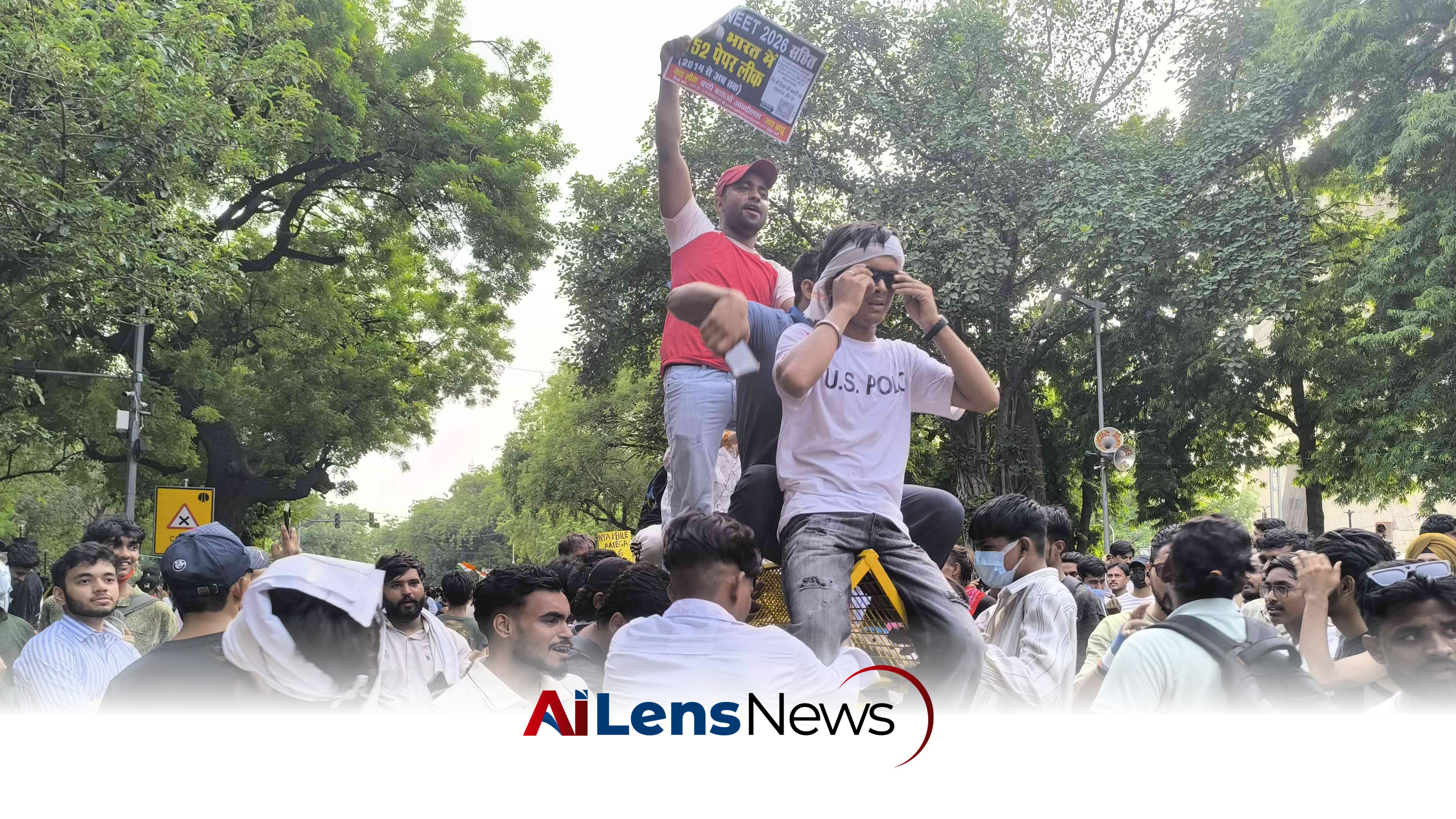


Students celebrate the resignation of Union Education Minister Dharmendra Pradhan at Jantar Mantar, marking a significant moment in their ongoing protest for education reform.
New Delhi, India Jul 26, 2026 ALN: Saturday was a carnival in Jantar Mantar, a prominent site in New Delhi known for hosting protests and gatherings. The atmosphere was electric, filled with a sense of triumph and celebration. A young woman was hoisted on the shoulders of her partner, blowing bubbles into the air, a symbol of the joy that permeated the crowd. A few hundred meters away, a group of energetic men danced enthusiastically to the beats of a surprisingly loud toy drum. Nearby, a group of boys took joyrides on a barricade, while a posse of Delhi Police personnel looked on with stone-faced expressions, seemingly unfazed by the revelry surrounding them. Among the crowd, a child walked casually with a speaker, playing on loop Prime Minister Narendra Modi's inadvertently vulgar mispronunciation of a Sanskrit sloka, which had become a meme in recent days.
This jubilant scene was sparked by the resignation of Union Education Minister Dharmendra Pradhan, a development that few resignations in India’s history have evoked such joy. Since June 6, students, driven by a movement that began as a meme page called the Cockroach Janta Party, had been demanding Pradhan's resignation due to a series of question paper leaks that had plagued the education system. The leaks raised serious concerns about the integrity of examinations and the future of students across the country.
Nearly two months later, this movement had escalated to a point where it successfully pressured the government to take action, resulting in the resignation of a minister—a rare occurrence in the Modi administration since it came to power in 2014. This event marks only the second time a minister has resigned as a direct result of public pressure during Modi's tenure, highlighting the growing discontent among the youth and the effectiveness of grassroots activism.
For Prime Minister Modi, this resignation represents a significant setback. The protestors at Jantar Mantar were elated, feeling as though they had achieved a seemingly impossible victory against a government often perceived as unyielding. "The past week has been so emotional," said Simran Arora, a 24-year-old participant in the celebrations. "But now we will party." Her sentiment echoed the feelings of many in the crowd, who saw this moment as a validation of their efforts and sacrifices.
Arora attempted to be magnanimous in victory, recalling a recent incident where protestors had faced assault from Delhi Police. However, she expressed a desire for unity, suggesting that even the police should celebrate this moment of accountability. "This is good for your kids too," she remarked, indicating her hope that the resignation would lead to broader reforms in the education sector.
Rounaq Raj, a 23-year-old protestor, carried a poster demanding Pradhan's resignation, signifying the ongoing nature of the struggle. Despite the celebrations, Raj acknowledged that the fight was far from over. "I feel great," he said, having traveled from Patna to participate in the protests. "We have won." His comments also reflected a growing sentiment among the youth regarding the media's role in shaping narratives. He took a jab at what he termed "godi media," a colloquial term used to describe media outlets perceived as overly sympathetic to the ruling party. "Ab godi media kya bolegi?" he asked with a smile, suggesting that the media would struggle to justify the government's actions following this resignation.
Despite the euphoria, a sense of realism permeated the celebrations. Many young students recognized that while the resignation was a significant achievement, it was not the end of their struggles. Aayush Rai, a 21-year-old from Himachal Pradesh who was in Delhi preparing for competitive exams, stated that this was not a "final win." He emphasized the need for comprehensive reforms within the education system, indicating that the resignation of one minister would not suffice to address the systemic issues plaguing education in India.
His friend, who chose to remain anonymous, expressed skepticism about the future. "Nothing will change," he said, suggesting that a new minister might be equally or more corrupt than Pradhan. He articulated a broader frustration with the Modi government, asserting that until Modi himself takes accountability for the issues facing the country, real change would remain elusive. He paused mid-sentence, realizing the weight of his words, and asked for a moment of discretion regarding his criticisms, especially considering his father's loyalty to the BJP.
While the protests had ostensibly targeted Pradhan, it became increasingly clear that Prime Minister Modi was the main focus of the crowd's ire. Class X student Aakash Jaiswal articulated the sentiment shared by many in attendance, arguing that after Pradhan's resignation, it should be Modi who steps down next. He cited police violence during the protests as a direct reflection of Modi's leadership. "The police used their dandas on Modi’s orders," he claimed, underscoring the perception that the government's heavy-handed approach to dissent was indicative of a larger authoritarian trend.
At just 17 years old, Jaiswal's views reflected a growing disillusionment among India's youth with the ruling party. "When I get to vote, I’ll vote for the best party," he declared, adding emphatically, "But I will never vote for Modi. The man who can beat up his own students can do anything." His comments highlighted a significant generational divide, with many young voters expressing a desire for change and a rejection of the status quo.
While the protest initially centered on the issue of paper leaks, it quickly evolved into a broader critique of the Modi administration. Slogans calling for revolution, celebrating the Constitution, and invoking the legacy of Dr. B.R. Ambedkar permeated the air, alongside posters and chants that were sharply critical of Modi's leadership. This amalgamation of grievances reflects a growing anti-Hindutva sentiment among younger voters, who feel increasingly alienated by the government's policies and rhetoric.
The potent combination of anti-government sentiment and targeted criticism of Modi's strongman image explains the fierce reaction from the Bharatiya Janata Party (BJP) to the protests. The party has historically positioned itself as a defender of nationalism and Hindu identity, and any perceived threat to its leadership is met with swift and often aggressive responses.
Aaron Hangshing, a 26-year-old pursuing his PhD at Delhi University, articulated a broader dissatisfaction with the BJP that extended beyond the immediate issue of paper leaks. "The paper leaks for me is not personally a big issue," he stated, emphasizing that his primary concern was the government's treatment of Manipur, a state that has faced significant unrest and violence in recent months. For Hangshing, Pradhan's resignation was merely a symbolic gesture. "Is it really revolutionary if all you’re doing is asking for the resignation of one minister?" he questioned, implying that the demands of the protestors should extend far beyond individual accountability.
As he spoke, a sudden rush of people caused a momentary panic, reminiscent of previous police actions against protestors. Fortunately, it turned out to be a false alarm, leading to laughter and relief among the crowd. However, the underlying fear of government retribution remained palpable. Many protestors chose to remain anonymous, expressing concerns about potential police action against them. One young woman, holding a poster that labeled Modi a "fascist," insisted on anonymity, stating, "Just write down my name as desh ki vasi, a resident of this country." She articulated a sentiment of frustration, saying, "No one asked questions for 12 years, we forgot to ask questions."
Another participant, a 23-year-old Muslim student from a university in Delhi, echoed the need for continued protests. "Otherwise corruption will continue," he warned, emphasizing the importance of sustained activism. Despite initially sharing his name and university, he quickly retracted that information, fearing negative repercussions from the authorities. "Don’t run them, please," he implored, highlighting the chilling effect that dissent can have on individuals in a politically charged environment.
The celebration at Jantar Mantar following Pradhan's resignation is emblematic of a growing discontent among India's youth. While they revel in this victory, the road ahead remains fraught with challenges. The protests have sparked conversations about accountability, governance, and the future of democracy in India. As the Modi government grapples with this unprecedented wave of dissent, the implications for its policies and political capital could be profound. The students at Jantar Mantar, while celebrating their moment of triumph, are acutely aware that their fight for a better education system and a more accountable government is far from over.
To learn more about the latest developments in Crime & Law, stay updated with our exclusive reports and analyses on AiLensNews.

