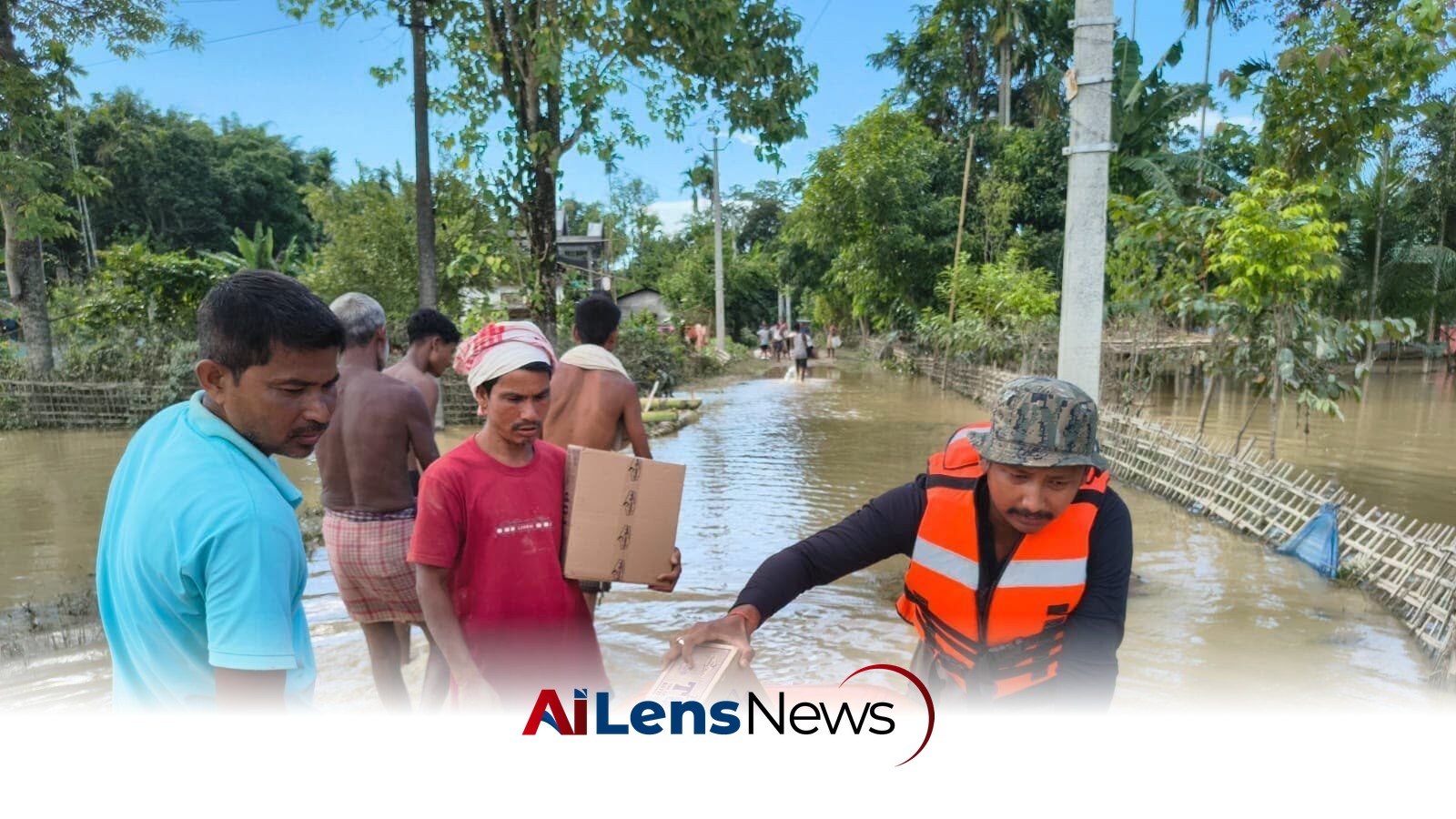


As floodwaters recede in Assam, CM Himanta Biswa Sarma reports a death toll of 66, while Akhil Gogoi calls for national calamity status due to inadequate relief efforts.
Dispur, India Jul 26, 2026 ALN: The flood situation in Assam showed signs of improvement on Sunday as water levels receded across most flood-hit areas of Upper Assam following a pause in rainfall. However, more than 6.54 lakh people remained affected across six districts, while the death toll rose to 66.
Four more deaths were reported in the past 24 hours, three in Sivasagar and one in Charaideo, taking this year's flood toll to 66. The severity of the floods this year has drawn attention to the recurring nature of such disasters in Assam, which is prone to seasonal flooding due to its geographical and climatic conditions.
Chief Minister Himanta Biswa Sarma said the overall situation was gradually improving, although challenges persisted in some inundated pockets. "The death toll has risen to 66, including one death from the Guwahati floods. There are four missing, and I believe the number could touch 70 to 75. However, we earlier assumed the number to touch 100, but it will be below that. Every death is unfortunate and it cannot be compared via numbers," Sarma told reporters after attending the Mann Ki Baat programme on Sunday.
Despite the receding waters, the Chief Minister noted that floodwaters continued to linger in certain localities. "The waters are receding, but there are areas such as Gourisagar and Sivasagar town where water levels have not dropped. We have still not been able to restore electricity to 25,000 families. Probably the waters have no path to move out and we might use machines to drain them," he said. This highlights the ongoing logistical challenges faced by the state government in restoring normalcy in the affected areas.
Sarma added that rescue operations had largely been completed. "All stranded people have been rescued and relief materials are reaching even the remote areas," he said. The successful completion of rescue operations is a vital step in the overall response to the disaster, but it is only the beginning of the long road to recovery for many affected families.
He also reiterated that a Central team had arrived in Assam to assess the damage caused by the devastating floods in Upper Assam. This assessment is crucial for determining the extent of aid and support that the state may receive from the national government to assist in recovery efforts.
According to the Assam State Disaster Management Authority (ASDMA), the flood situation improved in Charaideo, Sivasagar, and Jorhat districts, raising hopes that the continued recession of floodwaters would accelerate relief and rehabilitation efforts. The latest ASDMA bulletin stated that more than 6.54 lakh people remain affected in Charaideo, Dibrugarh, Golaghat, Jorhat, Nagaon, and Sivasagar districts. Sivasagar continued to be the worst-hit district, with nearly 2.9 lakh affected people, followed by Charaideo with around 1.9 lakh and Jorhat with about 1.3 lakh.
Despite the improving situation, Sivasagar MLA and Raijor Dal president Akhil Gogoi alleged that relief and rescue operations had yet to reach all affected areas and reiterated his demand that the floods be declared a national calamity. "The State government has failed. There are 30% remote areas where rescue or relief still hasn't reached. Those families with a good financial background lost everything, including vehicles, houses, and household belongings," Gogoi said.
Gogoi's remarks reflect a broader concern among some local leaders and residents regarding the adequacy of the state government's response to the floods. His call for a national calamity declaration underscores the belief that a more robust response is necessary to address the scale of the disaster. "If we fail to declare this a national issue, the affected victims will get only Rs 5,000 to Rs 6,000 as compensation. However, assets built over four generations have been destroyed. The Assam Chief Minister should go to Delhi and speak to the Prime Minister and the Home Minister to declare this a national calamity," he added.
Claiming that people in several parts of Sivasagar were still suffering, Gogoi said, "People in several areas of Sivasagar are crying. I urge everyone to press the government to declare this a national calamity because only then will the affected victims receive adequate compensation." This sentiment is echoed by many who have lost their homes and livelihoods, emphasizing the need for comprehensive support for recovery.
ASDMA said 274 relief camps and distribution centres were operational across the six affected districts, sheltering 18,902 displaced people. The establishment of these camps is critical for providing immediate shelter and necessities to those who have lost their homes. However, the number of displaced individuals reflects the scale of the crisis and the ongoing need for humanitarian assistance.
Multiple agencies, including the Army, NDRF, SDRF, Fire and Emergency Services, the police, and the civil administration, continued rescue and relief operations. The collaboration of these agencies highlights the multifaceted approach required to manage such a large-scale disaster, involving not only local government but also national resources and expertise.
The authority reported that 810 villages remained submerged and 34,970.8 hectares of cropland had been damaged. The impact on agriculture is particularly concerning, as many families in Assam rely on farming for their livelihoods. This damage could have long-term implications for food security and the local economy.
Embankments, roads, bridges, and other infrastructure also suffered extensive damage, which could hinder recovery efforts and exacerbate the challenges faced by affected communities. The Dikhow river at Sivasagar and the Dhansiri river at Numaligarh continued to flow above the danger level, indicating that while the immediate crisis may be improving, the risk of further flooding remains a concern.
In conclusion, while the flood situation in Assam shows signs of improvement, the road to recovery is fraught with challenges. The state government, along with various agencies, is working to provide relief and restore normalcy, but the call for a national calamity declaration raises important questions about the adequacy of the response and the support available to those affected. As the situation develops, the focus will need to remain on both immediate relief and long-term recovery efforts to ensure that the people of Assam can rebuild their lives after this devastating natural disaster.
To learn more about the latest developments in Crime & Law, stay updated with our exclusive reports and analyses on AiLensNews.

