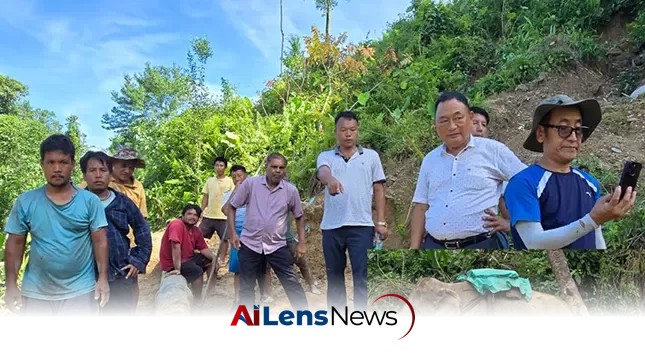


The water supply from the Lesing mega project has been restored, benefiting Ledum and Bilat villages after disruptions caused by a flash flood.
Itanagar, India Jul 16, 2026 ALN: Prafulla Kaman
RUKSIN, 15 Jul: The restoration of water supply from the Lesing mega water supply project, located near Ledum village in the East Siang district, has been successfully completed. This crucial development enables the resumption of drinking water supply to both Ledum and Bilat villages, which had been severely affected by a recent natural disaster.
The Public Health Engineering (PHE) department has reported that while water supply has been restored to these two villages, efforts are still ongoing to address the damage at other impacted sites. Officials estimate that the restoration of water supply to these additional locations will take approximately two to three days, as they work diligently to repair the infrastructure.
In an innovative approach to overcome the logistical challenges posed by the region's difficult terrain, the PHE department has enlisted the help of elephants to assist in lifting water pipes to the project site. This method is particularly necessary due to the absence of motorable roads in the rough foothills surrounding the affected areas, highlighting the unique challenges faced by the region's infrastructure development efforts.
As part of the restoration efforts, officials have reported that they are currently working on repairing breached pipelines in various affected sites. Water supply to other nearby villages, including Mirem, Mikong, Niglok, Ngorlung, Ruksin, and Oyan, which are also part of the Pasighat West constituency, is expected to be restored soon, providing relief to residents who have been without a reliable water supply for weeks.
The water supply project itself suffered significant damage due to a cloudburst-induced flash flood that occurred on June 28. This natural disaster led to a widespread disruption of water supply in the Pasighat West area, leaving many residents without access to clean drinking water for the last two weeks. The incident underscores the vulnerability of the region to extreme weather events, which can have devastating impacts on local infrastructure and communities.
In response to the crisis, Pasighat West MLA Ninong Ering has taken proactive measures by sanctioning ₹10 lakh for the procurement of new pipes and the renovation of the Lesing water supply project. This financial support is part of a broader commitment to address the damages caused by the floods and to ensure that residents have access to essential services.
On a recent visit to the damaged water supply project at Korang, MLA Ering not only sanctioned funds for the renovation of the water supply system but also allocated an additional ₹10 lakh for the reconstruction of two wooden bridges that were washed away by the flash floods. These bridges are critical for maintaining connectivity between Sido and Tene villages, and their reconstruction is essential for the local economy and community cohesion.
During his visit, Ering assured local residents that he would advocate for a scheme under the central-sponsored Pradhan Mantri Gram Sadak Yojana (PMGSY) to facilitate the reconstruction of the RCC bridge over the Rema river, which was also damaged during the flooding. This commitment reflects a broader recognition of the need for improved infrastructure resilience in the face of climate-related disasters.
Furthermore, MLA Ering has granted ₹10 lakh for the renovation of public infrastructure that was damaged by floods and erosion in Bokrang and Dekam colonies in Ledum. This financial support is part of a comprehensive approach to rebuilding the community and restoring essential services.
In addition to the government schemes and MLA Local Area Development (LAD) funds, Ering has personally contributed ₹25 lakh from his own resources to expedite the restoration of water supply systems across his constituency. This includes funding for multiple villages such as Mirem, Remi, Miglung, Mikong, Niglok, and Ngorlung, highlighting his commitment to ensuring that residents have access to clean water as quickly as possible.
In a broader context, MLA Ering has been active in discussions with key government officials, including Chief Minister Pema Khandu and Union Minister Kiren Rijiju, to address the funding needs for disaster recovery under the Flood Damage Repair (FDR) schemes for the Pasighat West area. These discussions are vital for securing the necessary resources to support the affected communities and to implement long-term solutions to prevent future disasters.
Ering has also reached out to the inter-ministerial central team and Rajya Sabha Member Tai Tagak, who recently visited the flood-hit areas in the Pasighat West constituency. These engagements are aimed at advocating for adequate relief and rehabilitation measures for families affected by the floods, ensuring that their needs are prioritized in the recovery process.
The flash flood event has caused widespread devastation across the region, breaching roads and bridges, washing away standing crops, animal farms, and orchards, as well as damaging fishponds, homes, and public properties. The impact of such disasters not only disrupts daily life but also poses long-term challenges for the local economy and food security, as many families rely on agriculture and livestock for their livelihoods.
The restoration of water supply to Ledum and Bilat villages marks a significant step in the recovery process, but it also highlights the ongoing challenges faced by communities in the region. As climate change continues to exacerbate the frequency and intensity of extreme weather events, there is an urgent need for comprehensive disaster preparedness and infrastructure resilience strategies to protect vulnerable populations.
Community engagement and support will be essential in the coming weeks and months as residents work to rebuild their lives and recover from the impacts of the floods. Local leaders, government officials, and civil society organizations will need to collaborate closely to ensure that recovery efforts are effective and inclusive, addressing the needs of all affected residents.
To learn more about the latest developments in Local & Regional, stay updated with our exclusive reports and analyses on AiLensNews.

