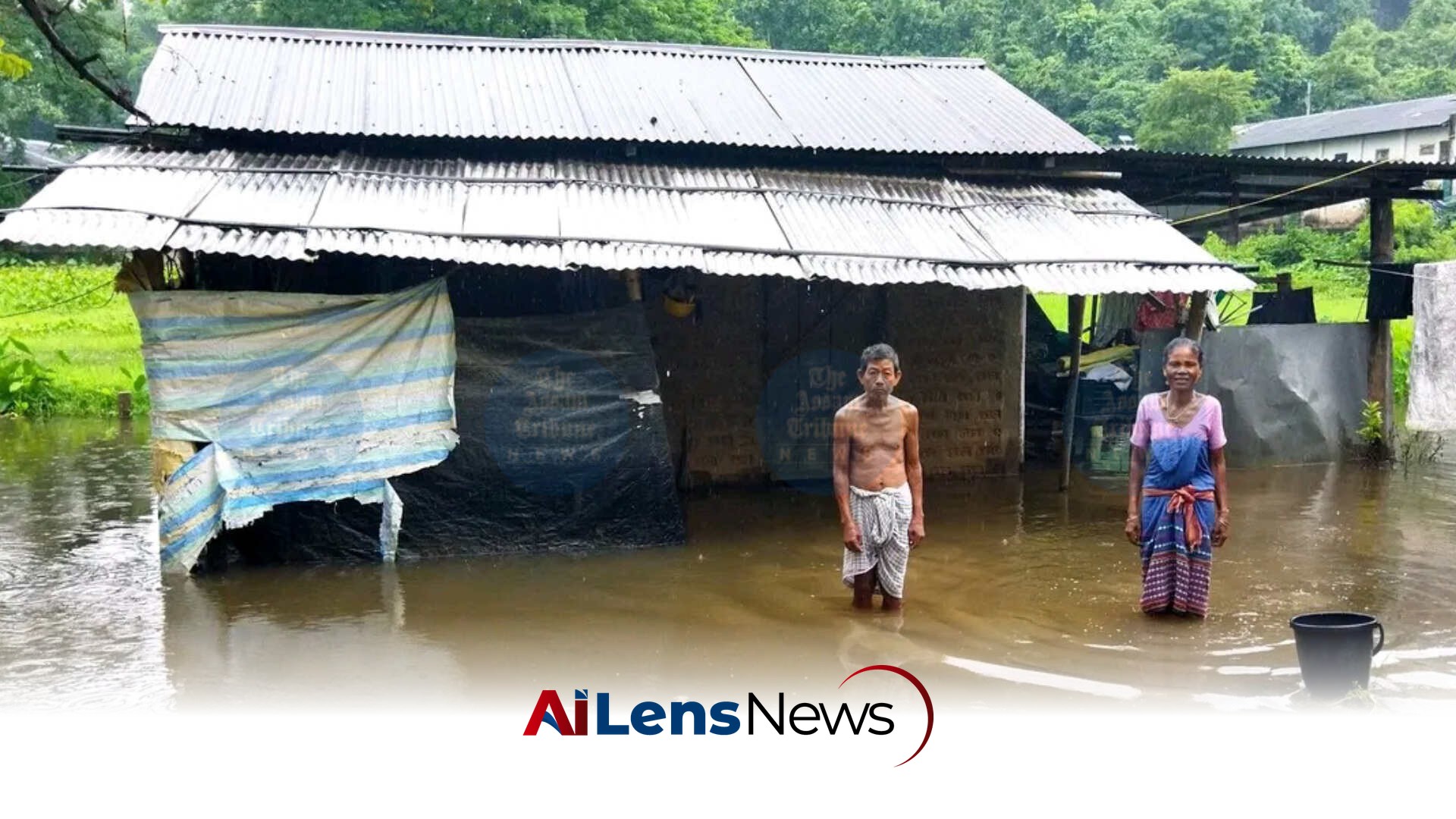


Residents of Pitbari village in Rani claim that Pluscom Industry LLP's improper drainage planning is causing severe flooding during the monsoon season.
Itanagar, India Jul 15, 2026 ALN: Residents of Pitbari village in Rani under the Palasbari LAC have alleged that an improperly planned private industrial unit has been causing artificial flooding during the monsoon, leaving houses, courtyards, and nearby agricultural land submerged while disrupting the livelihood of several families.
The unit, Pluscom Industry LLP, a sack-manufacturing factory, was reportedly constructed on agricultural land near the Rani Industrial Estate. Villagers claim that the factory was built without providing adequate drainage for rainwater flowing down from the adjoining Hatimara hills of the Rani Reserve Forest. As a result, they say, runoff water now accumulates in the surrounding residential areas after every spell of heavy rain.
The worst affected are the families of Lalmohan Boro (60) and Nilima Boro (55) and Sunil Boro (55) and Mira Boro (50), whose houses are located adjacent to the factory. According to the residents, their homes and courtyards remain inundated for much of the monsoon season. Even after the floodwater recedes, thick layers of mud and foul-smelling sludge remain, creating unhygienic conditions and leading to the breeding of mosquitoes and flies.
“Our lives have become miserable ever since the factory was established. Every time it rains, our house and courtyard are flooded. We repeatedly clean the mud, but another spell of rain brings the same situation back,” said Lalmohan Boro and his wife Nilima.
Villagers said that the area between the Rani Industrial Estate and Pitbari has traditionally been fertile agricultural land where farmers continue to cultivate paddy. They alleged that a portion of this farmland was purchased a few years ago and converted into the industrial unit without adequate planning for natural drainage.
Tapan Boro, a local resident, claimed that he had earlier approached the CRPF Commandant regarding the issue but was advised to take up the matter with the revenue authorities. This highlights a broader issue of governance and accountability in relation to industrial development in rural areas, where the interests of local communities often seem to be overlooked in favor of economic development.
According to Tapan Boro, the Palasbari circle officer informed him that no official drainage channel connected to the factory was reflected in the government land records, limiting the scope for official action. This situation raises questions about the efficacy of land use planning and regulatory oversight in the region. Although the authorities could request the factory management to address the problem, the lack of formal acknowledgment of the drainage issue complicates matters further.
Another affected resident, Mira Boro, said that she depended on renting out rooms for her livelihood. “On July 12, floodwater entered both the courtyard and the rented rooms. All my tenants vacated the premises, causing me significant financial loss,” she said. This situation underscores the economic ramifications of environmental mismanagement, as local businesses and livelihoods are directly impacted by the flooding.
Home to around 60 families, Pitbari village is witnessing growing resentment against the factory. Residents alleged that they had repeatedly urged upon the factory management to construct proper drainage facilities during the construction phase, but their concerns were ignored. They further claimed that whenever they now raise the issue, they are met with intimidation instead of a solution. This perception of intimidation adds a layer of complexity to the community’s struggle, as it may deter residents from voicing their concerns or seeking further action.
The affected villagers have also questioned how an industrial unit was permitted on agricultural land despite the existence of the nearby Rani Industrial Estate. This raises significant concerns about land use policies and the regulatory framework governing industrial development in the area. The villagers have demanded that the authorities should investigate the approval process and ensure proper drainage infrastructure to prevent recurring flooding and further damage to homes, farmland, and public roads. The implications of this situation extend beyond the immediate community, as it reflects broader issues of environmental sustainability and the need for responsible industrial practices.
In recent years, there has been a growing awareness of the need for sustainable development practices that balance economic growth with environmental stewardship. The situation in Pitbari village serves as a reminder of the potential consequences of neglecting these principles. As industries expand, it becomes increasingly important for regulatory bodies to enforce compliance with environmental standards and ensure that local communities are not adversely affected.
Moreover, the residents’ plight highlights the importance of community engagement in the planning and approval processes for new industrial developments. Ensuring that local voices are heard and considered can help prevent conflicts and foster a more harmonious relationship between industries and surrounding communities.
Attempts to obtain the response of the management of Pluscom Industry LLP have been unsuccessful as of now. The factory management’s version will be reported as and when it is received. It is crucial for the management to address the community’s concerns transparently and constructively, as this could pave the way for potential solutions and restore trust between the factory and the residents.
As the monsoon season continues, the urgency for a resolution becomes increasingly critical. The flooding not only poses immediate challenges for the residents but also threatens the long-term viability of agriculture and local businesses in the area. In light of these ongoing challenges, it is imperative for local authorities, industrial stakeholders, and community members to collaborate in finding effective solutions that prioritize both development and the well-being of the residents.
In conclusion, the situation in Pitbari village serves as a microcosm of the challenges faced by many rural communities in the face of industrialization. It underscores the need for careful planning, adequate infrastructure, and a commitment to sustainable practices that respect the rights and livelihoods of local populations. As the dialogue continues, it is hoped that a path forward can be forged that addresses the concerns of the residents while allowing for responsible economic development in the region.
To learn more about the latest developments in Local & Regional, stay updated with our exclusive reports and analyses on AiLensNews.

