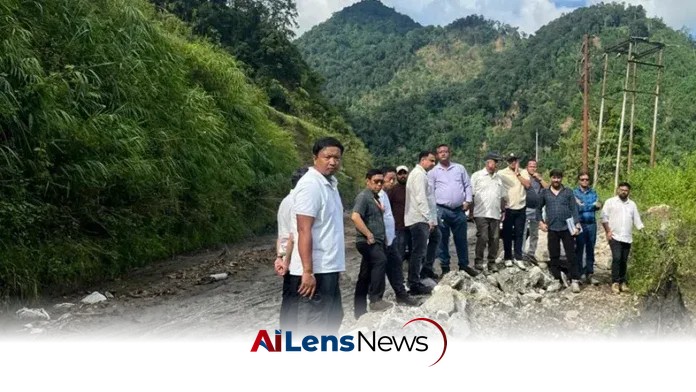


The restoration of the Hoj-Potin road, severely damaged by a cloudburst, is projected to take an additional two months, according to state officials.
Itanagar, India Jul 22, 2026 ALN: [ Bengia Ajum ]
ITANAGAR, 21 Jul: Complete restoration of the Hoj-Potin road is expected to take another two months.
This was informed after a team comprising engineers from the state PWD (Highway), officials of the Ministry of Road Transport and Highways (MoRTH), and representatives of the contractor, NTLLP, visited the Waterfall area along the Hoj-Potin section of the Trans-Highway.
The inspection was carried out to assess the extensive damage caused by the 24 June cloudburst, which has had a significant impact on the region's infrastructure. The Hoj-Potin road has remained closed since 24 June after a major portion of the road was completely washed away near the Waterfall area before Potin. Besides the Waterfall stretch, multiple sections of the road have also suffered extensive damages, further complicating the restoration efforts.
According to PWD Chief Engineer (Highway) CS Choutang, the visit was undertaken to explore ways to restore road connectivity at the Waterfall area, which is a critical point on this route. “We have three major locations where the road has been extensively damaged, with the Waterfall area being the most critical. Experts were consulted on the feasibility of installing a Bailey bridge and carrying out slope protection works at the site,” Choutang said.
Following detailed discussions, it was decided to install a heavy-load-class Bailey bridge at the Waterfall area. The Bailey bridge is a modular bridge system that can be assembled quickly, making it an ideal temporary solution in emergency situations. “For a permanent solution, we have submitted a proposal to the MoRTH for the construction of a viaduct. Until that materializes, we will install a heavy-load-class Bailey bridge, as this is a vital road for the state,” the chief engineer said.
However, he pointed out that abutments would have to be constructed before the Bailey bridge can be launched. “The soil at the site is unstable, so the abutments must be built first. If the weather remains favorable, we should be able to restore connectivity on the Hoj-Potin road within the next two months by launching the Bailey bridge at the Waterfall area,” he added. This highlights the complexities involved in the restoration process, particularly given the geological challenges posed by the heavy rains and landslides.
Choutang informed also that efforts are underway to clear mudslides and landslide debris from the Hoj-Potin road to restore it to its original two-lane width. “The contractor has deployed machinery from both the Potin and Hoj sides up to the Waterfall area to clear the debris accumulated on the road due to heavy landslides,” he said. The coordinated efforts of the contractor are crucial in expediting the restoration process, as the continuous rain poses a risk of further landslides and road damage.
The Hoj-Potin road is not just a local thoroughfare; it is an essential artery for the region, facilitating not just local travel but also serving as a crucial link for trade and commerce. Its closure has significant implications for the local economy, as it hampers the movement of goods and services, which are vital for the livelihoods of many residents. The road connects various towns and villages, making it a lifeline for many communities that rely on it for access to markets, healthcare, and education.
In recent years, the region has experienced increasing instances of extreme weather events, including cloudbursts and heavy rainfall, which have led to severe infrastructural challenges. The 24 June cloudburst was particularly devastating, highlighting the vulnerability of the region's infrastructure to such natural disasters. These weather patterns are increasingly recognized as a consequence of climate change, which has made it imperative for local governments to develop more resilient infrastructure.
The decision to install a heavy-load-class Bailey bridge reflects a temporary yet effective solution to restore connectivity while a more permanent structure, such as a viaduct, is planned and constructed. Bailey bridges are known for their quick assembly and ability to support heavy loads, making them ideal for emergency situations where rapid restoration of access is critical. This approach allows for immediate relief to the affected communities while longer-term solutions are developed.
However, the installation of the Bailey bridge is contingent upon the construction of stable abutments, which poses additional challenges given the unstable soil conditions at the site. The engineers are aware of the complexities involved and are taking necessary precautions to ensure that the bridge is safely and securely installed. This includes thorough assessments of the soil and ongoing monitoring to prevent future collapses or structural failures.
Moreover, the ongoing efforts to clear mudslides and debris are also crucial for restoring the road to its original width, which is necessary for the safe passage of vehicles. The deployment of machinery from both ends of the road demonstrates a coordinated effort by the contractor to expedite the restoration process. The ability to maintain a two-lane width is essential not only for local traffic but also for emergency services that may need to navigate the area quickly in case of further incidents.
The impact of the road closure extends beyond immediate transportation issues; it affects emergency services, access to healthcare, and the delivery of essential supplies. In a region where road connectivity is often the only means of transportation, the restoration of the Hoj-Potin road is a priority for local authorities. Delays in restoring this road can lead to dire consequences for residents who depend on it for timely access to medical facilities and other essential services.
As restoration efforts continue, the collaboration between state authorities, the MoRTH, and the contractor will be critical in ensuring that the work is completed efficiently and effectively. The involvement of technical experts during the inspection indicates a commitment to employing best practices in road construction and disaster management. This collaborative approach aims to not only restore connectivity but also to enhance the overall resilience of the region's infrastructure.
The broader implications of this situation highlight the need for improved infrastructure resilience in the face of climate change and increasing weather unpredictability. As the region grapples with the effects of extreme weather, long-term planning and investment in robust infrastructure will be essential to mitigate future risks and enhance community safety. This includes not only immediate restoration efforts but also a strategic vision for future infrastructure development that takes into account the changing climate and its potential impacts.
In conclusion, while the immediate focus is on restoring the Hoj-Potin road within the next two months, the situation underscores the importance of strategic infrastructure development and maintenance in vulnerable regions. Stakeholders must remain vigilant and proactive in addressing the challenges posed by natural disasters to ensure the safety and well-being of the local population. The lessons learned from this incident can inform future infrastructure projects and disaster preparedness strategies, ultimately contributing to a more resilient community.
To learn more about the latest developments in Transport & Mobility, stay updated with our exclusive reports and analyses on AiLensNews.

