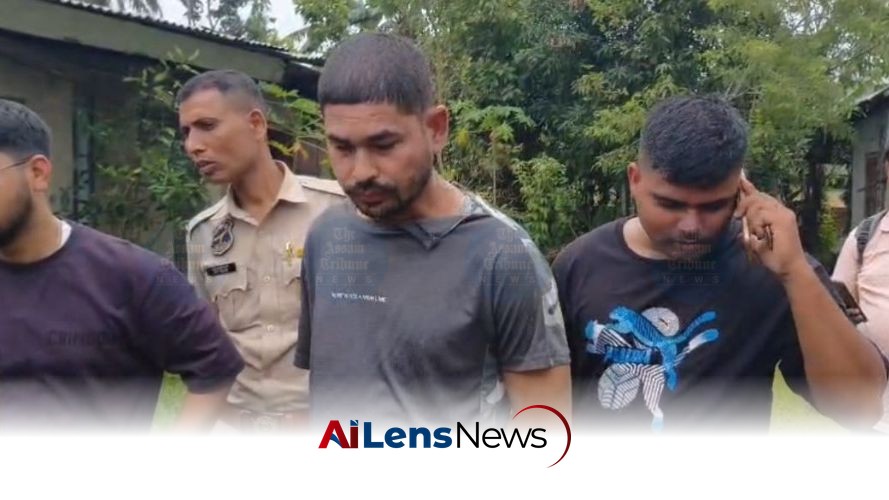


Police have arrested Sanjib Barua, suspected of trafficking firearms from Nagaland to Jorhat, raising concerns over illegal arms movement in the region.
Itanagar, India Jul 18, 2026 ALN: An alleged illegal firearm trafficker was arrested and a pistol, live ammunition, and a motorcycle were seized in Jorhat on Saturday, with investigators suspecting the weapon was brought into Assam from neighbouring Nagaland.
The accused, identified as Sanjib Barua, a resident of Dimapur district, was apprehended at Nandanpur on Jail Road in the heart of Jorhat town following a targeted operation led by Inspector Utpal Dutta of the Jorhat Traffic Branch. This arrest highlights ongoing concerns regarding illegal arms trafficking in the region, which has been a persistent issue for law enforcement agencies.
Police recovered a 7.65 mm pistol, three rounds of live ammunition, and a Pulsar motorcycle (AS-03S-5153) from his possession. The seizure of a firearm, especially in a civilian context, raises alarms about public safety and the potential for violence, particularly in a region that has seen its share of conflict and unrest over the years.
According to police, Barua had been under surveillance for some time based on intelligence inputs regarding his alleged involvement in illegal activities. The meticulous nature of the operation reflects the increasing efforts of law enforcement to clamp down on the illegal arms trade, which poses significant risks not only to local communities but also to the broader security landscape of the region.
"We had been receiving intelligence input. A team of police had been monitoring the accused's movement for hours. After a chase, we were able to successfully apprehend him in the Nandanpur area," Dutta told reporters. The police's proactive approach to tracking Barua indicates a shift towards more intelligence-driven policing, which is essential in combating organized crime.
"Barua's home has been traced to Dimapur. He is involved in several other anti-social and criminal activities. Further details will emerge during the investigation," he added. Dimapur, the largest city in Nagaland, is often cited as a hub for various illegal activities, including arms trafficking, drug smuggling, and human trafficking, which complicates law enforcement efforts.
Investigators suspect the firearm was transported from Dimapur in Nagaland into Assam and are probing its source, the intended recipient, and whether the accused was part of a larger inter-state illegal arms supply network. The geographical proximity of Nagaland to Assam makes it a strategic point for traffickers, who exploit the porous borders and the varying enforcement levels across states.
During preliminary interrogation, Barua allegedly told police that he had brought the firearm to Jorhat to sell it. "I had brought it to sell it to a man called Bogai who lives near Jorhat Medical College and Hospital," the accused allegedly told investigators. This statement, if verified, could provide crucial leads in identifying other individuals involved in the arms trade and unraveling the network operating in the region.
Police said the claim is being verified and stressed that the investigation is still at a preliminary stage. The complexities of arms trafficking often involve multiple players, making it challenging for investigators to trace the origins of the weapons and the flow of money that fuels this illicit trade.
Officials are also examining Barua's alleged involvement in other criminal and anti-social activities and are probing his possible links to organized illegal arms trafficking. The interconnected nature of these crimes suggests that Barua may be just one piece of a larger puzzle that includes drug trafficking, extortion, and other forms of organized crime that plague the region.
The arrest has raised fresh concerns over the alleged movement of illegal firearms into Assam from neighbouring states, particularly through Dimapur, a route that has figured in previous investigations into arms smuggling. The historical context of conflict in the Northeast, including insurgency movements and ethnic strife, has created a demand for illegal firearms, further complicating the security scenario.
Police are continuing to interrogate the accused to determine where the weapon was procured, who financed the transaction, whether other individuals were involved, and if the accused had links to a wider organized illegal arms trafficking network. This investigation could potentially uncover a more extensive operation that spans across state lines, implicating various actors in the arms trade.
The implications of such arrests extend beyond immediate law enforcement actions. They bring to light the ongoing issues related to governance, law enforcement capabilities, and the socio-economic conditions that allow such illegal activities to thrive. The presence of illegal firearms in civilian hands can lead to increased violence, undermining public safety and eroding trust in law enforcement.
Furthermore, the arrest of individuals like Barua underscores the need for a multifaceted approach to tackling illegal arms trafficking. This includes not only stringent law enforcement measures but also community engagement, economic development, and educational initiatives aimed at addressing the root causes of crime.
As the investigation unfolds, it will be essential for authorities to collaborate with neighboring states to effectively tackle the transnational nature of arms trafficking. This may involve sharing intelligence, conducting joint operations, and developing regional strategies that address the complexities of cross-border crime.
In summary, the arrest of Sanjib Barua in Jorhat is a significant development in the ongoing battle against illegal arms trafficking in Northeast India. While it sheds light on the challenges faced by law enforcement in curbing such activities, it also highlights the need for a comprehensive strategy that encompasses not only enforcement but also socio-economic interventions to mitigate the factors that drive individuals toward crime.
The Northeast region of India, characterized by its diverse ethnic groups and historical conflicts, has long been a hotspot for various forms of organized crime, including arms trafficking. The porous borders with neighboring countries and states have enabled traffickers to operate with relative ease, posing significant challenges to law enforcement agencies. The arrest of Barua may serve as a catalyst for renewed efforts to address these systemic issues and enhance cooperation between states in tackling organized crime.
Moreover, the socio-economic conditions in the region often contribute to the proliferation of illegal activities. High unemployment rates, limited economic opportunities, and social unrest can drive individuals towards crime as a means of survival. As authorities seek to dismantle networks like the one allegedly involving Barua, it is crucial to also focus on creating sustainable livelihoods and educational opportunities for the youth in the region.
The implications of arms trafficking extend beyond the immediate threat of violence; they can destabilize entire communities and undermine governance. The presence of illegal firearms can embolden criminal organizations and lead to increased incidents of violence, extortion, and other forms of crime, creating a cycle that is difficult to break. Therefore, addressing the root causes of arms trafficking requires a holistic approach that combines enforcement with socio-economic development.
In conclusion, the arrest of Sanjib Barua is a significant moment in the ongoing struggle against illegal arms trafficking in Northeast India. It underscores the urgent need for a coordinated response that addresses not only the symptoms of the problem but also the underlying factors that contribute to the proliferation of illegal arms and organized crime in the region. As the investigation progresses, the collaboration between various law enforcement agencies, both at the state and national levels, will be critical in dismantling the networks that threaten public safety and security in the region.
To learn more about the latest developments in Crime & Law, stay updated with our exclusive reports and analyses on AiLensNews.

