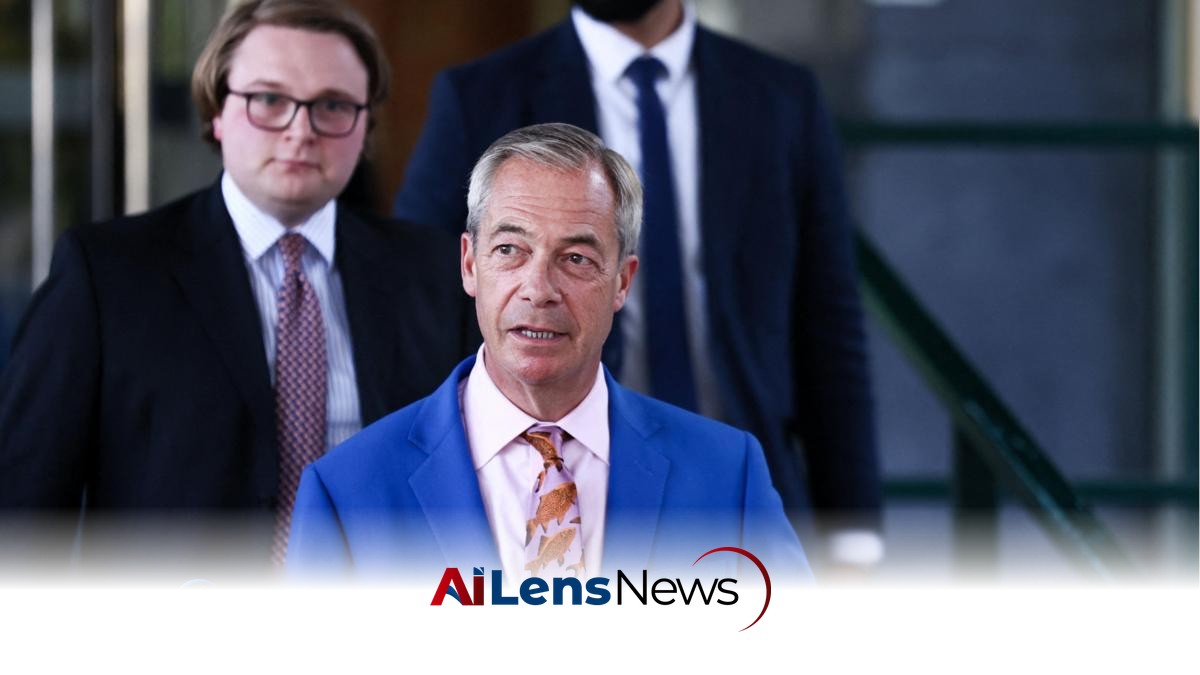


Major political parties have declined to contest the Clacton by-election following Nigel Farage's resignation, labeling the situation a 'circus'.
New Delhi, India Jul 8, 2026 ALN: Labour, the Conservatives, the Liberal Democrats, the Green Party, and Restore Britain have all ruled out contesting the Clacton by-election triggered by the resignation of Nigel Farage.
The resignation of Farage, a prominent figure in British politics and leader of Reform UK, has sparked significant political discourse regarding the implications of such a move. Farage, who has had a substantial impact on the political landscape in the UK, particularly through his role in the Brexit campaign, announced that he would re-fight the Essex seat in what he described as a "people versus the establishment" by-election. His decision to resign comes amid increasing scrutiny over his financial dealings and a parliamentary investigation into his conduct.
In a statement, Farage expressed his belief that the people of Clacton should be the ultimate judge of his actions, suggesting a level of confidence in his support among constituents. The context of his resignation is multifaceted, with critics alleging that it is an attempt to divert attention from ongoing investigations into his financial affairs. Labour Party representatives have characterized the by-election as a "circus," accusing Farage of attempting to shift the narrative away from serious allegations against him. A spokesperson for Labour stated, "It's pathetic, and the Labour Party is not going to indulge it," emphasizing their stance on allowing the parliamentary investigation to proceed without interference.
Further complicating the political landscape, Conservative leader Kemi Badenoch has also indicated that her party will not participate in what she referred to as a "fake election." This sentiment reflects a broader concern among opposition parties that Farage's resignation and subsequent by-election may serve as a distraction from ongoing issues that require public attention. Badenoch's statement underscores the potential for political maneuvering in the wake of Farage's announcement, as parties navigate the implications of his actions on their respective strategies.
The Liberal Democrats have taken a more proactive stance, calling for the government to block Farage's resignation until the standards investigation concludes. They argue that constituents deserve to have all relevant facts before making a decision at the ballot box. This call for transparency highlights the tension between political accountability and the right of individuals to participate in democratic processes, particularly in light of the serious allegations facing Farage.
Restore Britain, a party established by MP Rupert Lowe after his suspension from Reform, has also opted not to contest the by-election. However, they have indicated a willingness to participate if a second by-election is necessitated by the standards inquiry. This decision reflects the complex interplay of party dynamics and individual political ambitions in the context of ongoing investigations.
Initially, the Green Party of England and Wales indicated that the decision would rest with local party members. However, Green MP Hannah Spencer later confirmed that local members had decided against fielding a candidate, further consolidating the political landscape around Farage's bid for re-election. Despite the absence of major party candidates, comedian Jon Harvey has announced his intention to run under the pseudonym Count Binface, adding an element of humor and spectacle to the proceedings.
In a 20-minute video statement recorded at his party headquarters in London, Farage defended his actions, asserting that he had "done nothing wrong" concerning his finances. He expressed frustration with media coverage, particularly regarding the impact on his family, and characterized the investigation as a politically motivated attack by the establishment. Farage's rhetoric suggests a strategy aimed at galvanizing support among his base by framing the by-election as an opportunity to challenge the status quo and send a message to the political elite.
Farage's assertion that the by-election represents a chance to "stick two fingers up to the entire establishment" illustrates his ongoing commitment to positioning himself as an outsider challenging entrenched political interests. Reform UK sources have indicated a desire for the election to occur swiftly, with parliamentary rules allowing for scheduling as early as August. This urgency may reflect a strategic calculation on Farage's part to capitalize on the momentum generated by his resignation and the surrounding media attention.
When questioned about whether his resignation was a political stunt, Farage acknowledged the risks involved, describing it as "a big gamble." This acknowledgment of uncertainty may resonate with voters who are attuned to the unpredictable nature of contemporary politics. Furthermore, Farage has stated that his party would cover the costs of the by-election, which are typically funded by central government resources. A government estimate from 2016 placed the cost of by-elections at approximately £228,964, although this figure is likely to have increased in the intervening years.
Farage's electoral history in Clacton is notable; he won the constituency in the 2024 general election with a substantial majority of over 8,000 votes, defeating the Conservative candidate and securing a significant lead over Labour, the Liberal Democrats, and the Green Party. This previous success may bolster his confidence as he seeks to reclaim his seat amidst the current political turmoil.
Central to the ongoing controversy is Farage's investigation by Parliament's standards commissioner, Daniel Greenberg. The inquiry was initiated after Farage failed to declare a £5 million gift from billionaire Reform donor Christopher Harborne prior to his election as an MP. Farage has described this financial support as "the equivalent of a lottery win," asserting that it was intended to cover his personal security costs due to his high-profile status and perceived threats against him. This situation raises critical questions about transparency and accountability in political financing, particularly regarding the declaration of gifts and benefits received by MPs.
Parliament's regulations stipulate that newly elected MPs must declare gifts or benefits received in the 12 months preceding their election if they relate to parliamentary or political activities. However, there exists an exemption for gifts that are deemed "purely personal." Farage has argued that the support he received falls within this exemption, a claim that will likely be scrutinized as the investigation unfolds.
The standards commissioner's investigation has been temporarily paused following Farage's resignation, but it could be resumed if he successfully wins the by-election and returns to Parliament. The potential outcomes of the investigation are significant, as one possible result could be a suspension from Parliament, which would trigger a recall petition. This process allows constituents to remove an MP if 10% of eligible registered voters sign a petition, leading to another by-election. Such a scenario could further complicate Farage's political future and that of Reform UK.
In a separate but related development, it has come to light that George Cottrell, a longtime ally of Farage, provided financial support leading up to the 2024 general election. This support included funding for staff who assisted with Farage's security and managed his social media presence. These financial transactions have raised eyebrows and added another layer of complexity to the ongoing scrutiny of Farage's political and financial dealings.
Additionally, it has been reported that Cottrell and his mother made significant contributions to a company and think tank associated with Reform's deputy leader, Richard Tice. The financial activities of Tice's company, Tisun Investment, and his think tank, Britain Means Business, have drawn attention, particularly following revelations that these payments were flagged to the National Crime Agency (NCA) as part of its Suspicious Activity Reports program. Tice has expressed concern over the potential leak of this information and has reached out to the NCA to investigate whether the agency was responsible for disclosing his private financial details to the media.
The NCA has stated that it does not confirm or deny the receipt of suspicious activity reports, nor does it comment on how such reports are utilized. The confidentiality surrounding these reports is critical, as breaching that confidentiality could lead to legal repercussions under the Proceeds of Crime Act. The SAR program is designed to alert law enforcement to potential instances of money laundering and has flagged over 866,000 reports in the 2024/25 period alone, highlighting the scale of financial scrutiny in the current political climate.
As the political landscape in Clacton evolves, the implications of Farage's resignation and the ensuing by-election will likely reverberate throughout the UK political system. The reactions of major parties, the outcomes of ongoing investigations, and the broader discourse surrounding political accountability will shape the narrative in the lead-up to the by-election and beyond. The situation remains fluid, with potential ramifications for Farage, Reform UK, and the political landscape as a whole.
To learn more about the latest developments in Politics, stay updated with our exclusive reports and analyses on AiLensNews.

