

Despite its sleek design and promising specs, Valve's Steam Machine fails to deliver on gaming performance, struggling to meet expectations for 4K gaming.
New Delhi, India Jul 17, 2026 ALN: From the moment it was unveiled, the new Steam Machine has been a captivating proposition for gamers. A decade on from Valve’s flawed first attempt to bring PC gaming into the living room—a mess of competing manufacturers and inconsistent hardware specs—surely this time, Valve would get it right?
Early signs were positive. A single device from a single manufacturer, the only variable being a choice between 512 GB and 2 terabytes of storage, promised consistency. Technical specifications offered roughly six times the power of Valve’s successful Steam Deck handheld, hinting at high-end performance. In many ways, it seemed Valve was pitching a console experience, a way to access the impossibly large Steam library on a big-screen TV.
So, how did it all go so frustratingly wrong? Sadly, while 2026’s Steam Machine is tantalizingly close to greatness, it ultimately can’t live up to either its grand potential or players’ expectations.
As a device, the Steam Machine is easy to like. Its tightly engineered design is adorable; the 156 x 152 x 162.4-mm body is comparable to Nintendo’s GameCube and fits just as easily into most media consoles. The signature LED light bar, which by default serves as a visual progress bar for game installations, almost smiles out from under your TV.
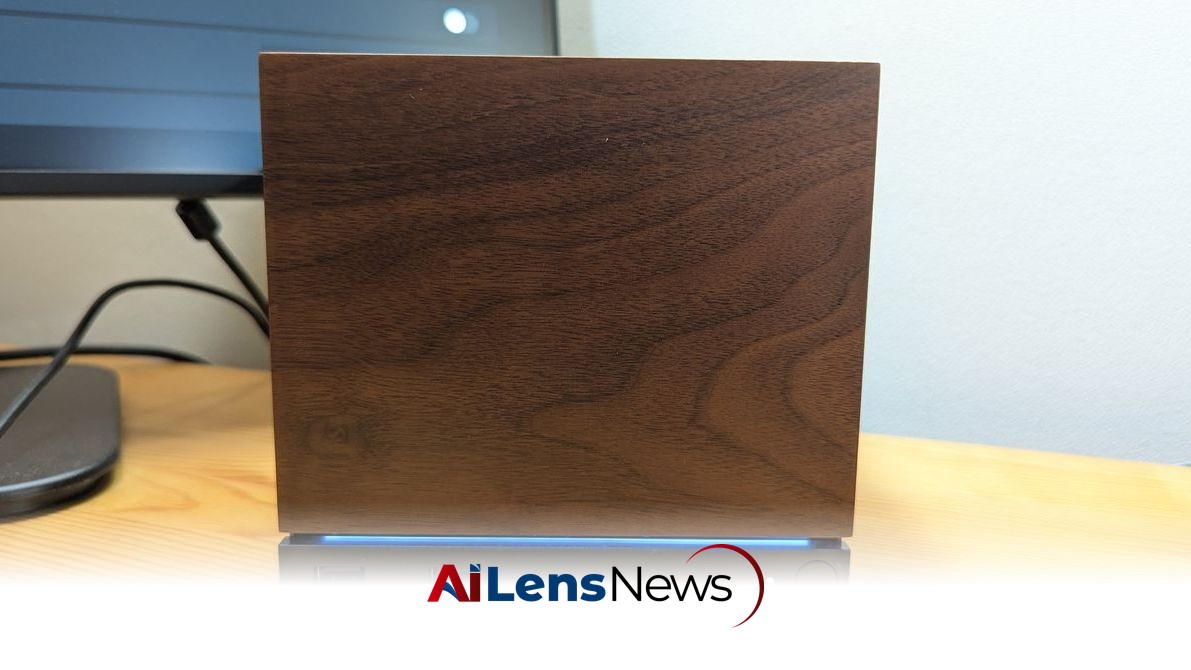
It has a sleek, clean design, with replaceable faceplates to offer some aesthetic versatility, though only the 2-TB model comes with any—one wooden, one red fabric—both giving 1970s Aperture Science offices from Portal vibes. Take the panel off, and you’ll see the tightly packed PC case is mostly tailored toward ventilation, an airway leading to a vast exhaust fan dominating the rear.
Connection options impress, with two USB-A 3.2 Gen 1 ports and a microSD slot at the front, while the back crams in two USB-A 2.0 ports and one USB-C 3.2 Gen 2, DisplayPort 1.4 and HDMI 2.0 outputs, plus a Gigabit Ethernet port. It’s got fast Wi-Fi 6E and Bluetooth 5.3 for wireless options too. An internal power supply accounts for much of its 5.7-pound weight, but the lack of an external power brick means it’s easy to move it between rooms or screens as needed.
Its plug-and-play design makes setup simple, bar a roughly 15-minute wait for necessary system updates. You’ll need a controller, and while any PC-compatible pad will do the trick, it’s really designed for the new Steam Controller. Unfortunately, it doesn’t actually come with one unless you pay extra—unforgivable given the grip really does come alive here. Connect via USB, and the Steam Controller pairs directly with the hardware, forsaking its wireless puck, and becomes capable of waking the Steam Machine from sleep.
Once everything’s updated, the Steam Machine boots into the now-familiar SteamOS in Big Picture mode, a console-like interface tailored for the TV, with bold, clear tiles and easily sorted categories. Sign in to your existing Steam account, install some games, and thanks to cloud save support, you’ll be able to pick up where you left off from the comfort of your couch.
Before getting too cozy, though, you might want to check out the desktop mode. As Valve is keen to insist, the Steam Machine is, technically, a full PC; you can switch to its desktop through the power menu at any point.
It runs KDE Plasma, a graphical shell for Linux, and USB-compatible mice and keyboards are automatically detected for simple navigation. Compared with Microsoft and Apple’s efforts, it’s a refreshingly clean OS install—a desktop with a link back to Steam’s gaming mode, and a taskbar with icons for Settings, Discover software center, Dolphin file manager, and a link to install Firefox as a browser. That’s it.
Realistically, hardly anyone is going to be buying a Steam Machine for office tasks. The real question is how it holds up as a gaming rig, and that’s where cracks begin to show. Let’s talk numbers.
Bluntly, its specs are comparable to the nearly six-year-old PlayStation 5. The Steam Machine’s CPU clinches a small win, with a semi-custom AMD Zen 4 housing six cores and 12 threads, promising up to 4.8-GHz clock speed. The base PS5 has an eight-core, 16-thread chip but is built on much older Zen 2 architecture, with a max clock speed of 3.5 GHz (3.85 GHz on the PS5 Pro).
The Steam Machine’s similarly semi-custom AMD RDNA3 GPU offers 28 CU (compute units) of graphical power, versus Sony’s titan’s 36 CU, although the latter again uses an older RDNA2 process. Arguably, the Valve cube’s weakest spot is its single stick of 16 GB DDR5 RAM, with 8 GB of GDDR6 VRAM. Technically, as a PC, components are upgradable, but the thought of diving into those densely packed innards is daunting.
Valve claims the Steam Machine can hit “up to 4K at 120 Hz” on supported displays via HDMI 2.0 connections (albeit using AMD’s FidelityFX Super Resolution (FSR) upscaling tech, rather than at native resolutions), but the Steam Machine Verified label it will be applying to games on the Steam Store is based on a 1920 x 1080 benchmark.
I’ve been testing it on a 55-inch 4K OLED TV and a 27-inch 1080p desktop monitor, both with 120-Hz refresh rates, both using HDMI. I used four games as references: Marvel’s Spider-Man Remastered, Crimson Desert, Lego Batman: Legends of the Dark Knight, and Japanese RPG Granblue Fantasy Relink: Endless Ragnarok. Frame rates were tracked using the Steam Machine’s built-in monitor, accessed by tapping the “…” button on the Steam Controller and activating the “Performance Overlay.”
On the TV, Spider-Man defaulted its output resolution to 2048 x 1152 but hit a smooth 60 frames per second (fps). Manually switching to 3840 x 2160 (full 4K) without AMD’s FSR active and all graphics settings at “High” dropped performance to 30 to 45 fps. With FSR on and “Dynamic Resolution Scaling” set to a 60 fps target, the Steam Machine delivered, running in 4K at the desired frame rate, with no noticeable image degradation. My HDR-enabled TV also allowed for improved colors and contrast. On the PC monitor, the Steam Machine easily pushed out a 1080p image at 60 fps, though the panel lacks HDR, so everything looked a little muted. Overall, this would prove to be the best-performing game of the lot.
Crimson Desert is interesting—a notorious resource hog and officially unsupported on the Steam Machine. However, it boots and loads just fine. With graphics quality set to a demanding “Ultra,” FSR on, and upscale resolution at “Native Anti-Aliasing,” it pushed out a not-terrible 40 fps … in menus. In-game, that dropped to a juddery 20 to 25 fps. Dropping quality to “High” saw a marginal improvement to 25 to 30 fps, but introduced screen tearing during cutscenes.
Cutting the upscale resolution to “Quality” squeezed out 30 fps, and cutting further to “Balanced” saw the game brushing up against 60 fps, but image quality began to suffer, particularly with environmental details like foliage and water.
On the 1080p monitor, things were much better, serving a solid 60 fps even with settings at “Ultra” and advanced features like shadow ray tracing and advanced weather effects active. Still, not bad for a game that Valve says you can’t run on the Steam Machine at all.
Lego Batman on the TV, at 4K with FSR on and graphics quality set to “High” (rather than “Epic,” its best setting), saw wildly variable frame rates of 15 to 45 fps. Focusing FSR on performance got a reliable 45 fps, occasionally spiking to 75 to 90 fps, but dropping below 30 fps for vehicle sections. On the monitor, at 1080p, with settings at “High” and upscaling to “Ultra Performance,” I finally got a sweet 60 fps, but any attempts to improve image quality tanked it back down to around 30 fps. However, getting good results was just as problematic on the powerful MSI Claw 8 EX AI+ gaming handheld, which convinces me that the game is poorly optimized on PC—and therefore that the Steam Machine can’t handle poorly optimized games.
Granblue Fantasy gave the weirdest results. On the 4K TV, Steam’s performance monitor finally displayed 120 fps—but only in the game’s menu and loading screens. A flashy and fast-paced anime-styled game, I saw 30 to 45 fps for cinematic cutscenes and actual gameplay, with very occasional crests of around 55 fps. However, in undemanding and mostly static conversation scenes, it bizarrely sank to 15 fps. As the game itself has no options for frame gen or upscaling, I tried lower overall graphics quality presets, but frame rate numbers seemed uniform, whatever the setting. Oddly, on the 1080p monitor, it still thought it was outputting 4K, but manually dropping to 1920 x 1080 did deliver a reliable 60 fps.
My takeaway? Despite Valve’s lofty claims, the Steam Machine is almost wholly incapable of delivering a true 4K, high-frame-rate experience. Getting passable results for living room play requires mind-numbing dives through display settings, both at the system level and in every single game you try to play. It’s a massive faff, and for what—a worse experience than most people will get from a dedicated console, on a device that costs more than a PS5 Pro? The value proposition just doesn’t hold up.
To learn more about the latest developments in Product Innovations, stay updated with our exclusive reports and analyses on AiLensNews.

