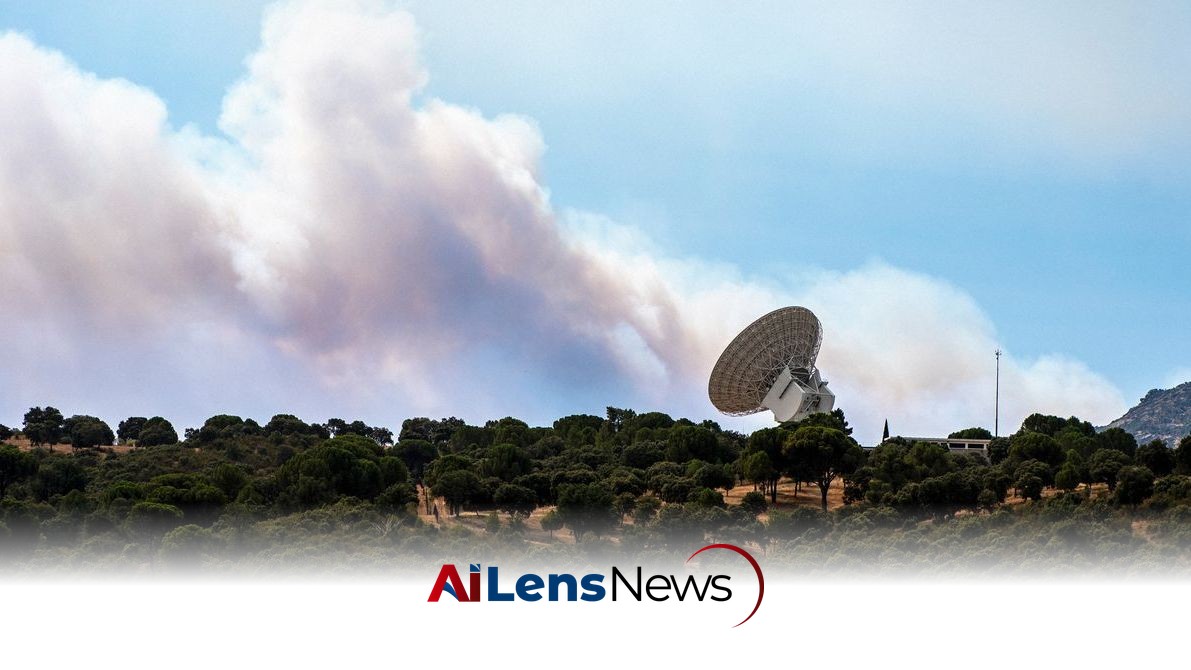


Wildfires near Madrid have endangered NASA's observatory, crucial for spacecraft communication. Personnel evacuated, but damage assessment pending.
New Delhi, India Jul 25, 2026 ALN: Climate change has now become a problem for the whole solar system. On Friday, wildfires in Spain overran one of three observatories the US National Aeronautics and Space Administration (NASA) uses to connect with spacecraft, including Voyager 1, the James Webb Space Telescope, and the recently completed Artemis mission around the Moon. This incident highlights an alarming trend where natural disasters, exacerbated by climate change, pose significant threats not only to terrestrial ecosystems but also to critical scientific infrastructure that supports space exploration.
Spain declared a wildfire emergency as multiple blazes burned out of control near Madrid, leading to evacuation orders for approximately 60,000 people. The affected area includes Robledo de Chavela, a municipality near the Deep Space Communications Complex run by NASA. This complex is crucial for maintaining communication with various space missions, making it a vital asset in the global scientific community. The ongoing wildfires serve as a stark reminder of the increasing frequency and intensity of such events, which are linked to rising global temperatures and changing climate patterns.
Dramatic images captured by news photographers showed the radio telescopes surrounded by smoke and fire, illustrating the immediate danger posed to the facility. A NASA spokesperson confirmed that the agency successfully evacuated all personnel, ensuring their safety amidst the chaos. The spokesperson further noted that while the fire has now passed through the observatory complex, it remains unclear what impact the flames may have had on the sensitive equipment inside. “Any potential damage will be assessed when it is safe to do so,” the spokesperson said. They added that if conditions allow, a site assessment could happen as soon as Saturday, underscoring the urgency of evaluating the infrastructure that plays a critical role in space communications.
For now, NASA stated it has “seamlessly transitioned support for mission operations to the Goldstone Deep Space Communications Complex in California, ensuring continuity of service and uninterrupted support for spacecraft communications.” This transition is vital, as it allows ongoing missions to continue receiving commands and transmitting data back to Earth without significant interruption. The facility in Spain, along with others in Canberra, Australia, and Goldstone, California, comprises what NASA describes as the “largest and most sensitive scientific telecommunications system in the world.” This network allows NASA to transmit information from Earth to spacecraft, including the most distant human-made object in our solar system, Voyager 1. It’s also used to transfer data from the James Webb Space Telescope and send commands to other space vehicles. Moreover, the sites contribute to radio astronomy observations, making them indispensable for understanding the solar system and beyond.
Spain is far from the only country facing a wildfire crisis. Blazes are also burning out of control in France, where beachgoers witnessed skies turning orange and waves of ash washing ashore as firefighters worked tirelessly to stop flames from spreading into the eponymous capital of the Bordeaux wine region. The situation in France has become increasingly precarious, with French interior minister Laurent Nunez stating on national television channel Tf1, “We learned in the middle of the afternoon that, following the wind shift, it had become a large, self-sustaining fire that is extremely difficult to bring under control. It is now moving east, toward the Bordeaux metropolitan area. We are going to reorganize our response so we can fight it from the ground and prevent it from advancing.”
Roughly 200,000 people have been told to evacuate across the two countries, highlighting the widespread impact of these wildfires on local communities. The evacuation orders reflect a growing concern for public safety in the face of unpredictable and rapidly spreading wildfires. Europe has seen record high temperatures this summer, driven by repeated heat domes camping over the continent and the UK, as well as the broader implications of climate change. Hot weather can dry out vegetation, priming forests to burn when hit by an errant spark, illustrating the complex interplay between climate conditions and wildfire risks.
Similar stories have played out in other parts of the world recently, from Ontario, Canada, to the US Pacific Northwest, where wildfires have become an annual challenge. The increasing incidence of wildfires raises questions about land management practices, urban planning, and the preparedness of communities to respond to such emergencies. As climate change continues to alter weather patterns, the frequency and severity of wildfires are expected to increase, necessitating a reevaluation of strategies to mitigate their impact.
Cooler weather is expected to arrive in the Mediterranean over the weekend, which should help firefighters gain control over the blazes. However, the respite will be short-lived; temperatures are projected to rise again on Monday and keep climbing throughout the week, eventually reaching up to 10 degrees Celsius (18 degrees Fahrenheit) above normal. This anticipated spike in temperature could worsen any wildfires in Spain or France that may still be burning or help spark new ones. The cyclical nature of climate change and its effects on weather patterns underscores the need for comprehensive strategies to address the underlying causes of climate change, as well as the immediate challenges posed by natural disasters.
In conclusion, the wildfires threatening NASA's Deep Space Communications Complex serve as a microcosm of a larger global issue. As climate change continues to induce extreme weather events, the implications for scientific research, public safety, and environmental health cannot be overstated. The need for coordinated efforts to combat climate change and its consequences has never been more urgent, as communities and institutions alike grapple with the realities of a warming planet. The incident not only highlights the vulnerability of critical infrastructure but also calls for a collective response to ensure the safety and continuity of scientific endeavors that expand our understanding of the universe.
To learn more about the latest developments in Research & Breakthroughs, stay updated with our exclusive reports and analyses on AiLensNews.

