

The Bublue BuVortex V5 introduces a vortex-powered cleaning method for pools, but its impracticality raises concerns about its effectiveness.
New Delhi, India Jul 2, 2026 ALN: Pool skimmers, which flit along the surface of the water, constitute a small but stable subsection of the pool robot world. While their effectiveness varies, all of them work more or less the same way, cruising around the pool on a catamaran-like body, scooping up leaves into a basket that sits between the two propeller-powered hulls.
Until now. Enter the Bublue BuVortex V5, billed as “the world’s first active absorption skimmer.” I don’t have a clue what that means, but the simple explanation of how it works can be found in the “vortex” part of the name. Rather than gathering debris into a mouthlike chamber, the BuVortex creates a tiny whirlpool that draws nearby debris into it, sinking leaves and trapping them in an underwater basket.
The device exemplifies, without question, the weirdest concept I’ve ever seen for cleaning the surface of a pool, but of course I had to wonder if it was so crazy it just might work, so I put it to the test in my own pool for a week, giving it free rein to collect both standard organic debris and synthetic leaves.
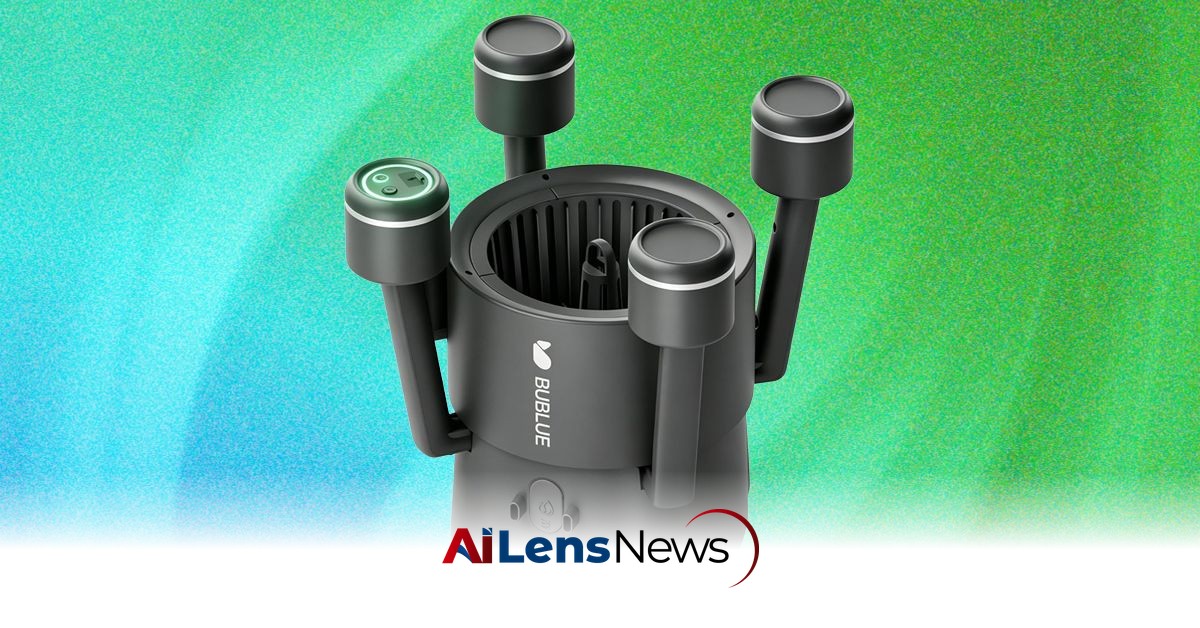
The 11.5-pound Bublue BuVortex V5 is built around a central cylinder about a foot in diameter that houses the vortex-creation system. Above that sits the filter basket, in two parts, including a bit of netting that prevents trapped debris from escaping the whirlpool once it gets sucked in.
Surrounding the cylinder are four arms that help the device float and stay upright. One of the arms contains the power port and on/off button, plus a Bluetooth button used to initiate pairing with the Bublue mobile app. The only additional component is a mesh filter that sits underneath the filter basket. This filter, in turn, is held inside a circular frame, which holds it in place. All told, there are five pieces to the device, a fact that will become more important later when I discuss cleanup.
Put together, the robot is quite tall, needing a full 1.5 feet of water depth in which to operate. This requirement limits its usability in shallower pools, which could be a concern for potential buyers. Additionally, the design, while innovative, raises questions about its practicality in various pool shapes and sizes.
Your first order of business with the BuVortex V5 is to charge its 7800 mAh battery, as—and this is essential—the unit has no solar-power charging function, a standard feature on traditional pool skimmer robots. The unit takes a sizable four hours to charge and is specified to run for three. I got close to four hours of runtime during my testing.
The lack of solar power alone may be something of a deal-breaker for most. (It is for me, at least.) When I use a pool skimmer, I typically drop it in the pool and have it run for a week or more, letting it sleep overnight when the battery is drained and firing it up again in the morning when the sun is out. The beauty of solar power on a skimmer is that you don’t have to think about it. I can’t remember the last time I plugged mine in. The only time I take the skimmer out of the pool is to periodically clean it.
Even with four hours of running time, operationally, the device makes little sense. Imagine the occasions when you need a skimmer the most—during the fall, especially, when leaves are continually falling. Four hours of skimming won’t put a dent in a day’s worth of debris landing on the surface of your pool, and even if you dutifully retrieve the robot, recharge it, and run it a second time, you’re still accounting for only a third of a 24-hour period. While no skimmer is perfect, with the BuVortex, there’s just no way to prevent most leaves from ending up on the floor of the pool or, at best, in a wall skimmer.
In action, the BuVortex bobs around the pool seemingly at random—at a rate of up to 33 feet per minute—though a “corner boost” mode did seem to sequester the robot more to the edges of the pool. That said, most of the leaves throughout my testing seemed to hover more in the middle, making this mode less effective in my environment. Quantitatively, the unit performed decently by the end of its run, collecting about 70 percent of my test leaves and sinking 20 percent.
About 10 percent remained curiously on the surface at the end of the run, likely because the BuVortex doesn’t disturb the surface of the water as much as a typical skimming robot, which causes a lot of leaves to sink. Most standard skimmers will leave my pool’s surface empty (with almost all the leaves either collected or sunk) within 90 minutes of start-up. This raises questions about the efficiency of the vortex system compared to traditional methods.
From a control standpoint, the Bublue mobile app is incredibly simple, offering just the two modes to choose from and an exit option that instructs the robot to return to the edge of the pool for pickup. (This works only if the battery is still charged, of course.) I did experience trouble with the robot’s initial Bluetooth onboarding—it repeatedly failed to connect during setup—but a day later, everything began working normally. The reliance on Bluetooth connectivity can be a double-edged sword; while it allows for some level of control, it also introduces potential points of failure that might frustrate users.
Given that the BuVortex has to be disassembled into five pieces, cleanup can be a bit tiresome, though it’s not really challenging. The only component that gave me any trouble was the mesh filter, which is difficult to get back into its circular frame—and impossible to fully clean, as debris sticks to it with incredible tenacity. Maybe that’s a good thing.
The bigger issue, of course, isn’t the cleanup complication, it’s the fact that using this robot means constant visits to the pool, back and forth, back and forth, retrieving the device, cleaning it, recharging it, and deploying it again. More than once during my testing, I felt as if it might just be easier to grab a net and fish out floating debris by hand. This aspect of usability raises concerns about the practicality of the device for everyday use, especially for those with larger pools or busier schedules.
On the plus side, the BuVortex is reasonably quiet, and it’s objectively fun to watch as it gobbles up leaves into its swirling maw. At its current on-sale price of $260, the value is decent as well. However, the price point also invites comparison with traditional skimmers that may offer more reliability and ease of use.
But in the end, it unfortunately just wasn’t a very useful solution for me given the size of my pool and the amount of debris it tends to attract. Those with smaller pools and more sporadic cleaning needs may have better luck with it. It’s essential for potential buyers to consider their specific pool environment and cleaning requirements before investing in a device like the BuVortex V5.
In conclusion, while the Bublue BuVortex V5 presents an innovative approach to pool cleaning, its practical implications reveal several limitations. The absence of solar power, the need for frequent recharging, and the complexity of cleanup may deter many users. As the pool cleaning technology continues to evolve, consumers are encouraged to weigh the pros and cons of such devices and consider traditional skimmers that have proven effective over time. The future of pool maintenance may lie in a balance between innovation and practicality, ensuring that homeowners can enjoy their pools without the hassle of constant upkeep.
To learn more about the latest developments in Product Innovations, stay updated with our exclusive reports and analyses on AiLensNews.

