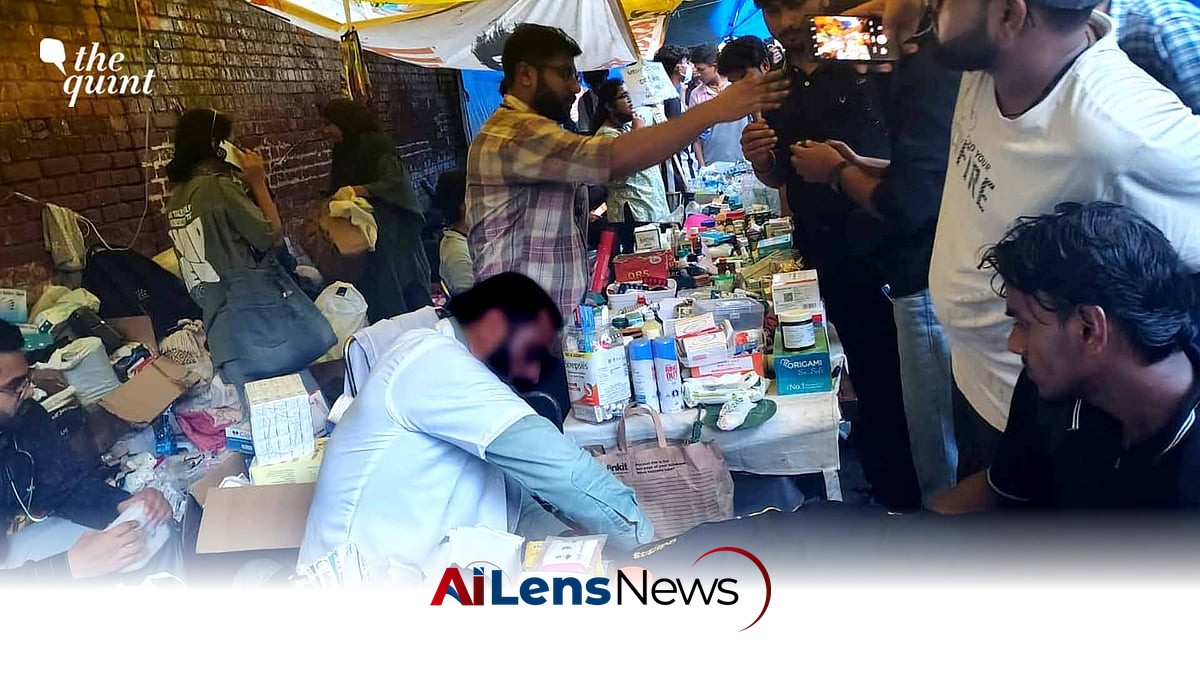


Volunteer doctors at the Jantar Mantar protest site provide critical care to injured protesters, recalling their own experiences as NEET students and the urgency of the situation.
New Delhi, India Jul 24, 2026 ALN: Wade through the sea of protesters chanting slogans, distributing food, and fanning each other in the oppressive heat at the Jantar Mantar protest site. Just to the left of the entrance, beneath yellow and blue tarpaulins, you'll find the movement's sanctuary of relief.
Here volunteer doctors and medical students shuffle around with urgency, tending to an endless stream of injured and exhausted protesters.
Some need bandages and painkillers; others come asking for surgical masks and ORS, while still others are simply looking for a place to lie down for a while.
In front of the medical camp, a row of mats and mattresses under the shade offer some respite to injured, exhausted, and unwell protesters, who rest under the watchful eyes of the volunteer medics.
Amid the chaos of a growing crowd in a confined space and sporadic clashes with armed police forces, this makeshift medical camp has become one of the protest's busiest and most indispensable spaces.
"An image I can't get out of my head is watching young, injured kids being trampled that day," says Dr Shilip Chandra, a 26-year-old general physician, referring to the lathi charge and tear gas used by security forces to disperse protesters on 20 July, Monday during the 'Sansad Chalo' march where protesters decided to move from the designated protest site in Jantar Mantar to the Parliament to make their voices heard.
"Some of them were from the police itself. It was really hard to watch. I just felt so helpless watching the violence because there was nothing I could do in the moment during all the chaos except flee myself," adds Dr Shilpi.
Dr Shilpi has been volunteering at the site since 18 July, and added that at first she and her colleagues were mainly providing basic first aid and tending to those on hunger strike, including activist Sonam Wanchuk. "There were very few doctors at that time."
But, on 20 July, things took a turn.
"Here, we can only bandage minor injuries, provide first aid, and administer painkillers. When it comes to life-threatening injuries and seriously injured patients, there isn't much we can do here," says Dr Keyur, a resident at Dr Ram Manohar Lohia Hospital (RML), who has been volunteering at the protest site between his shifts.
This also happens to be where many of those seriously injured in the clashes are being taken for treatment. "The best thing we can do is stabilise them and shift them to a hospital," he says.
There have also been reports of police personnel being injured during the clashes, with many taken to RML Hospital for treatment alongside injured protesters. However, doctors say the number of critically injured protesters far exceeds that of injured police personnel.
They tell The Quint that most police personnel treated there had mainly suffered soft tissue injuries and minor abrasions. In contrast, many of the students brought in had sustained severe trauma.
Over 100 protesters were reportedly brought to RML Hospital on Monday afternoon with a range of serious and minor injuries. Of these, doctors said, at least 30-40 cases involved head injuries.
Four protesters have also sustained serious injuries caused by pellet guns, including a 19-year-old who is reportedly likely to lose his eyesight on one side. However, the Delhi Police denies these claims.
"What they (Police and RAF) did was horrible. I witnessed it in front of my eyes," adds Ansh, a 25-year-old MBBS student in Romania who is here on leave, and has been participating in the protest since 19 July.
"As a doctor, I have often been disappointed by my colleagues and the way they have responded to social justice issues in the past," says 30-year-old Dr Priyansha Gupta, a resident in Community Medicine at Safdarjung Hospital.
She adds that doctors usually tend not to involve themselves in activism. And something like this—a full-fledged medical camp with several volunteer doctors working round the clock—is a rare sight at protests.
Dr Shilpi says that before Monday, she would have agreed with that perception too. But now, she says, she doesn’t think so.
Dr Shilpa spends upwards of seven hours at the protest site every day, and she's not the only one. She says,
Many of these doctors, including Dr Shilpa, Dr Priyansha, and Dr Keyur are volunteering as medical professionals at a protest for the first time.
Dressed in scrubs, wearing gloves and carrying a garbage bag, The Quint finds 24-year-old Dr Keyur picking up litter on the road leading to the protest site. "The first time I came here was on 19 July at night after my duty. Today my shift starts at 8 pm, so I came before that."
When Dr Keyur reaches the hospital later, a 13-hour night shift from 8 pm to 9 am awaits him.
Dr Priyansha says that the first time she went to volunteer at the protest was on 22 July, but she wishes she had gone sooner. "Because I'm a doctor of community medicine, because my branch isn't strictly clinical, at first I felt like my services wouldn't be as relevant in this situation and I wouldn't be able to provide the care needed here."
So, what is it this time that has pushed Dr Priyansha and all the other young first-time medical volunteers to lend their services at this protest while also showing up for the gruelling shifts at their workplace?
For many, the reason is directly linked to activist Sonam Wangchuk, who had been on a hunger strike since 28 June, which he eventually broke on 24 July.
"I was really moved by the fact that so many people were protesting, and Sonam Wangchuk had been on a hunger strike for so long, yet the government still didn’t acknowledge them. They still haven’t. There has been no accountability on their part," says Dr Keyur.
Dr Priyansha Gupta says that Wangchuk's detention was the trigger for her as well.
Another major reason for so many doctors showing up is that the protests stemmed from NEET paper leaks, something that hits close to home.
"We were NEET students once, so we understand the pain that these students would have gone through," says Dr Shilpi. "The cause resonated with me."
Dr Keyur adds that this isn't the first time the NEET paper has leaked. "Sadly, it's something students have come to expect for years, so we deeply relate to the pain of the current students", he says.
The doctors say the job is not easy. While caring for others, ensuring the well-being of healthcare volunteers themselves has also been a challenge. However, they add that the support they have been receiving from those around them keeps their spirits high.
"We have gotten so much support," says Ansh. "Initially we were low on medicines, but we are very well stocked now. Every 1-2 hours, people are coming up to us and donating something or the other."
Ansh recalls that on 22 July, "a student gave as much as Rs 50,000 for medical supplies. It's incredible!"
"We are not a part of any organisation or here in official capacity from any hospital. We are all here in our personal capacity, on our own time," she adds.
"As doctors, we have immense respect and privilege in society that we don't always realise, and we need to utilise it well to do good in the world, even beyond our regular duties," explains Dr Priyansha.
To learn more about the latest developments in Health News, stay updated with our exclusive reports and analyses on AiLensNews.

