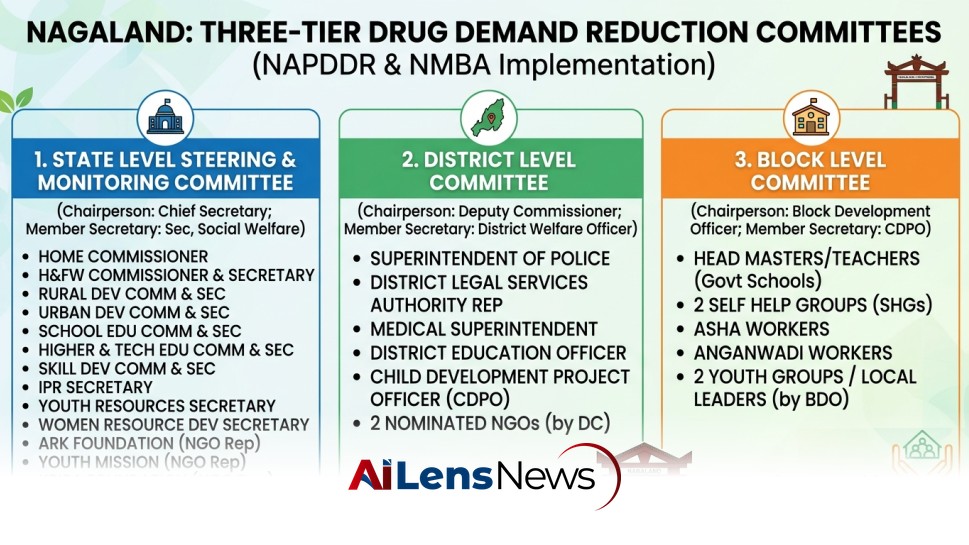


The government has formed three-tier committees at state, district, and block levels to effectively implement the National Action Plan for Drug Demand Reduction and Nasha Mukt Bharat Abhiyan.
Kohima, India Jul 21, 2026 ALN: The government has constituted three-tier committees at the State, district, and block levels for effective implementation of the National Action Plan for Drug Demand Reduction (NAPDDR) and Nasha Mukt Bharat Abhiyan (NMBA) in the State, in pursuance of directives from the Ministry of Social Justice and Empowerment.
The establishment of these committees comes at a time when drug abuse and addiction have emerged as significant public health issues in India. The NAPDDR and NMBA aim to address these challenges by promoting a comprehensive approach to drug demand reduction, focusing on prevention, awareness, and rehabilitation. The government recognizes that a multi-faceted strategy is necessary to combat the growing menace of substance abuse, which affects not only individuals but also families and communities. This recognition is particularly important in a country like India, where the social fabric is often strained by the repercussions of drug-related issues.
According to a notification issued by the Department of Social Welfare, the committees have been formed to strengthen coordination, monitoring, and implementation of drug demand reduction initiatives at the State, district, and block levels. This structured approach is intended to ensure that efforts are not only well-coordinated but also tailored to the specific needs and challenges faced by different regions within the State. The diversity of issues surrounding drug abuse, including cultural attitudes, economic conditions, and availability of resources, necessitates such a localized approach.
The State Level Steering and Monitoring Committee will be chaired by the Chief Secretary, with the Secretary of Social Welfare serving as Member Secretary. It comprises senior officials including the Home Commissioner, Commissioners and Secretaries of Health & Family Welfare, Rural Development, Urban Development and Municipal Affairs, School Education, Higher & Technical Education, Skill Development & Entrepreneurship, and Secretaries of Information & Public Relations, Youth Resources & Sports, and Women Resource Development. Three NGOs working in the field of drugs including the Ark Foundation, Youth Mission, and Kripa Foundation have also been included as members. The inclusion of NGOs is particularly noteworthy, as these organizations often have on-the-ground experience and insights that can enhance the effectiveness of government initiatives. Their involvement can bridge the gap between policy and practice, ensuring that strategies are not only theoretically sound but also practically viable.
At the district level, the Deputy Commissioner will chair the committee, with the District Welfare Officer as Member Secretary. Other members include the Superintendent of Police, District Legal Services Authority, Medical Superintendent, District Education Officer (representing Higher and School Education), CPDO, and two NGOs nominated by the Deputy Commissioner. This diverse membership is crucial for addressing the multi-dimensional aspects of drug abuse, which intersect with law enforcement, health care, education, and community welfare. The collaboration between these various sectors is essential for creating a holistic response to drug-related issues, recognizing that effective solutions often require input from multiple perspectives.
The Block Level Committee will be chaired by the Block Development Officer, with the CDPO as Member Secretary. Members include Head Masters/Teachers from government primary schools, two Self Help Groups nominated by the BDO, ASHA and Anganwadi workers, and two youth groups/local leaders nominated by the BDO. The involvement of local leaders and educators is particularly important, as they can facilitate community engagement and awareness initiatives that are vital for effective drug demand reduction. Educators, for instance, play a key role in shaping youth attitudes towards drugs and can implement preventive education programs in schools.
The notification stated that the committees will oversee planning, coordination, monitoring, awareness generation, rehabilitation support, and community-based interventions under NAPDDR and NMBA. This comprehensive mandate underscores the government's commitment to not only reducing the demand for drugs but also providing necessary support for rehabilitation and recovery. The focus on community-based interventions is especially critical, as local communities often play a pivotal role in both the problem and the solution regarding substance abuse. Community engagement is essential for fostering an environment that discourages drug use and promotes healthy lifestyles.
The State Level Committee will meet quarterly, while District and Block Level Committees will meet monthly. This regular meeting schedule is designed to ensure ongoing communication and responsiveness to emerging challenges and needs within the community. By establishing a structured framework for collaboration and oversight, the government aims to enhance the effectiveness of drug demand reduction efforts and ensure that they are aligned with national priorities. Such a framework not only promotes accountability but also facilitates the sharing of best practices and lessons learned among different levels of the committees.
The implications of these committees extend beyond mere administrative structure; they signal a proactive approach by the government to tackle the pervasive issue of drug abuse in the State. With increasing awareness of the social and economic costs associated with substance abuse, there is a growing recognition of the need for a concerted effort that involves multiple stakeholders, including government agencies, non-governmental organizations, and community groups. This multi-stakeholder approach is crucial for fostering a comprehensive and sustainable response to drug-related challenges, as it encourages collaboration and resource sharing among different entities.
Furthermore, the establishment of these committees aligns with broader national policies aimed at creating a drug-free society. The Nasha Mukt Bharat Abhiyan, launched by the Indian government, seeks to create awareness about the dangers of drug abuse and promote healthy lifestyles among youth. By implementing these initiatives at the grassroots level, the government hopes to foster a culture of prevention and resilience against drug dependence. This national initiative reflects a growing recognition of the need to address drug abuse not just as a criminal issue, but as a public health challenge that requires a comprehensive and compassionate response.
In conclusion, the formation of three-tier drug demand reduction committees represents a significant step towards addressing the complex challenges posed by drug abuse in the State. By leveraging the expertise and resources of various stakeholders, these committees are poised to develop and implement effective strategies that not only reduce drug demand but also promote rehabilitation and community well-being. The success of these initiatives will depend on sustained commitment, collaboration, and a comprehensive understanding of the local context in which they operate. As these committees begin their work, it will be crucial to monitor their progress and adapt strategies as needed to ensure they are meeting the evolving challenges of drug abuse in the State.
To learn more about the latest developments in Health News, stay updated with our exclusive reports and analyses on AiLensNews.

