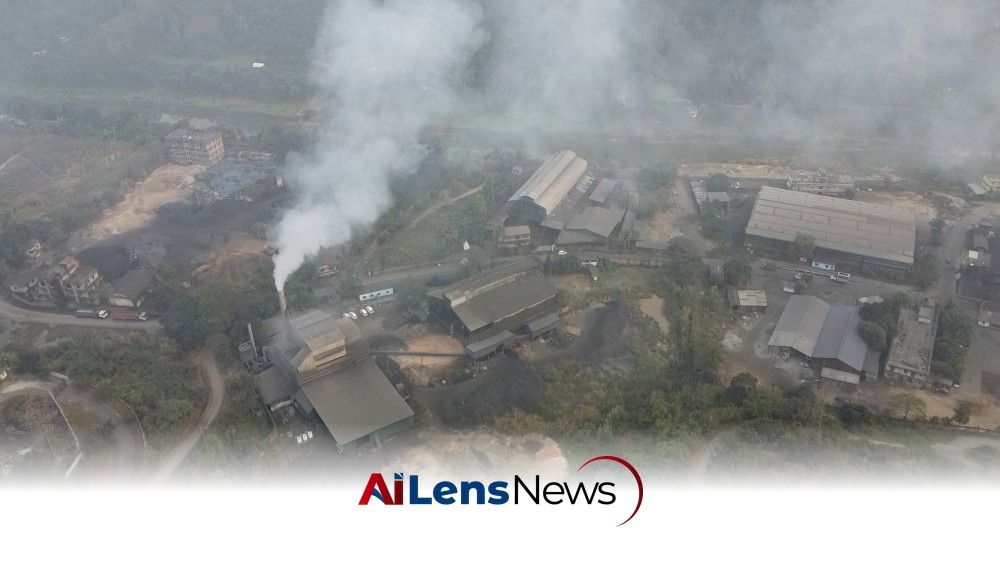


Health Minister Wailadmiki Shylla emphasizes the need for formal written complaints before investigating air pollution in Byrnihat, where respiratory illnesses have surged.
Shillong, India Jul 15, 2026 ALN: Following alarming reports surfacing on social media about air pollution levels in Byrnihat, the Health and Family Welfare Minister Wailadmiki Shylla has emphasized that the government requires formal written complaints to initiate any investigations into the matter. This announcement comes in the wake of claims that respiratory illnesses in the region have surged by nearly 77 percent over the past two years, raising significant concerns about public health and environmental safety.
The minister's comments have sparked a wave of criticism, particularly regarding the necessity of formal complaints before the government can take action against polluters. Many members of the public and environmental advocates have questioned the efficacy and role of the State Pollution Control Board (MSPCB) if it relies on public complaints to trigger investigations into pollution issues. Critics argue that the MSPCB should proactively monitor and address pollution without waiting for formal complaints, especially when public health is at stake.
In a press conference, Shylla defended the government's position, stating that while various allegations and reports circulate on social media, the government cannot act solely based on unverified information disseminated online. He explained that the government must adhere to established procedures to ensure that any actions taken are justified and grounded in reliable evidence. “With today’s technology, anyone can put out any information on social media. But the government cannot respond to every claim without following due process,” he remarked. This highlights the challenges that authorities face in the digital age, where misinformation can spread rapidly and complicate public discourse.
Shylla's comments reflect a cautious approach to governance, particularly in light of the potential consequences that could arise from hasty decisions. He noted that any actions taken, such as shutting down a factory due to pollution concerns, could have significant implications for local employment, potentially leading to job losses for many residents who depend on these industrial units for their livelihoods. This balancing act between environmental protection and economic stability is a critical issue that many governments face, especially in industrial regions like Byrnihat.
The urgency of the situation is underscored by a report from the Green-Tech Foundation, an organization dedicated to addressing environmental and public health issues in the Assam industrial belt. Their findings, derived from an IQAir study conducted in collaboration with the Centre for Research on Energy and Clean Air (CREA), revealed that Byrnihat has recorded an alarming annual average PM2.5 concentration of 128.2 micrograms per cubic meter. This level of particulate matter is classified as hazardous to public health, raising serious concerns about the long-term health effects on the local population.
In acknowledgment of the pollution crisis, Shylla recognized that Byrnihat has previously been identified as one of the most polluted locations in India. He noted that the state government has taken steps against industrial units that have failed to comply with pollution control norms, resulting in the closure of several establishments. Such enforcement measures indicate a recognition by the government of the need to address pollution proactively, yet the reliance on formal complaints raises questions about the sufficiency of these measures.
Shylla further stated that the MSPCB has received recognition for its efforts in monitoring and enforcing pollution control, which suggests that there have been some successes in addressing environmental issues. However, the effectiveness of these measures may be undermined if the public feels disempowered or discouraged from reporting pollution issues due to the requirement for formal complaints. This could create a disconnect between the government and the community, where residents may feel that their concerns are not being heard or adequately addressed.
In drawing a comparison with Delhi, where authorities often act based on air quality index (AQI) readings, Shylla emphasized that the government would similarly verify all available data and complete necessary procedures before taking action. This approach suggests a methodical and structured response to pollution, but it also raises concerns about the speed at which the government can respond to urgent public health threats. In densely populated urban areas like Delhi, rapid responses are often necessary to mitigate the immediate impacts of air pollution on health.
When questioned about the possibility of conducting a health audit of residents in Byrnihat, Shylla mentioned that the MSPCB continuously monitors industrial units using advanced technological systems. He indicated that the board follows a detailed assessment process before issuing Consent to Operate (CTO) certificates to industrial units and takes action whenever violations are detected. This proactive monitoring is essential for ensuring compliance with environmental regulations, but it also relies on the availability of accurate data and the capacity of the MSPCB to act swiftly in response to violations.
“If any irregularity is found, appropriate directions will be issued,” Shylla concluded, reinforcing the government’s commitment to addressing pollution issues. However, the effectiveness of this commitment will ultimately depend on the government's ability to engage with the community, streamline complaint processes, and respond to environmental challenges in a timely manner.
The implications of this situation extend beyond Byrnihat, as it reflects broader trends in environmental governance across India. As urbanization and industrialization continue to accelerate, the need for effective pollution control measures becomes increasingly urgent. The reliance on formal complaints may hinder timely responses to pollution crises, potentially endangering public health and undermining community trust in governmental institutions. Therefore, it is crucial for the government to consider alternative mechanisms for monitoring and addressing pollution, ensuring that the voices of residents are heard and that their health is prioritized in decision-making processes.
To learn more about the latest developments in Health News, stay updated with our exclusive reports and analyses on AiLensNews.

