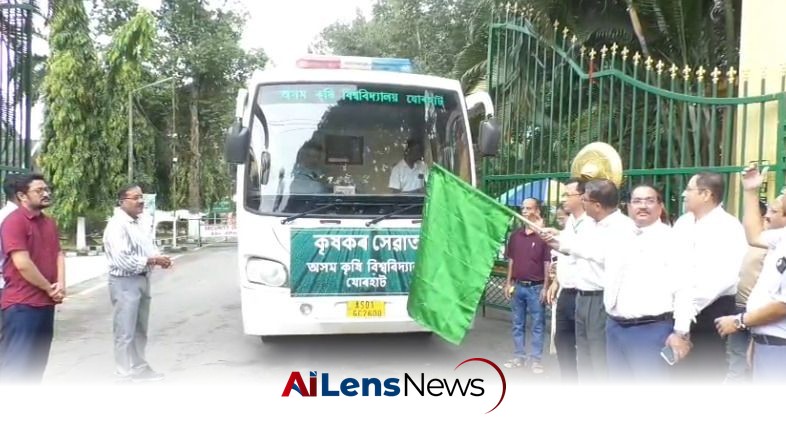


Assam Agricultural University has introduced a mobile plant health clinic to provide on-site agricultural support to farmers, enhancing crop productivity and disease management.
Dispur, India Jul 17, 2026 ALN: In a push towards science-driven agriculture, the Assam Agricultural University (AAU) on Friday launched the State's first mobile plant health clinic, a fully equipped vehicle designed to take agricultural scientists and diagnostic facilities directly to farmers' fields.
The initiative, aimed at strengthening the agricultural extension system and delivering timely scientific support to cultivators, was formally flagged off by AAU Vice-Chancellor Deepjyoti Rajkhowa at the university campus in Jorhat. This launch is a part of a broader movement within the agricultural sector in India to enhance productivity and sustainability through the integration of scientific research and practical farming techniques.
Launched in line with the National Maize Mission, the mobile clinic is expected to bridge the gap between agricultural research and on-field farming by enabling scientists to diagnose crop diseases, pest infestations, and nutrient deficiencies at the source. The National Maize Mission itself is a government initiative aimed at increasing maize production and productivity in India, recognizing maize as a crucial crop for food security and income generation.
Equipped with advanced microscopes, plant disease diagnostic kits, soil and water testing equipment, pest identification tools, GPS, internet connectivity, a digital database, and an LED display, the vehicle functions as a travelling laboratory capable of carrying out preliminary scientific assessments in farmers' fields. This technological integration not only enhances the efficiency of diagnostics but also ensures that farmers receive immediate feedback on their crop health.
Officials said that once a farmer reports signs of disease or poor crop health, experts travelling in the vehicle will collect plant or soil samples and conduct on-the-spot examinations. This immediate response is crucial, as delays in diagnosing crop issues can lead to significant losses in yield and quality. If detailed analysis is required, the samples will be sent to specialised laboratories, following which farmers will receive scientific recommendations on disease management, pest control, fertiliser application, and ways to improve crop productivity.
The initiative is expected to benefit cultivators engaged in the production of paddy, tea, maize, vegetables, fruits, pulses, and other major crops grown across Assam. Assam's diverse agricultural landscape, characterized by its unique climatic conditions and soil types, demands tailored approaches to farming, making the role of such mobile clinics particularly vital.
Speaking on the occasion, Vice-Chancellor Rajkhowa said the university has been working closely with the State government to make agriculture more productive and self-reliant. This collaboration is part of a larger strategy to modernize agricultural practices in Assam, which has historically faced challenges such as flooding, soil erosion, and pest outbreaks.
The Government of Assam has been taking several initiatives to strengthen agriculture, and Assam Agricultural University has been extending every possible support. Earlier this month, for the first time, we ceremonially distributed seeds and planting materials developed by the university to farmers from five districts through our Horticultural Research Station. This distribution is part of a comprehensive effort to provide farmers with high-quality inputs that can lead to better yields and enhance food security in the region.
We are now expanding that programme to districts such as Dhemaji, Tinsukia, Dibrugarh, Nagaon, Morigaon, Nalbari, and Barpeta, besides supplying planting materials to Krishi Vigyan Kendras under AAU. Our objective is to make farmers self-reliant by providing them with quality planting materials and scientific guidance. The Krishi Vigyan Kendras (KVKs) play a pivotal role in the agricultural extension system, serving as a bridge between research institutions and farmers.
Explaining the concept behind the mobile clinic, Dr. Deepjyoti Rajkhowa said the vehicle would carry a multidisciplinary team of scientists directly to farming communities. This approach not only facilitates immediate assistance but also fosters a deeper understanding of local agricultural practices and challenges faced by farmers.
This mobile clinic is essentially a laboratory on wheels. It will help analyse soil health, identify plant diseases, assess nutrient deficiencies, and recommend appropriate fertilisation. The vehicle is staffed by soil scientists, plant pathologists, entomologists, and other specialists who will interact directly with farmers, understand their problems, and provide immediate scientific advice. The vehicle has already begun its journey to Dhemaji, where the team will spend two days working with farmers before moving to other districts.
He added that the mobile clinic would eventually cover all 23 Krishi Vigyan Kendras (KVKs) under Assam Agricultural University, ensuring that farmers across the State receive direct access to scientific expertise. This extensive outreach is expected to empower farmers with the knowledge and tools necessary to improve their agricultural practices.
The initiative marks a significant shift from conventional extension services by taking agricultural laboratories beyond university campuses and into villages. Traditionally, farmers have had to travel to research institutions to seek advice, which can be time-consuming and logistically challenging. By bringing scientific expertise directly to the fields, the mobile clinic aims to democratize access to agricultural knowledge.
Officials believe that early detection of diseases and pests, coupled with timely scientific intervention, will help reduce crop losses, improve productivity, and encourage greater adoption of modern farming practices. This proactive approach is essential in a region where agriculture is not only a primary source of livelihood but also a critical component of the local economy and food security.
As the mobile plant health clinic embarks on its journey across Assam, it represents a promising step towards integrating scientific research with practical farming, ultimately aiming to uplift the agricultural community and foster a more resilient agricultural sector. The success of this initiative may serve as a model for other states in India, encouraging similar programs that prioritize accessibility to agricultural science and technology for farmers.
To learn more about the latest developments in Health News, stay updated with our exclusive reports and analyses on AiLensNews.

