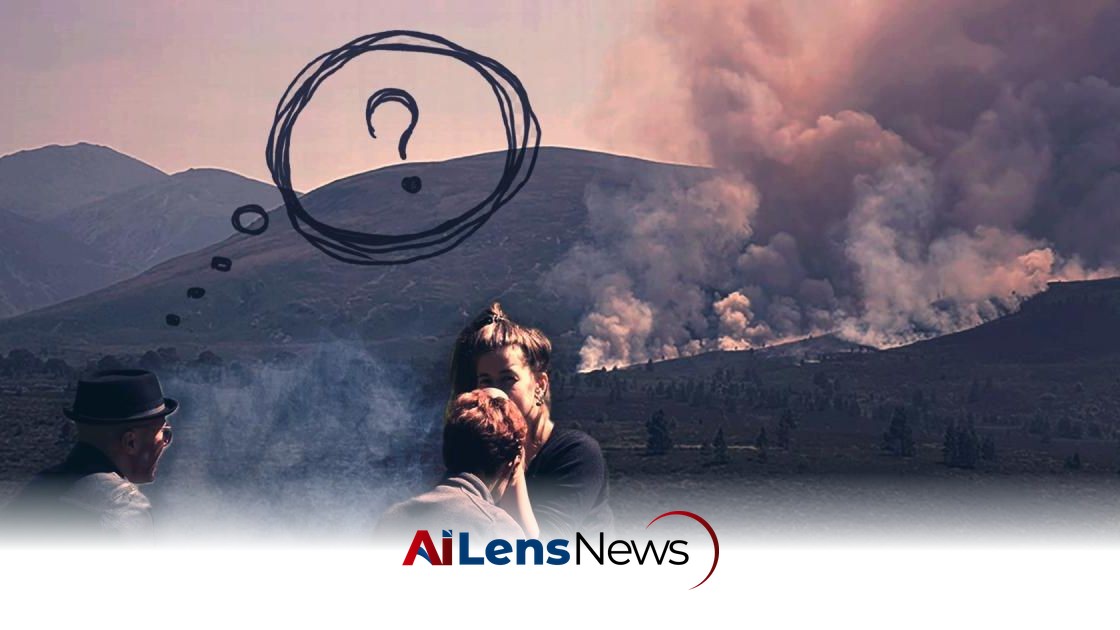


The Cairngorms National Park's byelaw banning disposable barbecues aims to reduce wildfire risks. However, local campaigners argue it's not working as intended.
London, United Kingdom Jul 17, 2026 ALN: A byelaw banning unauthorized fires lit by visitors to the Cairngorms National Park came into effect in April this year after several years of due process. But amid a recent surge in wildfires, a high-risk warning in the area, and the most recent kilometres-wide blaze, local campaigners claim it "isn't working."
The Cairngorms National Park Fire Management Byelaw was approved by the Scottish Government on September 25, 2025 following an extensive public consultation. It applies seasonally from April 1 to September 30, during which it is an offence to light or maintain open fires anywhere in the National Park during the time of year that the area is at its most tinder-dry.
The Herald spoke with the Park authority, local campaigners, and estate groups, as residents have been evacuated after a large wildfire broke out at Ryvoan Bothy, near Nethy Bridge, and continues to burn. It comes just over a year after the 'largest wildfires Scotland's ever seen' on Dava Moor, 30 miles away.
The wildfire started in the heathland late on Wednesday morning and had spread to more than 6km wide by Thursday afternoon, July 16.
A number of homes and businesses, including campsites and ski resorts in the Glenmore Forest Park area, have been closed and evacuated as a safety precaution.
Currently, anyone found breaching the byelaw can be reported to and prosecuted in the Sheriff Court, with a maximum fine of £500. To date, no fines have been issued or reports made to the procurator fiscal.
Paul White, founder of the Scottish Wildlife Council group, has been campaigning for three years for action to curb the rise in wildfires and launched a petition to completely ban disposable barbecues across Scotland in 2025, which was dismissed by Holyrood as "not achievable."
:
Firefighters work through night tackling wildfire which sparked evacuation
'Avoid the area': Residents evacuated amid fears Highlands wildfire could spread
Campaigners slam ‘regulatory vacuum’ as report confirms lice impact on wild salmon
Outlander helps rising visitor numbers generate almost £300m
White, from Aviemore, insists that the £500 cap on the possible fine through the byelaw "is not significant enough to deter people," and that instead of the current process, which requires a court session and Sheriff's judgement to impose a fine, on-the-spot fines "of at least £1,000" would be "the only way to get the message through."
He considers the current fine of up to £500 "a drop in the ocean" compared to the "hundreds of thousands of pounds in damage" a wildfire can cause to biodiversity, grazing land, and local businesses.
New powers due to come into force next year under the Natural Environment (Scotland) Act 2026 update national parks legislation to allow National Park Authorities to issue fixed‑penalty notices (on‑the‑spot fines) for breaches of park byelaws, once detailed regulations are in place. However, the set amount of these fines is yet to be confirmed.
While no fines have been issued, the Cairngorms National Park Authority believes that the figure, which "some people may see as being negative", is actually positive as "it shows people are willing to comply when asked to."
Colin Simpson, Cairngorm National Park Authority's head of visitor services and active travel (Image: Beth Reid)
Colin Simpson, the Park's head of visitor services and active travel, added that: "The purpose of this legislation is not to take enforcement against people. The purpose of this legislation is to reduce the number of fires."
White also raised concerns about several businesses within the National Park continuing to sell disposable barbecues after the byelaw came into effect. The Park Authority wrote to all retailers in March this year, urging them to reconsider stocking them; however, it has been confirmed that multiple stores still do so.
Disposable barbecues are said to be responsible for around 4% of serious accidental fires, according to the Home Office. White said: "They're a horrible invention, and the consensus locally is that they should be banned and long overdue. Every time people use them, they are always going to cause some form of damage."
In its annual review in September last year, the Scottish Fire and Rescue Service (SFRS) reported that “since February 2025, the Service has responded to 231 large outdoor fires, with many regions of the country affected and some fires burning for days.” The same statement links those incidents directly to climate‑change impacts and periods of heightened wildfire risk, with 12 wildfire‑risk warnings covering 59 days between March and August.
Large parts of Scotland are currently under a 'very high' risk of wildfires as hot, dry weather continues. A warning is in place for Central Highlands, Southern and Eastern Scotland from Wednesday, 15 July to Monday, 20 July.
A wildfire burning in heathland in the Cairngorms National Park. (Image: PA/Duncan Ferguson)
White insists there is a lack of patrols to enforce the byelaw, leading to a "lack of awareness" amongst visitors. He notes that he's "only seen police patrols in the Glenmore area that've been ongoing since 2021," which accounts for Police Scotland patrols on "16 nights a year between July and August as paid for by the park authority."
However, the Park Authority says that so far this year their patrols, alongside Police Scotland, have increased from 674 in the same period last year to 771 to date this year. They also confirmed that these patrols take place until 10pm or after midnight at weekends during the peak season.
To address the peak time for camping, the Authority hired extra rangers this year, specifically on Friday to Sunday contracts to ensure higher evening coverage during the weekends.
What they did admit, in response to White's concerns about the "lack of signage" regarding the byelaw, was that they had a large number of extra signs along the way. There are 500 signs on order to be put in place throughout the park to add to the existing 12, which are currently in place. Those signs will be placed on public and estate land to address concerns that White has raised due to the lack of signage in places, including at the main access point to Ryvoan Bothy, near the area affected by the current wildfire.
White said: "The National Park authority has had three years to prepare and bring forward this byelaw after it was initially proposed in June 2023. The byelaw was finally approved in September 2025 by the Scottish Government before first being applied on April 1 this year.
"It is therefore concerning that it's taken 10 months to put in place or recognise there isn't sufficient signage. [This week] a representative from the park authority commented on their official Facebook page that there were already "1000 signs" across the national park.
"I know from my own inspections of visitor areas that is not the case; there seems to be conflicting information."
The wildfire started in heathland at Ryvoan Bothy, near Nethy Bridge, late on Wednesday morning (Image: RSPB Scotland/PA Wire)
Ross Ewing, director of moorland and strategic projects at Scottish land and estates, said they and their members are in favour of the byelaw as "prevention is always the best route."
When looking at it at an early stage, he added: "It's definitely far too early to pass judgement on whether or not the byelaw has been effective or not in the Cairngorms, seeing as this is the first wildfire season it has been in place, and there is still plenty of that season to go. It's important to give it a chance to properly bed in.
"What has definitely been effective is the signage put in place by the Cairngorms National Park and their work with the local businesses and communities.
Ewing admitted that wildfires are an issue that has "increased massively in recent years," but many estates have responded by investing heavily in equipment and other measures to ensure they can respond to fires as they arise, in conjunction with the SFRS.
A point that Simpson agrees on, he said: "There’s a need to continue putting out this messaging that we’re not the place we were 20, 30, 40 years ago. We are now a place with a fire risk that, historically, we wouldn't have had nearly as much of.
"We do know in the past there have been fires caused by things other than campfires and barbecues; it could be something as simple as a discarded cigarette. It could be discarded litter that's started something."
Increased education is a point that White also raised, he said that "banning things should always be a last resort", but an "ideal long-term solution is a widespread education programme across Scotland, particularly in inner city schools."
He cited Norway as an example from his time spent there that "children are immersed in nature from age three onwards all the way through school," leading to a "deeper understanding and respect for nature." He believes that if people were taught about ecology, environmental protection and the value of nature from a young age, this "would instil deeper values that might result in a ban being unnecessary."
However, White insists that "The byelaw isn't effective at the moment because it cannot be practically enforced on the ground. It isn't stopping people from having campfires or using disposable barbecues, which are the primary source of ignition for wildfires."
Simpson provided figures on the number of fires the Park Authority shared with The Herald for April 1 to July 12, showing that rangers have noted 28 fires in the area during that period this year, compared with 55 in 2025, 135 in 2024, and 151 in 2023.
A Scottish Fire and Rescue Service spokesperson said: “Wildfires pose a real risk to people, communities and the natural environment. The recent incidents we have attended are a reminder of how quickly these fires can spread, and the significant resources needed to bring them under control.
“The byelaw is an important tool to help reduce wildfire risk within the Cairngorms National Park. Alongside responsible behaviour and public awareness, it supports efforts to protect local communities and the surrounding areas.”
To learn more about the latest developments in Environmental Policy, stay updated with our exclusive reports and analyses on AiLensNews.

