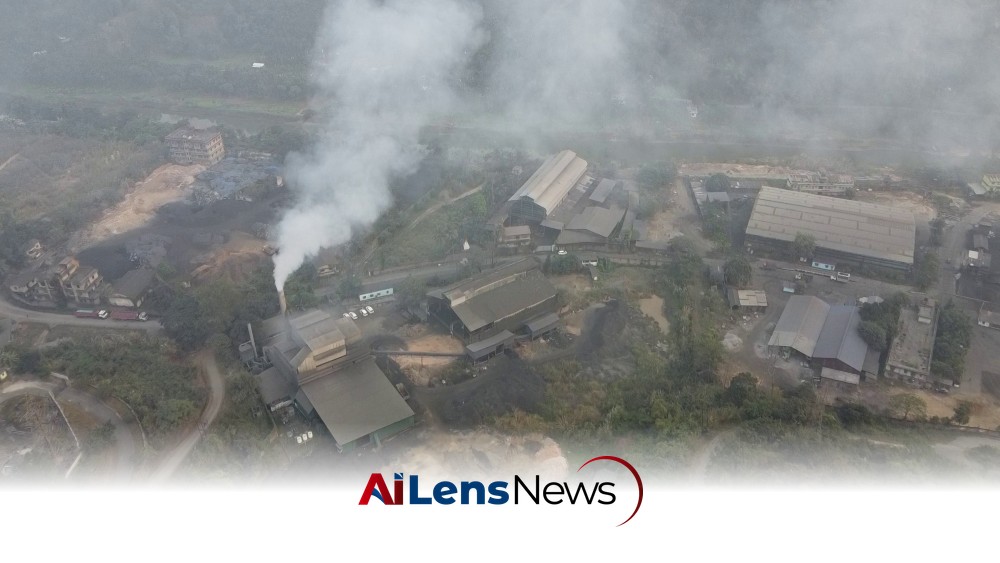


The High Court has expressed concern over the State Pollution Control Board's failure to address severe pollution issues in Byrnihat, urging immediate action.
Shillong, India Jul 21, 2026 ALN: The State Pollution Control Board (MSPCB) has not taken prompt action on damning environmental statistics for the Byrnihat area in Ri-Bhoi, the High Court noted in a suo motu case. The situation in Byrnihat has become critical, with rising pollution levels severely affecting the health and well-being of the local population and the surrounding environment.
In a hearing on July 7, a two-judge bench comprising Chief Justice Revati Mohite Dere and Justice Wanlura Diengdoh noted that the MSPCB had tasked the Council of Scientific and Industrial Research’s National Environmental Engineering Research Institute (CSIR-NEERI) in 2024 to submit a comprehensive report on the air pollution sources and emissions within Byrnihat and the Export Promotion Industrial Park (EPIP) there. The report was submitted to the MSPCB in March 2025, revealing alarming data about the pollution levels in the area.
The EPIP was developed under a central government scheme aimed at providing infrastructure for industrial units with export potential. This initiative was part of a broader effort by the Indian government to boost the manufacturing sector and promote economic growth in the region. However, the establishment of several industrial units in the area, including steel plants, smelters, and alloy production units, has led to significant environmental degradation. The presence of these industries, coupled with their associated activities and overall growth, has caused Byrnihat and the adjacent EPIP area to be classified as “a non-attainment town in terms of ambient particulate matter (PM10).” This classification indicates that the air quality in Byrnihat does not meet the national air quality standards set by the government.
In addition to the pollution generated by industrial activities, the national highway that runs between Guwahati and Shillong also contributes significantly to the area's pollution levels. The heavy traffic along this route, which includes a large number of commercial vehicles, exacerbates the already dire situation, leading to increased emissions of harmful pollutants. The cumulative effects of industrial emissions and vehicular pollution have raised serious concerns among environmentalists and health experts.
The High Court took up the case after new claims regarding the poor state of air and water pollution in Byrnihat were highlighted through news reports and on social media. Byrnihat lies on the Assam border and was infamously named as the world’s most polluted town in late 2023 or early 2024. At that time, the government blamed Assam for being the main driver of the poor ranking, which sparked a heated debate about accountability and responsibility for pollution control in the region.
The CSIR-NEERI report sets out specific and general conclusions and recommendations aimed at addressing the pollution crisis in Byrnihat. Among the specific recommendations are measures to tackle the emission of silica/quartz; industrial emissions, including those from fuel combustion; dust emission and resuspension; vehicular tailpipe emission; and biomass and waste burning. Furthermore, the report emphasizes the need for a comprehensive approach to air quality management, suggesting that the entire Byrnihat airshed should be integrated into an air quality action plan to ensure accountability and achieve clean air goals.
Some of the general recommendations outlined in the report include the installation of structures for particulate matter control by all particulate-generating industries, the implementation of dust control measures such as de-dusting and water sprinklers for materials like coal, coke, loose earth, ore, cement, and quartz. The report also advocates for the use of grey water or rainwater for such sprinklers instead of groundwater or streams, to conserve precious water resources. Additionally, the establishment of greenbelts around industrial facilities is recommended to act as a buffer against pollution, while a transition to renewable energy sources is urged to reduce reliance on fossil fuels.
Recent news reports indicated to the court that the MSPCB “needs to act with alacrity before the situation worsens” and apply existing laws strictly. The urgency of the situation cannot be overstated, as continued inaction could lead to irreversible damage to the environment and public health. The court's intervention reflects the growing concern among citizens and activists regarding the MSPCB's effectiveness in managing pollution and enforcing environmental regulations.
At that July 7 hearing, the court impleaded the MSPCB and Central PCB, signaling the seriousness of the matter. However, during the proceedings, the MSPCB’s legal representative requested additional time to file an affidavit-in-reply, raising questions about the board's preparedness to address the crisis. Furthermore, a Health Department status report was found to have provided “sketchy” data that did not adequately address the actual issues at hand, highlighting a lack of comprehensive understanding of the pollution crisis by the authorities.
The case will be heard again on July 23, and the outcome of this hearing could have significant implications for the future of environmental governance in the region. It remains to be seen whether the MSPCB will take the necessary actions to implement the recommendations from the CSIR-NEERI report and whether the court will impose stricter measures to ensure compliance with environmental laws. The situation in Byrnihat serves as a critical reminder of the need for effective pollution management strategies and the importance of holding responsible parties accountable for environmental degradation.
As the situation develops, the residents of Byrnihat and surrounding areas continue to grapple with the health impacts of pollution, including respiratory issues, skin problems, and other related ailments. The community's resilience will be tested as they await the outcomes of legal proceedings and the potential for meaningful change in environmental policy and enforcement.
In conclusion, the High Court's criticism of the MSPCB for its inaction on the Byrnihat pollution crisis underscores the pressing need for robust environmental management and accountability mechanisms. The court's involvement may serve as a catalyst for change, prompting the MSPCB and other authorities to take decisive action to address the pollution crisis in Byrnihat and protect the health and environment of its residents.
To learn more about the latest developments in Environmental Policy, stay updated with our exclusive reports and analyses on AiLensNews.

