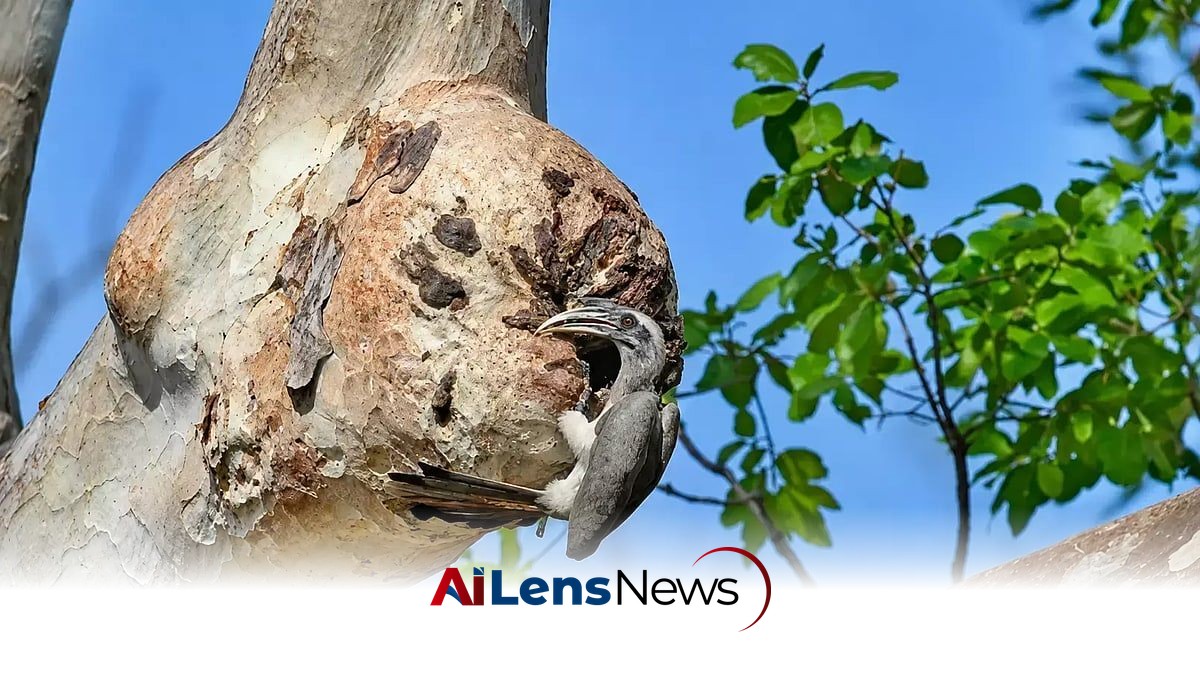


The Indian Grey Hornbill has successfully returned to Gujarat's Gir forests, marking a significant conservation success after nearly six decades of absence.
Itanagar, India Jul 15, 2026 ALN: The Indian Grey Hornbill, locally known as the Chilotro, has successfully returned to Gujarat's Gir forests after being absent for nearly six decades. A new scientific study confirms that the birds have settled, nested, and begun breeding in the wild following a state-led reintroduction programme.
Published in the international peer-reviewed journal Birds, the study is the first comprehensive assessment of the project, which began in 2021 after scientific assessments found Gir's habitat suitable for the species once again.
A total of 40 Indian Grey Hornbills were translocated from the Aravalli forests and released in two phases—28 birds in 2021-22 and 12 more in 2023. Researchers found that one breeding pair nested successfully in the first year after release, while three additional pairs established nests in the second year, indicating that the programme has achieved its primary conservation objective. Satellite tracking of 11 male hornbills showed that the birds initially explored large areas before settling into smaller home ranges. Their average range shrank from about 61 sq km to 5.7 sq km, while average daily movement declined from 4.3 km to 1.4 km, reflecting successful adaptation to the Gir ecosystem.
The hornbill had disappeared from Gir during the 1950s and 1960s. Researchers attribute its successful return to improved habitat protection following the declaration of the Gir Wildlife Sanctuary in 1965 and Gir National Park in 1975. The study also highlights the species' ecological importance as an effective seed disperser, contributing to the natural regeneration of fruit-bearing trees and forest ecosystems. The reintroduction is part of broader wildlife conservation efforts in India aimed at restoring locally extinct species to suitable habitats through scientific monitoring.
The Indian Grey Hornbill is a medium-sized bird known for its distinctive curved bill and striking plumage. It plays a crucial role in maintaining the health of forest ecosystems. As a frugivore, it feeds primarily on fruits, and in doing so, it aids in seed dispersal. This process is vital for the propagation of various plant species, which in turn supports a diverse range of wildlife. The return of the Indian Grey Hornbill to Gir is not only a success story for conservationists but also a significant step towards restoring ecological balance in the region.
Historically, the decline of the Indian Grey Hornbill in Gir was attributed to several factors, including habitat destruction, hunting, and competition with other species. The area faced significant ecological changes due to agricultural expansion and deforestation during the mid-20th century. The establishment of protected areas like the Gir Wildlife Sanctuary was a turning point for various species, including the Asiatic Lion, which has become a symbol of conservation success in India. The return of the hornbill is a testament to the positive impacts of these conservation efforts.
The reintroduction programme for the Indian Grey Hornbill involved meticulous planning and execution. Researchers conducted habitat assessments to ensure that the environment was conducive to the hornbills' survival. The selection of the Aravalli forests as the source for translocation was based on the population stability and health of the hornbill population there. The process included capturing, transporting, and releasing the birds in suitable locations within Gir, with ongoing monitoring to assess their adaptation and breeding success.
Following their release, the hornbills were closely monitored using satellite tracking technology, allowing researchers to gather valuable data on their movements and behavior. This data has provided insights into their settling patterns and habitat preferences, which are crucial for future conservation strategies. The initial wide-ranging movements of the hornbills indicate a period of exploration as they searched for optimal nesting sites and food sources. Over time, their range contracted, suggesting they found suitable habitats where they could thrive.
The success of this reintroduction programme is part of a larger trend in wildlife conservation in India, where efforts are being made to restore species that have been lost from their natural habitats. This approach is gaining momentum as conservationists recognize the importance of biodiversity in maintaining healthy ecosystems. The Indian government, along with various non-governmental organizations, is increasingly focused on implementing science-based conservation strategies to ensure the survival of endangered species.
The implications of the Indian Grey Hornbill's return extend beyond its immediate ecological benefits. It serves as a symbol of hope for conservation efforts in India and highlights the importance of protecting and restoring natural habitats. The success story of the hornbill can inspire similar initiatives for other species that are facing the threat of extinction. It also reinforces the need for continued investment in conservation programs, habitat protection, and community involvement in wildlife management.
Engaging local communities in conservation efforts is critical to the long-term success of initiatives like the reintroduction of the Indian Grey Hornbill. Local populations can play a vital role in monitoring wildlife, protecting habitats, and promoting sustainable practices. Education and awareness campaigns can help foster a sense of ownership and responsibility towards local wildlife, ensuring that conservation efforts are supported at the grassroots level.
As the Indian Grey Hornbill begins to thrive in the Gir forests, researchers and conservationists will continue to monitor its population dynamics and ecological impact. The ongoing study will provide insights into the long-term success of the reintroduction and the role of the hornbill in the ecosystem. Such research is essential for adapting conservation strategies to changing environmental conditions and ensuring the resilience of both the species and its habitat.
In conclusion, the comeback of the Indian Grey Hornbill in the Gir forests marks a significant milestone in wildlife conservation in India. It underscores the effectiveness of targeted reintroduction programmes and the importance of habitat protection. As the species establishes itself in the region, it offers a glimmer of hope for the restoration of biodiversity and the continued health of forest ecosystems in Gujarat and beyond.
To learn more about the latest developments in Conservation, stay updated with our exclusive reports and analyses on AiLensNews.

