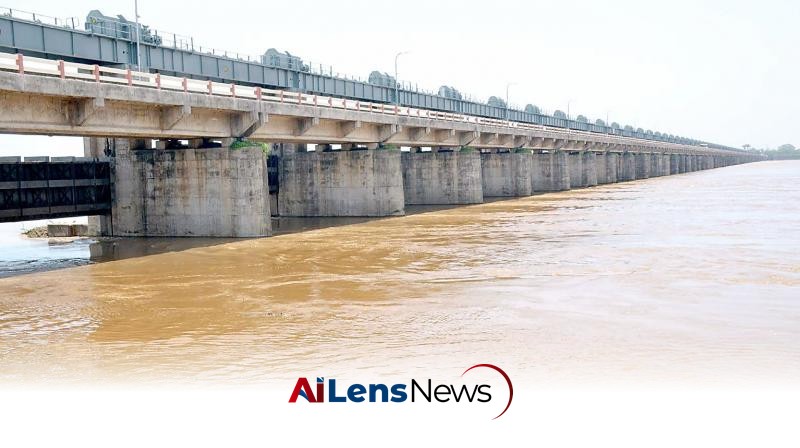


Andhra Pradesh's Irrigation Minister N Ramanaidu reports a drastic drop in Godavari River water flow, attributing it to the super El Nino phenomenon, affecting irrigation across the region.
Amaravati, India Jul 21, 2026 ALN: Amaravati: Andhra Pradesh Irrigation Minister N Ramanaidu on Tuesday announced that the "super El Nino ravaging irrigation and agriculture on a global scale" has led to a historic drop in water flow in the Godavari River, reaching levels unseen in the past 70 years. The flow has dwindled to just 20,000 cusecs in July, a significant decrease compared to historical averages.
Citing irrigation experts, Ramanaidu emphasized that under normal conditions, the flow would typically range between 1 lakh and 2 lakh cusecs during this month. This drastic reduction has raised alarms among agricultural stakeholders and local farmers who heavily depend on the river for irrigation. The Godavari River, one of the major rivers in India, plays a crucial role in supporting the agricultural economy of Andhra Pradesh, particularly in the Godavari Delta region.
The Godavari River, often referred to as the "Ganges of the South," spans approximately 1,465 kilometers and is the second longest river in India. It originates in the Western Ghats and flows eastward into the Bay of Bengal, traversing several states, including Maharashtra, Chhattisgarh, Odisha, Telangana, and Andhra Pradesh. The river is not only significant for irrigation but also for drinking water supply, power generation, and transportation. Its watershed supports millions of people, making it a lifeline for the region.
Ramanaidu attributed the reduced water availability to the super El Nino phenomenon, a climatic event characterized by the warming of ocean surface temperatures in the Pacific, which has far-reaching effects on weather patterns globally. The super El Nino is expected to have intensified effects on weather, leading to altered rainfall patterns and increased temperatures, which have been detrimental to agriculture. He noted that normally, 3,000 TMC (Thousand Million Cubic) feet of Godavari River water would drain into the sea annually. However, the current conditions are leading to a concerning imbalance in water availability.
The implications of such a severe drop in water flow are profound. Agriculture in Andhra Pradesh is primarily rain-fed, with many farmers relying on the Godavari River for irrigation during the Kharif season, which typically runs from June to October. The Kharif season is crucial for the cultivation of staple crops such as rice, maize, and pulses, which are essential for food security in the region. The current water crisis threatens not only the immediate crop yields but also the livelihoods of farmers who depend on these crops for their income.
Due to the lower flow in the river, the government is sourcing water from Sileru to meet irrigation needs in the Godavari Delta region, where approximately 10.17 lakh acres are currently being cultivated. This shift in water sourcing is indicative of the severity of the situation, as Sileru water is typically tapped only for the Rabi crop during March and April, not for the Kharif season when the demand for irrigation is at its peak. The Sileru River, a tributary of the Godavari, is also facing pressure due to the increased demand, raising concerns about its sustainability as an alternative water source.
Recently, Chief Minister N Chandrababu Naidu highlighted that the southern state has experienced a 49 percent deficit in rainfall this year, compounding the challenges faced by farmers and agricultural planners. The rainfall deficit has been attributed to the broader climatic changes associated with the super El Nino, which has disrupted seasonal weather patterns and led to reduced precipitation across the region. This has exacerbated the already critical situation, as farmers were hoping for timely rains to support their crops.
Despite these challenging conditions, Ramanaidu reassured that 14,800 cusecs of water is still being supplied to the Godavari Delta for irrigation. However, he acknowledged that the more distant areas of the Godavari Delta continue to face irrigation challenges, as the infrastructure in this region, along with the Krishna Delta, was designed to deliver water primarily through a canal network, with only 30 percent reliant on rainwater. This reliance on canal systems means that when water flow decreases, the impact is felt more acutely in areas that are not as easily accessible.
The lack of rainwater has left both deltas under significant stress, making them entirely dependent on canal water. The situation has prompted the government to take immediate action to address water supply issues, particularly in remote regions where access to water has been severely limited. To mitigate these challenges, maintenance works are being conducted, and blockages are being removed from the canal systems to enhance water flow. This includes dredging canals to improve capacity and ensure that water can reach the fields that need it the most.
Furthermore, the Irrigation Minister noted that while elevated areas in the Godavari Delta may not receive water, 90 percent of the remaining fields will be supplied with water for cultivation during the Kharif season. Arrangements for this will be coordinated with district collectors and the revenue and irrigation departments, Ramanaidu stated. This proactive approach aims to ensure that farmers are supported during this critical growing season, despite the adverse conditions. The government is also exploring the possibility of introducing crop insurance schemes to mitigate the financial risks faced by farmers due to crop failures.
The implications of this water crisis extend beyond immediate irrigation needs. The agricultural sector in Andhra Pradesh is a vital component of the state's economy, providing livelihoods for millions of farmers and contributing significantly to food production. A sustained reduction in water availability could have long-term effects on crop yields, food security, and the overall economic stability of the region. Additionally, the pressure on water resources may lead to conflicts among users, especially in a region where water is already a contentious issue.
As the situation develops, it will be essential for the state government to monitor water resources closely and implement effective management strategies. This may include exploring alternative water sources, investing in rainwater harvesting systems, and enhancing the efficiency of irrigation practices. Engaging with local farmers and agricultural experts will also be critical in developing sustainable solutions that can withstand the challenges posed by climate variability. The government may need to consider policies that promote drought-resistant crops and practices that can help farmers adapt to changing climatic conditions.
In conclusion, the current water flow crisis in the Godavari River, exacerbated by the super El Nino phenomenon and significant rainfall deficits, poses a serious threat to agriculture in Andhra Pradesh. As the government works to address these challenges and support farmers, the long-term sustainability of water resources and agricultural practices will be crucial in navigating the impacts of climate change and ensuring food security for the future. The situation serves as a stark reminder of the vulnerabilities faced by agricultural systems in the face of climate change, highlighting the need for comprehensive strategies to manage water resources effectively and sustainably.
To learn more about the latest developments in Water & Oceans, stay updated with our exclusive reports and analyses on AiLensNews.

