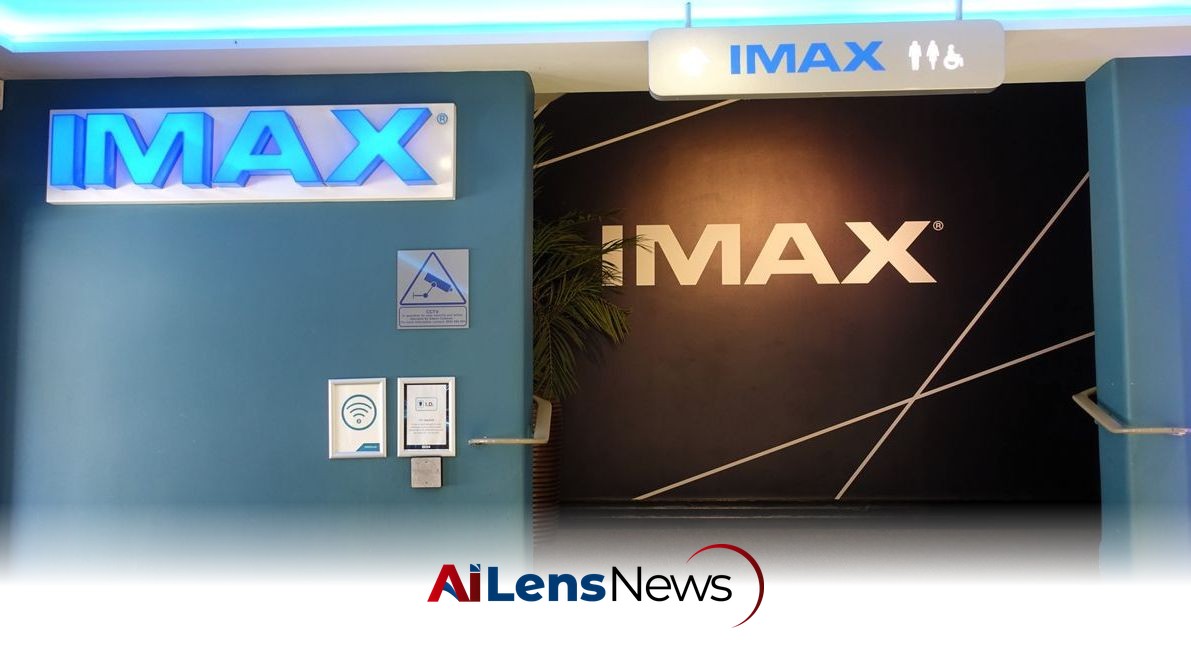


Christopher Nolan's 'The Odyssey' is available in Imax 70mm, but only a few theaters can screen it, leading to high demand and sold-out shows.
Washington DC, United States Jul 25, 2026 ALN: Christopher Nolan’s The Odyssey in Imax 70mm is the hottest club in town, if you can get in.
While Nolan’s adaptation of Homer’s epic is available on thousands of screens around the world, there are only 41—including 25 in the US—that can offer it in full Imax 70mm glory. Many of those are sold out for weeks. Levels of FOMO are off the charts.
That’s partly because The Odyssey is the first feature film shot entirely on Imax film with Imax cameras. For the uninitiated, the Imax film format takes an already large 65-mm film negative and runs it through the camera horizontally, resulting in an image 15 perforations wide compared to the standard 5 perf. When projected on a giant Imax screen, the resulting image, with a squarish aspect ratio of 1.43:1, is enormous and incredibly sharp, creating a far more immersive experience than standard cinema offerings. This is real Imax, according to fans of the format, which was first introduced in 1970.
Imax, though, comes in a variety of flavors: digital formats in 2K and 4K resolutions, xenon and laser light configurations, on top of the classic 15/70-mm. Outside of a select few, most digital Imax theaters crop the image to a wider 1.90:1 aspect ratio and project on screens a good deal smaller than a traditional Imax giant theater.
“This all started in 2008 when Imax introduced its first digital system,” says James Hyder, who managed the Smithsonian Air and Space Museum’s Langley Imax theater in the ’80s, and ran the giant-screen industry journal LF Examiner from 2008 to 2021. Imax did not respond to requests for comment.
The company’s foray into digital exhibition with a 2K-resolution dual-projector system was part of a long-planned shift. Executives wanted to expand beyond museums and science centers and into big theater chains, which didn’t always have the screen real estate the traditional Imax experience demands.
The result, though, has been notably different Imax experiences depending on what type of Imax theater you’re in. Especially as major theater chains have invested in PLF (Premium Large Format) screens that rely on Dolby Vision or other systems, it’s hard to know what you’re going to get, or if Imax is even your best bet.
Complicating things further for The Odyssey is that it’s available in so many premium formats—six, altogether—that the film’s official website includes a guide to their various strengths and aspect ratios. While it disambiguates between 70mm Imax and “regular” Imax, it doesn’t capture the wide range of what those “regular” experiences can entail.
“It's a disservice to their customers, and it's basically trading on a reputation for real giant screens that used to be what Imax stood for,” Hyder says of the lack of clarity and consistency around how Imax is implemented.
Recent years have seen a resurgence in shooting and projecting on film, with Imax 70mm in particular becoming the gold standard. Nolan’s films regularly get Imax 70mm releases on the few screens that can accommodate it, but following the success of Oppenheimer, a string of releases, including Dune: Part Two, Sinners, One Battle After Another, and Project Hail Mary, have followed suit.
While The Odyssey was shot in a 1.43:1 aspect ratio, its images were composed to function just as well when cropped to other ratios, all the way down to the very wide 2.39:1. It was intentionally shot to work across digital, 35-mm, and regular 5-perf/70-mm, all overseen by the director and reflective of his intent. Eventually, it will also be available to buy on Blu-ray or stream online. It’s not unlike the difference between seeing a print or digital image of the Mona Lisa—which most people will in their lifetimes—and actually being lucky enough to see it in person at the Louvre.
Of course, there’s only one Mona Lisa, while there are a few dozen places to see The Odyssey on Imax 70mm. Still, the relative scarcity understandably leaves many wanting more. They may not get it any time soon.
“The problem is they haven’t made new Imax film projectors in about 50 years,” Imax CEO Rich Gelfond told Variety in a recent interview. “So we retrofit them, rebuild them, and part of our strategy is to see how far we can take it. But certainly, demand-driven, I’d like to see more.” Variety also reported that sources at the company say many of the specialized parts needed to build a new Imax film projector “simply no longer exist.”
In truth, Imax was still building new projectors in the late ’90s and early ’00s, and engineers can surely always find ways of machining new parts. But even Hyder agrees the difficulties and costs involved would make such an endeavor unlikely, and even unnecessary given the advances of digital projection. “It's the old chicken-and-egg problem. If you don't have a projector, if you don't have a theater to show it, you can't make the film. If you don't have the film to show in the theater, you can't show it in the theater,” Hyder says.
A 4K laser alternative to the full 1.43:1 experience of Imax 70mm does exist on some old giant Imax screens, and while it has its own advantages, it lacks the sharpness of the film format. To really get to an acceptable digital replacement for the 15/70-mm experience, Hyder speculates 8K projection would be needed, which could be done by tiling multiple 4K projectors across a single screen. “In fact, that’s what planetariums do all the time,” he says, noting that Imax itself has been supplanted by competitors on formerly Imax-branded giant dome screens.
Of course, there are other reasons Imax and exhibitors might not mind the scarcity of theaters that can screen the 15/70-mm format. “One of the reasons this is so popular is because it's rare,” Hyder says.
That said, Hyder is still happy to see so much attention on Imax 70mm, especially since he didn’t expect the format to still be alive in 2026. With good maintenance, the hefty machines could still run for decades more. “The last Imax film projector may still be running in 50 years with prints that are 20 or 50 years old,” he says. “The excitement [Imax film] creates still may not be enough to justify expanding it from the point of view of the financial people, but at least it’s still here.” It just might take a few weeks to snag a ticket.
To learn more about the latest developments in Movies, stay updated with our exclusive reports and analyses on AiLensNews.

