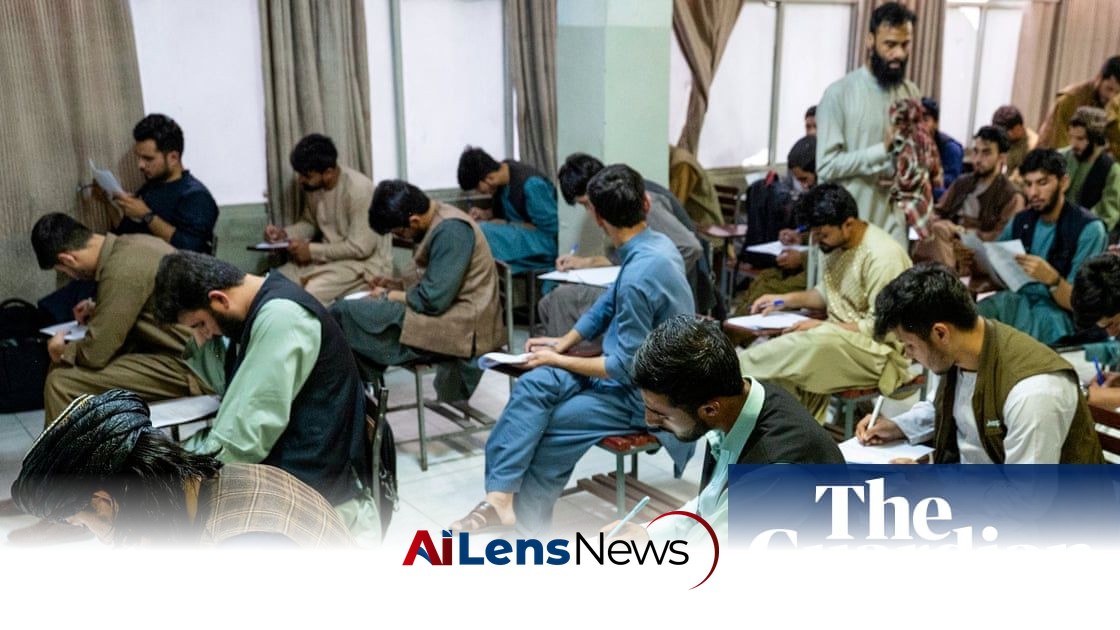


Five years post-Taliban takeover, Afghan male students face strict regulations, inadequate teaching, and a collapsing education system, raising concerns about their future.
London, United Kingdom Jul 13, 2026 ALN: Before he leaves for Kabul University each morning, Hashmat* checks his face for the beard he has been ordered to grow. Male students are required to grow their facial hair and wear traditional Afghan clothes, and those who fall short are punished. Hashmat says he recently saw a classmate beaten for wearing trousers.
“They look at you before they listen to you. If your appearance is wrong, you are already in trouble before the class begins,” he says. This emphasis on outward appearance reflects a broader trend under the Taliban's regime, where strict adherence to their interpretation of Islamic law governs many aspects of daily life, including education.
Five years after the ultra-conservative Islamists of the Taliban retook Afghanistan, students have described a collapsing education system, with women banned, lecturers leaving, and teaching increasingly focused on religious subjects and discipline. The Taliban's return to power in August 2021 marked a significant regression for Afghan education, which had made considerable strides over the previous two decades.
Students are required to attend religious lectures and pray in public every day, sometimes for two hours at a time, says Hashmat. The lectures are about Islam, conduct, and obedience. They are not optional. In some cases, he says, they are held during time that would otherwise be used for regular academic courses. This shift has raised concerns among students regarding the quality and relevance of their education.
“I am missing my actual classes to sit in a lecture about obeying. That is what they [the Taliban] think education is for. Everyone talks about the girls who were banned, but nobody talks about what is happening to the boys who were allowed to stay.” This sentiment highlights a troubling reality: while the focus has largely been on the exclusion of female students from educational institutions, male students are also facing significant challenges in their pursuit of knowledge.
Another student studying in central Afghanistan expressed similar frustrations, noting that the problem is not only weak teaching but also the disappearance of debate and questioning from the classroom. “We are expected to listen, not to question,” says Qader*. “Since the fall of Kabul, the university has lost its purpose. It feels more like a madrassa now — a place where curiosity is banned and remaining silent ordered.” This transformation of the educational environment has stifled intellectual growth, critical thinking, and the ability to engage in meaningful discourse.
Hashmat studies journalism, a subject shaped by digital tools, online platforms, verification, ethics, and technology, but as he listens in class, he says he wonders whether the person teaching the course understands the subject well enough to teach it. “He is teaching us about the modern world while struggling to use PowerPoint in the class. How can you teach journalism technology if you do not understand what technology is?” This situation underscores the disconnect between the educational curriculum and the practical skills needed in today's job market.
Hashmat’s account matches those of more than 20 students interviewed by phone at public and private universities in seven provinces across Afghanistan – Kabul, Kandahar, Helmand, Nangarhar, Bamiyan, Balkh, and Wardak. The testimonies reveal a widespread sentiment of disillusionment among students who once viewed education as a pathway to a better future.
Afghanistan’s higher-education sector contracted sharply between 2019 and 2024, according to Unesco, with female enrollment down to zero by 2024 and male enrollment falling from 310,369 in 2019 to 188,957 in 2024. This dramatic decline in enrollment reflects the broader societal changes and restrictions imposed by the Taliban, which have rendered education less accessible and less appealing to students.
Kabul University still looks like a university from the outside. The buildings are open, male students still attend, exams are held, and degrees are issued. But students say much of what makes it a university has been hollowed out. The vibrancy of academic life that once characterized Kabul University has been replaced by an atmosphere of fear and conformity.
Experienced professors have left the country, stopped teaching, or been pushed aside. And ideologically aligned Taliban lecturers have been hired in their place. In some departments, recent graduates and even undergraduates are teaching. This shift raises serious concerns about the quality of education and the future of Afghanistan's professional landscape.
Hashmat points to one lecturer who, he says, finished his own degree only two years earlier. “Now he is standing in front of us. It is clear he does not know more than we do.” This situation is emblematic of a broader trend towards underqualified teaching staff, which undermines the integrity of the educational system.
Zalmay*, a student in Helmand province, describes a similar decline in the quality of teaching. “Some teachers come to class and only read from old notes,” he says. “When we ask questions, they cannot explain beyond what is written in front of them. We are university students, but sometimes it feels like we are back in high school.” This regression in educational standards is deeply concerning, as it signals a departure from the critical and analytical skills that higher education is supposed to foster.
A former Kabul University professor, who has requested anonymity because he fears retaliation, confirms the students’ accounts and says the loss of qualified lecturers has weakened universities that are still expected to produce graduates. The exodus of experienced educators has created a vacuum that has yet to be filled, leading to a decline in the overall quality of education.
Nearly all those who have spoken to the Guardian describe some version of the same crisis: weak teaching, underqualified lecturers, mandatory religious lectures, pressure over appearance, and a growing belief that education no longer leads to work. This collective disillusionment among students reflects the profound impact of the Taliban's policies on the educational landscape.
Kabul University once meant something very different. For generations, it trained Afghanistan’s doctors, engineers, journalists, civil servants, and political leaders. To be admitted there was a source of pride for a family. It meant a brighter future was possible. The university served as a beacon of hope and opportunity for many, fostering a diverse and dynamic academic community.
After the fall of Kabul, Hashmat says two of his younger brothers dropped out of school. They no longer believe education would help them find jobs or build a future. For years, school was presented as the safest path forward: study, graduate, work, support the family. Since the Taliban takeover, that promise no longer seems real. This disillusionment extends beyond individual students; it represents a broader societal shift away from the value of education in a country grappling with political and economic instability.
“They do not believe education will help them anymore. I am reaching the same conclusion and find it hard to attend classes.” This sentiment encapsulates the growing frustration and hopelessness felt by many students who once aspired to achieve their dreams through education.
Even on campus, Hashmat says, journalism students feel hostility. They are studying an occupation that has been restricted, lost professionals, and treated with suspicion. Many independent news outlets have closed. He says he and his classmates have been called shaitan (Satan) by their teachers. This hostility reflects the broader climate of fear and repression that journalists face in Afghanistan, where the freedom of expression has been severely curtailed.
“We are studying journalism in a country where journalism barely exists. What are we being trained for?” he asks. This question resonates deeply with students who find themselves in a paradoxical situation: they are pursuing a degree in a field that is increasingly marginalized and dangerous.
The question has worn down many of his classmates. Some still attend because their families expect them to; some come because a degree, even a weakened one, still carries social status. However, the underlying disillusionment is palpable. Many students are caught in a cycle of attending classes without any real hope for a future.
But Hashmat says many fellow students no longer believe in what they are doing. “They come because their families want them to. But inside, they have already given up.” This resignation highlights the emotional toll that the current educational climate is taking on students, who are grappling with uncertainty about their futures.
“I keep going because I do not know what else to do. But every day it gets harder to believe it means something,” he says. “The Taliban war on the battlefields has stopped, but their war on education continues in silence.” This poignant statement underscores the ongoing struggle for Afghan students who are navigating an education system fraught with challenges and limitations.
* Names have been changed to protect their identities
To learn more about the latest developments in Higher Education, stay updated with our exclusive reports and analyses on AiLensNews.

