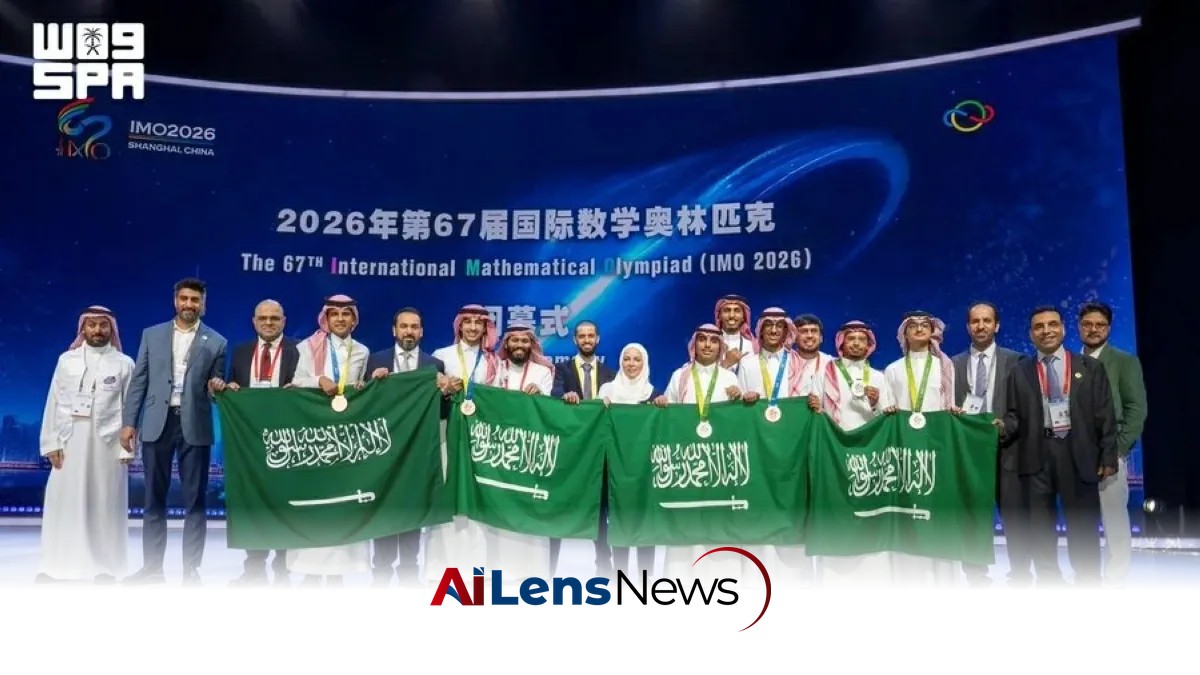


The Saudi Math Team won six medals at the International Mathematical Olympiad, marking the Kingdom's best performance and raising its total to 88 international awards.
Riyadh, Saudi Arabia Jul 21, 2026 ALN: The Saudi Math Team delivered its best-ever performance at the International Mathematical Olympiad (IMO), winning six medals and raising the Kingdom's total tally to 88 international awards. This remarkable achievement not only highlights the individual talents of the students but also underscores the growing emphasis on mathematics and science education in Saudi Arabia.
At the 67th International Mathematical Olympiad (IMO 2026), held in Shanghai, China, the team won three silver and three bronze medals in a competition that brought together 666 students from 117 countries. The diversity of participants and the high level of competition make the IMO one of the most challenging platforms for young mathematicians globally. The IMO has a long-standing reputation for being a rigorous test of mathematical prowess, often requiring not just knowledge but also creativity and critical thinking skills to solve complex problems.
The Saudi team's success is attributed to the hard work and dedication of its members, along with the comprehensive training programs designed to foster mathematical talent. Yousef Ayman Bakhit of the Royal Commission Education in Yanbu, Abdulsalam Abdullah Al-Sulami of the Madinah General Directorate of Education, and Abdulilah Mohammed Al-Saqqaf of the Jeddah General Directorate of Education each earned a silver medal, showcasing their exceptional problem-solving skills and creativity in mathematics. Their achievements are a testament to their commitment and perseverance, as well as the support they received from their educators and mentors.
Bronze medals were awarded to Elias Shaker Al-Faraj, Abdullah Tariq Al-Amer of the Eastern Province General Directorate of Education, and Faris Mohammed Al-Kunhail of the Riyadh General Directorate of Education. These achievements reflect not only their individual capabilities but also the effectiveness of the training and educational systems in place, which have evolved significantly in recent years. The focus on mathematics and science education in Saudi Arabia has been a strategic decision to prepare the youth for future challenges and opportunities in a globalized world.
The achievement follows a year-long training and qualification program supervised by the King Abdulaziz and His Companions Foundation for Giftedness and Creativity (Mawhiba) in partnership with the Ministry of Education under the Mawhiba International Olympiads Program. This initiative aims to identify and nurture gifted students in various fields, particularly in mathematics and science, which are critical for the Kingdom's vision of economic diversification and technological advancement. By investing in the education of gifted students, Saudi Arabia is taking proactive steps to ensure that its youth are equipped with the skills necessary to thrive in a competitive global environment.
The Mawhiba program combines theoretical and practical instruction with domestic and international training camps to strengthen students' mathematical skills and prepare them to compete at the highest international level. The rigorous training regimen includes advanced problem-solving techniques, exposure to complex mathematical concepts, and competitive simulations that mimic the pressures of the Olympiad environment. This multifaceted approach has proven effective in honing the students' abilities and boosting their confidence as they prepare for international competitions.
First held in Romania in 1959, the International Mathematical Olympiad is the world's oldest and most prestigious mathematics competition for secondary school students. Each year, it challenges the brightest young minds to tackle a series of complex problems that require not only knowledge of mathematics but also ingenuity and creativity. The IMO serves as a platform for students to showcase their talents on an international stage, fostering a spirit of collaboration and camaraderie among participants from different countries. This competition not only highlights individual achievements but also promotes a sense of global community among young mathematicians.
The significance of the Saudi team's success extends beyond the medals won. It reflects the Kingdom's commitment to enhancing educational standards and promoting STEM (Science, Technology, Engineering, and Mathematics) fields among the youth. This focus aligns with Saudi Arabia's Vision 2030, a strategic framework aimed at reducing the country's dependence on oil, diversifying its economy, and developing public service sectors such as education and health. By prioritizing STEM education, Saudi Arabia is positioning itself to be a leader in innovation and technology in the coming decades.
In recent years, there has been a noticeable increase in investment in education and training programs designed to equip students with the skills necessary for success in a rapidly changing global economy. The results at the IMO are a testament to the effectiveness of these initiatives and the potential of Saudi youth to excel in competitive global arenas. The Kingdom's emphasis on educational reform has included curriculum enhancements, teacher training, and the establishment of specialized schools focused on STEM disciplines.
The recognition and support for gifted students in mathematics and science are crucial not only for individual development but also for the overall advancement of the country. By nurturing talent and providing opportunities for students to excel, Saudi Arabia aims to create a generation of innovators and leaders capable of driving future advancements in technology and science. The success of the Saudi Math Team serves as an inspiration for other students, demonstrating that hard work and dedication can lead to remarkable achievements.
Moreover, the success of the Saudi Math Team can inspire a new wave of interest in mathematics among students across the Kingdom. As more young people become aware of the possibilities that arise from excelling in mathematics, it may lead to increased participation in math-related extracurricular activities, clubs, and competitions. This grassroots interest can further enhance the educational landscape and cultivate a culture of excellence in mathematics. Schools and communities may begin to foster environments that celebrate mathematical achievements, encouraging students to engage more deeply with the subject.
As the Kingdom celebrates this achievement, it is essential to recognize the role of educators, mentors, and families in supporting these young mathematicians. The collaborative efforts of teachers and educational institutions in fostering a conducive learning environment have been instrumental in shaping the skills and confidence of these students. The encouragement and support from families also play a vital role in motivating students to pursue their passions and strive for excellence. The involvement of parents and guardians can significantly impact a student's educational journey, reinforcing the importance of perseverance and hard work.
In conclusion, the Saudi Math Team's historic success at the International Mathematical Olympiad is a significant milestone that reflects the dedication of the students, the effectiveness of the training programs, and the broader educational reforms taking place in Saudi Arabia. As the Kingdom continues to invest in its youth and prioritize education, the future looks promising for aspiring mathematicians and scientists who will contribute to the nation's growth and development in the years to come. This achievement not only enhances Saudi Arabia's reputation on the global stage but also sets a precedent for future generations, encouraging them to pursue their academic and professional aspirations in STEM fields.
To learn more about the latest developments in Education News, stay updated with our exclusive reports and analyses on AiLensNews.

