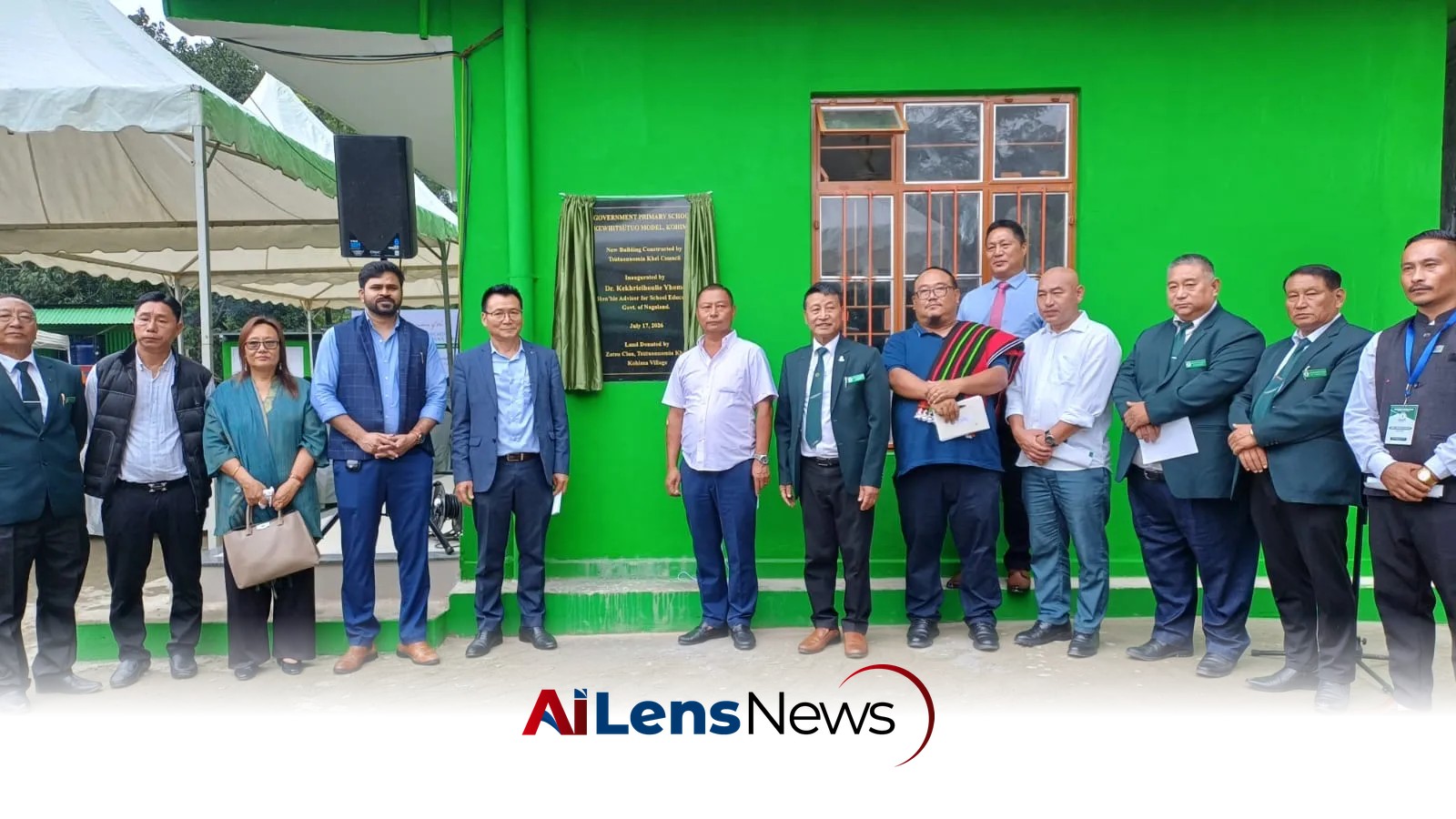


Dr. Kekhrielhoulie Yhome praises the local community's commitment to education during the inauguration of a new primary school in Kohima.
Kohima, India Jul 18, 2026 ALN: In a significant event for the local community, the newly constructed Government Primary School building at Kewhitsütuo Model, Kohima, was inaugurated on July 17. Dr. Kekhrielhoulie Yhome, advisor for School Education and SCERT, commended the community for their initiative in enhancing public education. This inauguration marks a pivotal moment not only for the immediate area but also for the broader educational landscape in Kohima, showcasing the power of community engagement in public service.
The establishment of the Government Primary School is a reflection of a growing trend in various parts of India, where local communities take the initiative to improve educational facilities, often filling gaps left by governmental efforts. In this case, Dr. Yhome highlighted that the school building was entirely constructed by the local community, showcasing their dedication to improving government education. He remarked, “We have only come here to witness what you have all accomplished,” praising the community for taking proactive steps without waiting for government intervention. This proactive approach has implications for how educational infrastructure can be developed in underserved areas, especially in regions where governmental resources may be limited.
Dr. Yhome emphasized the importance of Kewhitsütuo as a key area for the future expansion of Kohima Village under Tsütuonuomia Khel (T.Khel). Kohima, the capital of , has been experiencing rapid urbanization, which has significantly altered its landscape and demographics. He noted that the village has significantly contributed to the city’s growth by providing land for public infrastructure and development. However, he also cautioned that rapid urbanization is putting increasing pressure on village land resources. The balance between development and preservation of community resources remains a critical issue that local leaders must navigate.
In his address, Dr. Yhome praised the foresight of Tsütuonuomia elders for reserving land for educational purposes, describing it as an investment for future generations. This sentiment reflects a broader understanding of education as a fundamental pillar for community development and empowerment. Drawing a parallel between places of worship and schools, Dr. Yhome stated that while churches nurture faith, schools serve as “temples of education” that liberate society through learning. This analogy underscores the vital role that education plays in shaping not only individual lives but also the collective future of communities.
Currently, the Government Primary School has 67 students—32 boys and 35 girls—managed by eight teachers under the leadership of the head teacher. Dr. Yhome also acknowledged the School Management Committee for its role in guiding the institution’s development. The involvement of local governance structures in educational management is crucial, as it fosters a sense of ownership and accountability among community members. This model of governance is essential for ensuring that schools meet the specific needs of their communities.
In a comparison to the Corporate Social Responsibility (CSR) model, he noted that tribal communities embody a similar spirit through what he termed “Community Support Resources.” This concept emphasizes the commitment of local communities to support their own development initiatives, particularly in education. He praised the generosity of Tsütuonuomia Khel, stating that their contributions demonstrate how local institutions can actively promote public welfare and educational development. Such community-driven initiatives can serve as a model for other regions, highlighting the potential of grassroots movements to effect change.
Furthermore, Dr. Yhome informed that the School Education Department has started documenting such community-led initiatives to encourage similar efforts across the state. This documentation serves not only as a record of achievements but also as a source of inspiration for other communities looking to enhance their educational facilities. He expressed optimism that the school could eventually be upgraded to a composite school, considering the area’s strategic location and anticipated population growth. This potential upgrade reflects the community's aspirations for sustained educational development and improved access to quality education.
During the keynote address, K. Neibou Sekhose, chairman of T. Khel Council, described the inauguration as an exciting chapter in Tsütuonuomia’s history. He mentioned that the new school building, funded entirely by the T. Khel Council, fulfills a vision conceived in the late 1970s, reflecting the community’s commitment to prioritizing education. This long-term vision illustrates the importance of sustained community effort and planning in achieving educational goals.
Plans are already underway for a higher secondary school and an international-standard stadium to enhance sports infrastructure. This ambition highlights the community's holistic approach to development, recognizing the importance of both academic and extracurricular activities in fostering well-rounded individuals. Sekhose also acknowledged the launch of a sanitation vehicle funded by the Tsütuonuomia Council, symbolizing dignity, public health, and community pride, serving over 800 residents across 250 households. This initiative is a crucial step toward improving public health standards and sanitation practices in the area, which are essential for the overall well-being of the community.
KMC chairman Neibodzelie Solo emphasized the importance of proper waste management for the growing locality, urging residents to adopt responsible disposal practices. This call to action is particularly relevant in light of Kohima's rapid urbanization, which can lead to increased waste generation and environmental challenges. He also called on the public to actively participate in the Census 2027 exercise, stressing the significance of accurate population data for future planning. Accurate census data is vital for informed decision-making and resource allocation, which can directly impact the quality of education and public services in the community.
The program commenced with an invocation by Rev. Atuo Whuorie, pastor of Baptist Mission Church. A welcome address was delivered by Er. Kelhousinyü Solo, chairman of Kewhitsütuo Model, and students of the school presented a special song, showcasing the talents and enthusiasm of the young learners. The event was compered by Kiyakhrienuo Solo and Visasielie Suohu, who ensured that the proceedings ran smoothly. The participation of various stakeholders, including religious leaders, local governance representatives, and community members, illustrates the collaborative spirit that underpins this initiative and highlights the importance of collective effort in achieving educational advancements.
To learn more about the latest developments in Education News, stay updated with our exclusive reports and analyses on AiLensNews.

