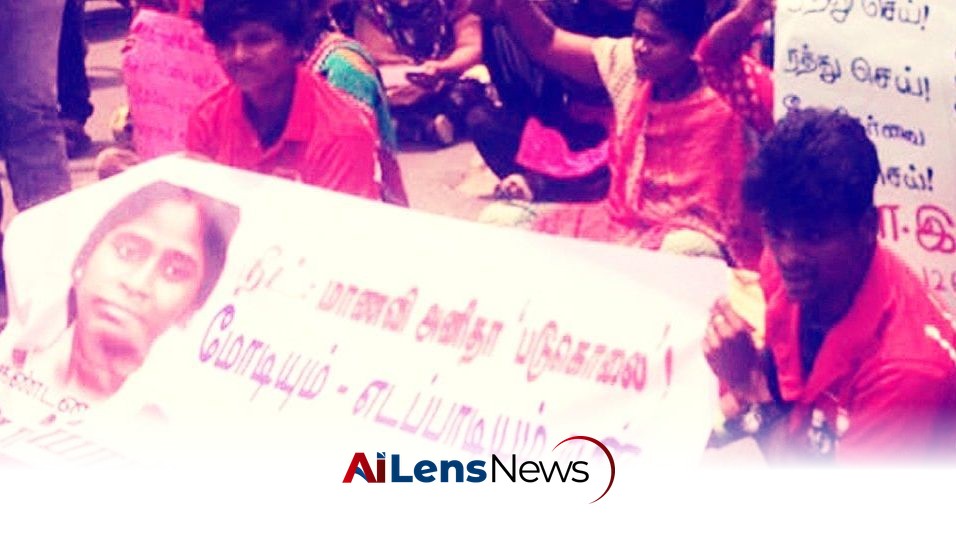


S. Manirathnam, brother of S. Anitha, the first NEET victim, protests in Delhi, calling for a ban on the exam that he claims destroyed his family.
New Delhi, India Jul 24, 2026 ALN: Standing amidst the sea of angry demonstrators and slogans echoing through Jantar Mantar, S. Manirathnam carried the quiet gravity of a family whose life was altered forever by India's medical entrance examination system.
The brother of S. Anitha, a 17-year-old Dalit student whose death by suicide nine years ago turned her into the enduring face of Tamil Nadu’s fight against the National Eligibility-cum-Entrance Test (NEET), traveled from Ariyalur to the national capital to join the student protest and align his sister's memory with the growing nationwide agitation against examination irregularities and systemic problems in the education system.
“NEET has destroyed my family,” Manirathnam told The Quint at the protest site. “Anitha wanted to become a doctor because she had seen the suffering caused by the lack of medical care after our mother passed away. She did not prepare specifically for NEET, she focused on her state board exams. One small mistake in this system affects 25 lakh people's dreams.”
The ongoing demonstrations at Jantar Mantar, led by the Cockroach Janta Party (CJP), were sparked by the fallout of the 2026 NEET-UG paper leak controversy. The cancellation of the initial exam and subsequent administrative delays threw over two million aspirants into turmoil. The emotional toll has been devastating, with multiple alleged student suicides reported across several states in the wake of the exam cancellation and re-test uncertainty, transforming what began as an administrative grievance into a national crisis over student welfare.
Protesters in New Delhi are demanding the resignation of Union Education Minister Dharmendra Pradhan, accountability from the National Testing Agency (NTA), compensation for the families of those students who died by suicide, and a complete structural overhaul of competitive examinations.
The current outcry reopens deep historical wounds over the imposition of NEET across India. Implemented nationwide to create a unified medical entrance mechanism, the single-window exam faced immediate and fierce resistance, particularly in southern states like Tamil Nadu. Critics and state lawmakers argued that a standardised exam based predominantly on the central CBSE curriculum systematically disadvantaged rural, state-board, and economically underprivileged students who could not afford expensive private coaching centres. For Tamil Nadu, where medical admissions had historically been granted based on Class 12 state board merit, the shift was seen as an encroachment on state autonomy and an equitable education framework.
No case illustrated this systemic gap more starkly than that of S. Anitha. A high-achieving Dalit student from Ariyalur district raised by her father, a daily-wage laborer, after her mother died when she was just seven years old, Anitha scored 1,176 out of 1,200 marks in her Class 12 state board examinations in 2017. Her medical cut-off score was 196.75 out of 200; marks that would have comfortably secured her a medical seat under Tamil Nadu's earlier admission system.
However, unable to secure a seat through the newly mandated NEET cutoff, she spearheaded the legal fight against the exam, traveling to the Supreme Court as a petitioner to seek an exemption for Tamil Nadu students. Days after the apex court dismissed the state's plea, on September 1, 2017, 17-year-old Anitha died by suicide, sparking widespread protests across South India and establishing her as the first victim of the exam's mandatory enforcement in the state.
Recalling the tragedy, Manirathnam spoke of the void left in their household. “Anitha was the only girl in my house. My mother passed away when Anitha was just seven years old, and my father worked in Trichy Gandhi Market. Anitha scored 1,176 out of 1,200, her marks were enough to get into a top medical college in Tamil Nadu under the state board system. But when the Union Government imposed NEET, she protested in the street and filed a case in the Supreme Court. The court didn't give her justice.”
Addressing the recent allegations of paper leaks and centre allocation flaws, he added, “Paper leaks, impersonation, centre allocation issues, repeaters, it is a full-and-full failure model. Resignation of Dharmendra Pradhan is just step one. That is not enough. We want NEET to be banned and exemptions granted because NEET is against marginalised people, village-level students, and economically weaker sections.”
What began at Jantar Mantar as a localized protest against paper leaks and alleged failures of the education system has now catalyzed broader demonstrations in Tamil Nadu, West Bengal, Uttar Pradesh, and Maharashtra. Students, activists, and political parties across multiple states are increasingly uniting against what they describe as systemic flaws in the national education framework.
The NEET examination was introduced in 2013 as a means to standardize the process of medical admissions across India. It aimed to address the disparities in medical education and ensure that students from various backgrounds had equal opportunities to pursue careers in medicine. However, the implementation of NEET has been contentious, with numerous debates surrounding its fairness and accessibility. Many argue that the exam favors students from urban areas who have access to better educational resources, while those from rural or economically disadvantaged backgrounds struggle to compete.
In Tamil Nadu, the resistance to NEET has been particularly pronounced. The state had a long-standing tradition of conducting its own medical entrance examinations based on state board syllabi, which many felt were more aligned with the educational backgrounds of its students. The introduction of NEET was perceived as an attempt by the central government to impose a uniform standard that did not consider the unique educational landscape of Tamil Nadu.
Manirathnam's participation in the protests is emblematic of the ongoing struggle faced by many families who have been affected by the stringent requirements of NEET. His sister's tragic story serves as a poignant reminder of the stakes involved in the debate over medical entrance examinations. The emotional weight of Anitha's story continues to resonate with many, fueling the protests and calls for reform.
In addition to the demands for the resignation of the education minister and the accountability of the NTA, protestors are also advocating for a re-evaluation of the entire examination process. They argue that the current system places undue pressure on students, leading to mental health crises and, in some cases, tragic outcomes. The recent spate of suicides linked to the exam has heightened concerns about the psychological toll on students, prompting calls for a more compassionate approach to education and assessment.
The protests have garnered attention not only from local media but also from national outlets, highlighting the urgency of the situation. As the demonstrations continue to grow, there is a palpable sense of solidarity among students and families who feel marginalized by the existing educational framework. The movement is not just about NEET; it is about advocating for a more equitable education system that prioritizes the well-being of all students, regardless of their background.
The implications of these protests extend beyond the immediate demands for NEET's abolition and the accountability of educational authorities. They raise fundamental questions about the nature of education in India, the accessibility of higher education, and the responsibility of the state to provide a fair and just system for all students. As the movement gains momentum, it is likely to influence policy discussions and shape the future of medical education in India.
Ultimately, the protests at Jantar Mantar represent a critical juncture in the ongoing struggle for educational equity in India. As the voices of students and families continue to rise in unison, they challenge the status quo and call for a reimagining of what education should look like in a diverse and democratic society. The fight for justice for S. Anitha and countless others like her is far from over, and the outcome of these protests may have lasting effects on the landscape of medical education in India for years to come.
To learn more about the latest developments in Education News, stay updated with our exclusive reports and analyses on AiLensNews.

