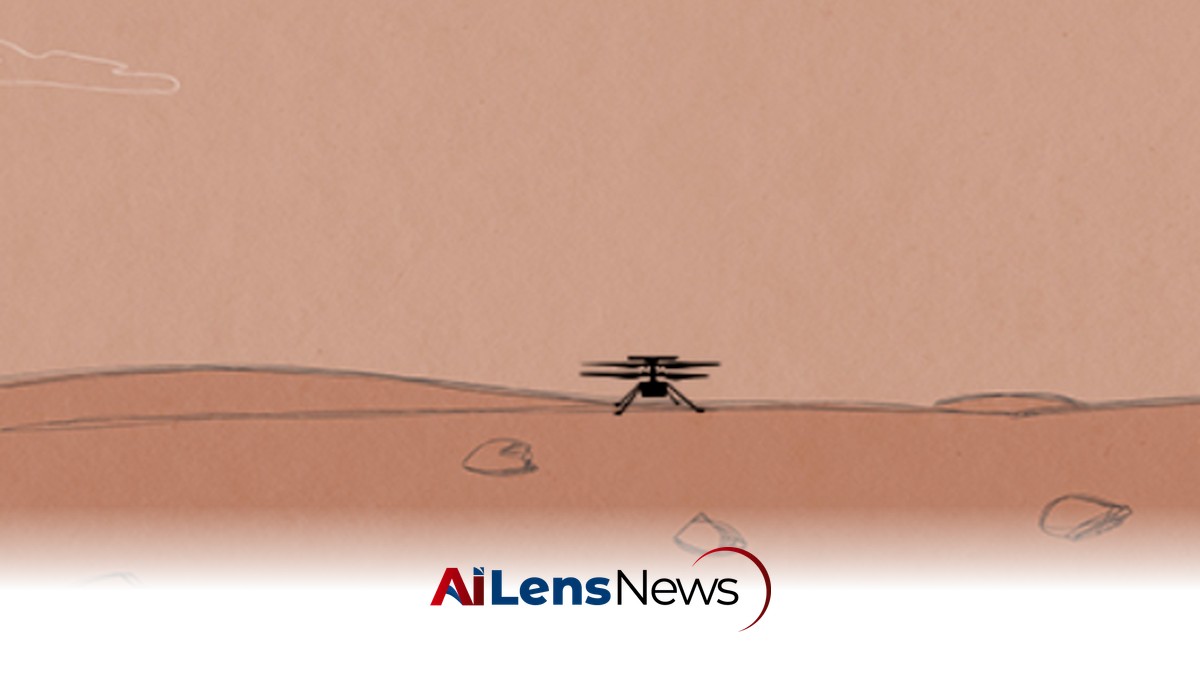


NASA introduces a fun coding activity for children, allowing them to create a video game featuring the Ingenuity helicopter exploring Mars using Scratch.
New Delhi, India Apr 12, 2021 ALN: NASA’s Ingenuity helicopter, which is set to take its first test flight on April 14, will mark a historic milestone as the first powered flight on another planet. This achievement represents a significant leap in our understanding of aerial exploration in extraterrestrial environments. The Ingenuity helicopter is designed to demonstrate the feasibility of powered flight in the thin Martian atmosphere, which has only about 1% of the density of Earth’s atmosphere. This flight is not merely a technological demonstration; it is a precursor to future missions that may involve aerial vehicles exploring other planets and moons, where traditional rovers may not be able to navigate effectively.
To celebrate this groundbreaking achievement, the space agency has launched a new activity in its Learning Space, enabling children to "code a Mars helicopter video game." This initiative is part of NASA's broader educational outreach efforts aimed at inspiring the next generation of scientists, engineers, and explorers. By engaging children in hands-on activities that blend coding, creativity, and science, NASA hopes to foster interest in STEM (science, technology, engineering, and mathematics) fields.
The Ingenuity helicopter is not simply a technological marvel; it represents years of research and development, culminating in a project that could redefine how we approach exploration on other planets. Its design incorporates lightweight materials and advanced engineering techniques to ensure it can navigate the harsh conditions of Mars. The helicopter weighs approximately 1.8 kilograms (4 pounds) and is equipped with two counter-rotating blades that spin at about 2400 revolutions per minute, significantly faster than helicopter blades on Earth due to the thin atmosphere. This innovative design allows Ingenuity to generate enough lift to ascend and maneuver in an environment that is vastly different from our own.
In this engaging project, children will utilize the visual programming language Scratch to design their own game. Scratch is a widely used platform developed by the MIT Media Lab that allows users to create interactive stories, games, and animations through a simple drag-and-drop interface. The platform is particularly effective for educational purposes, as it encourages problem-solving and logical thinking while providing a fun environment for learning coding basics. Participants will need a computer with internet access, along with Mars surface images and a Mars helicopter sprite image, both available on a dedicated NASA education page. A Scratch account is optional but recommended to enhance the development experience, allowing young coders to save their projects and share them with others.
“Create a video game that lets players explore the Red Planet with a helicopter like the one going to Mars with NASA's Perseverance rover,” the space agency stated in a web post. This call to action not only invites creativity but also serves as a bridge to understanding the complexities of Mars exploration. Children will learn about the challenges faced by engineers and scientists when designing vehicles that can operate on another planet, including considerations for gravity, atmosphere, and terrain. This hands-on approach encourages children to think critically about the engineering challenges involved in space missions.
After downloading the necessary images, children can initiate a new project on the Scratch website and follow detailed instructions to make the helicopter fly. They will learn to add a take-off location, a landing site, a countdown timer, and ultimately, create code that announces a successful mission. An instructional video is also available on YouTube for additional guidance, ensuring that participants have access to resources that can help them navigate the coding process. This multimedia approach caters to various learning styles, allowing visual learners to benefit from video tutorials while kinesthetic learners can engage directly with the coding interface.
“Success for game players can be the same as success for the Mars helicopter mission,” explained Lyle Tavernier, an educational technology specialist at NASA's Jet Propulsion Laboratory, in the instructional video. “Mission success will be achieved when the helicopter makes its first controlled flight on Mars, so develop code blocks that announce mission success when the game player successfully flies and lands the helicopter on the target.” This parallel between gaming success and real-world scientific achievement reinforces the idea that learning can be both fun and meaningful, linking the digital world to tangible accomplishments in space exploration.
The Ingenuity helicopter “hitched a ride” to the red planet aboard NASA’s Perseverance rover, which launched on July 30 and landed on Mars on February 18. The Perseverance rover is part of a larger mission aimed at searching for signs of ancient life and collecting samples for future return to Earth. The collaboration between the rover and the helicopter is a testament to the innovative spirit of NASA and its commitment to pushing the boundaries of exploration. While Perseverance is equipped to conduct scientific experiments and analyze the Martian landscape, Ingenuity serves as a technology demonstrator, testing new capabilities that could pave the way for future aerial missions.
The implications of successful powered flight on Mars extend beyond the immediate mission. If Ingenuity's flights prove successful, it could revolutionize how we explore other planets. Aerial drones could provide new perspectives on planetary surfaces, allowing scientists to gather data from locations that are difficult to reach by rover. This could lead to more comprehensive studies of planetary geology, climate, and potential biosignatures. Moreover, the lessons learned from operating a helicopter on Mars could inform the design of aerial vehicles for other celestial bodies, such as Titan, Saturn's largest moon, which has a dense atmosphere and lakes of liquid methane. The success of such missions could expand our understanding of the solar system and the potential for life beyond Earth.
In conclusion, NASA's initiative to allow children to code their own Mars helicopter video game not only celebrates a significant milestone in space exploration but also serves as an educational tool that inspires curiosity and innovation among young learners. As children engage with the concepts of coding and robotics through the lens of space exploration, they are encouraged to think critically and creatively about the future of science and technology. The Ingenuity helicopter's mission, along with educational projects like this one, embodies the spirit of exploration and discovery that continues to drive humanity's quest to understand the universe. This initiative not only fosters a love for STEM but also prepares the next generation for the challenges and opportunities that lie ahead in the field of space exploration.
To learn more about the latest developments in Education News, stay updated with our exclusive reports and analyses on AiLensNews.

