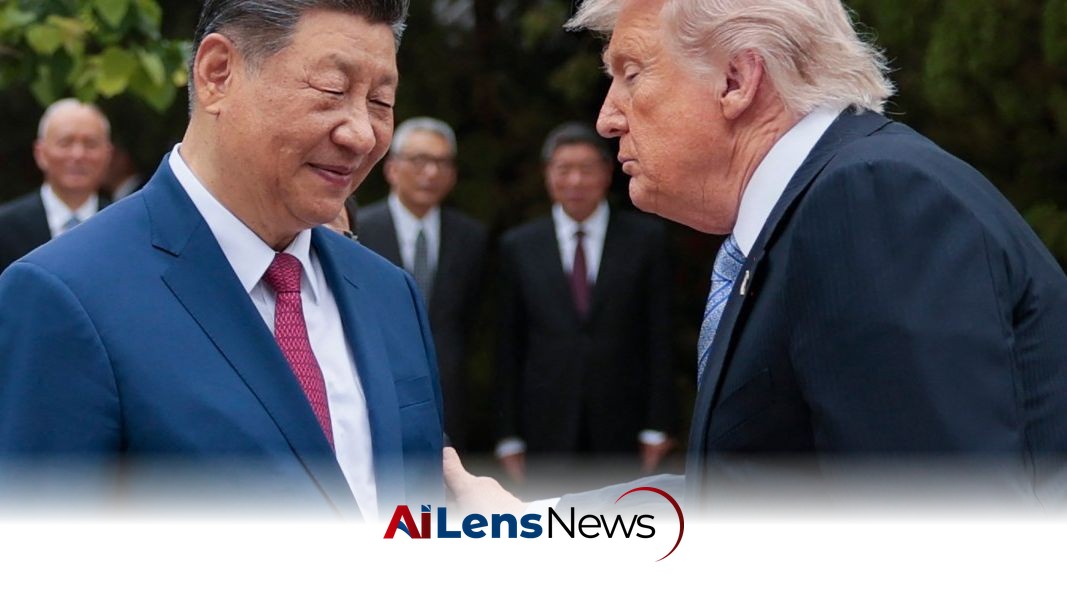


A new EY-Parthenon analysis reveals that the U.S. would need to invest $13.7 trillion to effectively reduce reliance on China, highlighting the challenges of decoupling.
Washington DC, United States Jul 16, 2026 ALN: As the Trump administration intensifies efforts to reduce reliance on China, a new report by EY-Parthenon has revealed that the financial cost of decoupling from the Chinese economy could reach an astonishing $14 trillion for the United States alone. This figure highlights the significant economic implications of moving away from a country that has become deeply integrated into global supply chains, particularly in sectors critical to modern economies.
The EY-Parthenon analysis suggests that the combined investment required for the U.S., Eurozone, and the UK to effectively sever ties with China in key industries would amount to approximately $23.6 trillion over the next 25 years. This staggering figure underscores the complexities and challenges associated with such a monumental shift in trade and economic policy. The U.S. would need to invest $13.7 trillion, which represents more than half of the total projected investment required. This investment would encompass a range of areas, including infrastructure development, research and development enhancements, manufacturing capabilities, software improvements, transportation networks, and workforce training.
President Donald Trump has taken significant steps to limit U.S. reliance on China, including imposing a 10% import tax under Section 122, which is set to expire soon. Additionally, tariffs ranging from 7.5% to 100% have been implemented under Section 301, targeting alleged unfair trade practices, such as forced labor. These tariffs are part of a broader strategy that includes initiatives from previous administrations aimed at boosting domestic manufacturing. For instance, former President Joe Biden's CHIPS Act was designed to revitalize America's semiconductor industry, which is crucial for various technological advancements.
Despite these efforts, the U.S. remains heavily reliant on China for numerous goods. According to data from the United Nations Comtrade database, the U.S. accounted for 14% of all Chinese exports. While this percentage has decreased from 20% in 2017, the reliance on Chinese imports remains significant, particularly in sectors like consumer electronics. In 2024, the U.S. imported 45% of its smartphone and telephone equipment, valued at $51.5 billion, and 76% of its toys, worth $14.4 billion, from China. Furthermore, recent customs data from China indicates that export growth accelerated by 27% year-over-year, highlighting China's ongoing role as a key player in global trade.
Mats Persson, the EY-Parthenon UK macro and geostrategy leader, emphasized the challenges of adopting a protectionist stance in an increasingly globalized world. He noted that while localization efforts—such as the U.S. push for domestic manufacturing and export bans on specific technologies—can enhance economic independence, they often come at the cost of economic expansion. The cheaper labor and manufacturing costs associated with importing goods from overseas have historically fueled growth, and the current geopolitical climate has intensified the need to balance these competing interests.
Persson pointed out that the dynamic between localization and globalization has existed for centuries, but the urgency of addressing these issues has become more pronounced in recent years. The COVID-19 pandemic and rising geopolitical tensions have further complicated this balance, leading to a reevaluation of global supply chains and dependencies.
The push for localization in both the U.S. and Europe faces significant hurdles. The cost of manufacturing certain components in the West is substantially higher—between 20% to 100% more—than in China, primarily due to the scale of production and the density of supply chains in the Asian nation. As a result, any attempt to establish independent supply chains would likely lead to heightened inflation, potentially increasing prices by 1% to 2% across the board.
To manage these elevated prices, Persson suggests that the U.S. would need to implement measures akin to the Inflation Reduction Act on an annual basis. This landmark legislation authorized approximately $891 billion in investments aimed at clean energy production, lowering prescription drug prices, and addressing the federal deficit. In Europe, the financial implications of such supply-chain and infrastructure changes could necessitate a doubling of the EU budget, a prospect that raises questions about fiscal sustainability and political feasibility.
Persson expressed skepticism about the likelihood of achieving the necessary levels of investment to facilitate a full decoupling from China. However, he noted that there are still realistic pathways for localization. The U.S. is uniquely positioned compared to Europe due to its robust capital markets, the strength of the U.S. dollar as the global reserve currency, and greater energy independence. Nevertheless, the U.S. remains dependent on China for critical resources, such as essential minerals, which can limit the independence of its semiconductor supply chains.
Moreover, the U.S. faces a skills gap in manufacturing, a legacy of decades of offshoring. According to projections from Deloitte and The Manufacturing Institute, approximately 2.1 million manufacturing jobs may go unfilled by 2030 due to this skills gap. Addressing this issue will be crucial for enhancing manufacturing productivity and ensuring that the U.S. can compete effectively in a globalized economy.
Beyond the U.S. and Europe, external factors complicate the landscape. China has implemented long-term industrial policies that have made its manufacturing processes incredibly efficient. While China may not be as nimble as the U.S. or EU, its experience in making policy decisions based on long-term cycles provides it with a strategic advantage. The EU, in particular, grapples with the challenge of balancing the diverse democracies and policies of its 27-member coalition, further complicating efforts to implement cohesive trade strategies.
The global economic landscape has undergone significant shifts in recent years, and the dynamics of globalization have evolved. The exclusion of Russia from the G8 in 2014 following its annexation of Crimea serves as a historical example of how geopolitical tensions can reshape trade relationships. In the wake of Russia's invasion of Ukraine, the West has further distanced itself from Russia, leading to closer trade partnerships between Russia, China, and India. These developments illustrate that the ability to adapt to changing trade dynamics is not always within a country's control.
Persson concluded that the future of globalization is likely to be complex and non-linear. It is challenging to envision a return to the previous levels of globalization within the next few decades, and while the current trends may not signal the end of globalization, they underscore the necessity of navigating a more intricate and multifaceted global economic landscape.
To learn more about the latest developments in Economic Reports, stay updated with our exclusive reports and analyses on AiLensNews.

