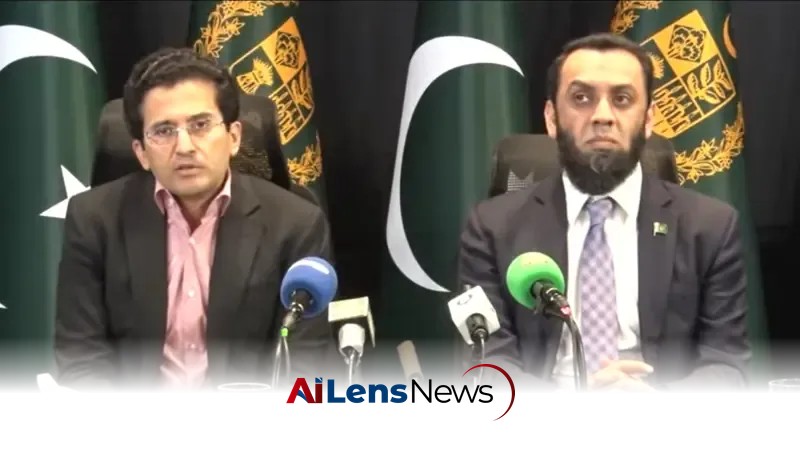


Petroleum Minister Ali Pervaiz Malik announces daily fuel price adjustments due to international market fluctuations amid escalating US-Iran tensions.
Islamabad, Pakistan Jul 17, 2026 ALN: Petroleum Minister Ali Pervaiz Malik on Friday announced that fuel prices in Pakistan would now be fixed on a daily basis due to fluctuations in international market prices following renewed hostilities between Iran and the US.
The government had previously announced weekly revisions to fuel prices since early March, alongside measures for fuel conservation amid potential oil supply disruptions due to the ongoing conflict in the Middle East. In April, the federal government also introduced targeted relief measures to provide subsidized fuel.
During a press conference alongside Information Minister Attaullah Tarar, Malik expressed gratitude to the nation on behalf of the government, acknowledging the public's patience in bearing the burden of the ongoing conflict.
He noted that despite the efforts of Chief of Defence Forces (CDF) and Chief of the Army Staff Field Marshal Asim Munir and Prime Minister Shehbaz Sharif, the US-Iran war appeared to be escalating in the region.
The petroleum minister stated that the cabinet and the prime minister had decided to assign the Oil and Gas Regulatory Authority (Ogra) the responsibility of determining fuel prices daily based on international market trends.
Malik emphasized that Ogra would not only publish the fuel rates on its website but also disclose the factors contributing to the prices seen at petrol pumps.
While acknowledging that this decision would likely add to the burden on citizens, he expressed confidence that the public would understand its necessity. He stated that the initiative was part of the government's efforts to enhance transparency, allowing people to comprehend why increases in fuel prices were unavoidable.
He also mentioned that there had been extensive discussions regarding the imposition of petroleum and climate levies, reiterating the prime minister's promise that any price reductions would directly benefit the public.
“The government is still determined to deliver on its promise,” he affirmed.
Malik reported that the price of diesel had decreased from Rs520 to approximately Rs300, and a significant reduction of Rs70-80 in petrol prices was observed when international market conditions permitted.
He further noted that the petroleum levy and carbon support levy on petrol and diesel remained low.
The minister indicated that daily price announcements would be based on a seven-day weekly average of international market prices. He added that, as part of deregulation efforts, prices in the country would be adjusted according to international market trends without requiring approval from him or the information minister.
Malik highlighted that, as part of these deregulation efforts, Prime Minister Shehbaz had formed a committee under the petroleum minister's leadership, which had already convened four meetings.
“In the next 15-20 days, we will decide on the post-war energy pricing and energy security architecture, based on which future generations will assess this government,” he stated.
He raised concerns about why Pakistan continued to meet its energy requirements through imports, mentioning that a study had been initiated to make informed decisions, with the assistance of internationally renowned consultants, regarding the government's capacity to maintain strategic petroleum reserves.
Other considerations included how much funding the government could allocate to this initiative over the next few years and how it could encourage large-scale traders in international markets and companies in neighboring countries to store their reserves in Pakistan and supply other markets from there.
The summary of this study would be presented to the cabinet next week, he added.
Malik also highlighted the government's initiatives to boost energy extraction, noting that following the prime minister's recent visit to Turkiye, Turkish Petroleum would commence oil and gas extraction in Pakistan in October after a 20-year hiatus.
“We will move towards betterment so that people will remember this government positively,” the minister remarked. “If there are any burdens … we will navigate these times using schemes like austerity measures.”
Information Minister Attaullah Tarar also addressed the press conference, stating that the pricing formula for daily petrol rates would be formally published by Ogra.
“We appreciate that it is not easy,” he said. “Increases in fuel prices affect people. The government understands this.”
He linked the rise in oil prices in international markets to the deteriorating regional situation, asserting that Pakistan’s efforts to address the situation had been “appreciated by the entire world.”
During oil shortages at the peak of tensions, he noted that “many developed countries in the world saw people lining up for fuel and they couldn’t get it.” Simultaneously, he mentioned that the prime minister had arranged additional oil reserves in advance.
“Many countries opted for rationing, but in Pakistan, there was no rationing or shortage,” Tarar stated. “Whenever the petroleum division provided a briefing, it would announce that we had reserves for one and a half to two months.”
He further explained that when global prices surged, the federal government reduced its development budget to provide Rs129 billion worth of subsidies, effectively countering the price hikes. This decision, he said, was “a conscious effort” by the prime minister to ensure that the burden was not transferred to the public.
He addressed the “misconception” that levies had been significantly increased, clarifying, “The fact is that the levy is currently lower than pre-war levels, if not equal … There was a special effort to reduce it.”
Tarar also remarked that “we, as an economy and as a country, must transition to electric bikes and electric vehicles. It is inevitable.” He described this shift as the best solution for reducing the country’s import bill and mitigating the effects of rising prices.
Additionally, he challenged the notion that oil marketing companies had made “huge profits,” noting that PM Shehbaz had directed investigative departments, including the Federal Investigation Agency (FIA), and regulators to prevent excessive profit-making. He added that strict action had been taken “just yesterday” against a company found to be hoarding.
Tarar emphasized the stringent regulations governing oil companies, stating that Ogra, as an independent regulator, had an “honest, upright officer” as its chairman, along with a new IT-based system introduced on the premier’s recommendation.
“Ogra is performing its duties to ensure that there is no extra profit-making, hoarding, or artificial inflation,” he asserted.
The information minister also encouraged experts and analysts to engage in discussions about the pricing formula with the government, noting that “often these debates are very healthy.”
He expressed hope for the success of Pakistan’s negotiation efforts and a permanent resolution to the conflict, adding that “there should be no politics over this.”
“Our priority is to provide as much relief to the nation as we can,” he concluded.
The All Pakistan Petrol Pump Owners’ Association has rejected the government’s proposed price deregulation policy, warning that it would consider protests and a strike against the decision next week if it is not withdrawn.
In a video statement, the association’s Vice Chairman Noman Ali Butt urged the government to review its policy and not shift the burden of its problems onto petrol pump owners.
“All stakeholders should be consulted before fixing rates with oil marketing companies,” he stated.
He highlighted that approximately 15,000 petrol pump owners across the country are facing serious concerns, asserting that the new policy would impact oil tankers, transportation, and the pricing system.
“The government should engage with petrol pump owners instead of making unilateral decisions,” the vice chairman emphasized.
Senior journalist Khurram Husain commented that the government’s decision to fix fuel prices daily was a “good step.”
“It was necessary to manage the extreme volatility in oil prices that we are witnessing today,” he remarked, noting his coverage of the economy and business.
A renewed escalation in tensions between the United States and Iran, following an interim agreement in June, has largely halted traffic through the Strait of Hormuz, the world’s most crucial shipping route for oil and gas, driving up global energy prices.
Tehran has resumed its blockade of the strait, while Washington has once again blockaded Iranian ports, as last month’s truce has devolved into daily attacks and counterattacks.
The diesel price has decreased from a peak of Rs520.35 recorded on April 3, having begun rising from Rs281 per litre after the US-Iran war erupted on February 28.
The petrol price peaked at Rs458.41 on April 3, having started its upward trajectory from Rs266 in the first week of March.
Petrol is primarily used in private transport, small vehicles, rickshaws, and two-wheelers, making changes in its price impactful for the middle and lower-middle classes.
Similarly, fluctuations in diesel prices also affect the public at large, as it is mainly utilized in the heavy transport sector, power plants, and large generators.
To learn more about the latest developments in Inflation & Prices, stay updated with our exclusive reports and analyses on AiLensNews.

