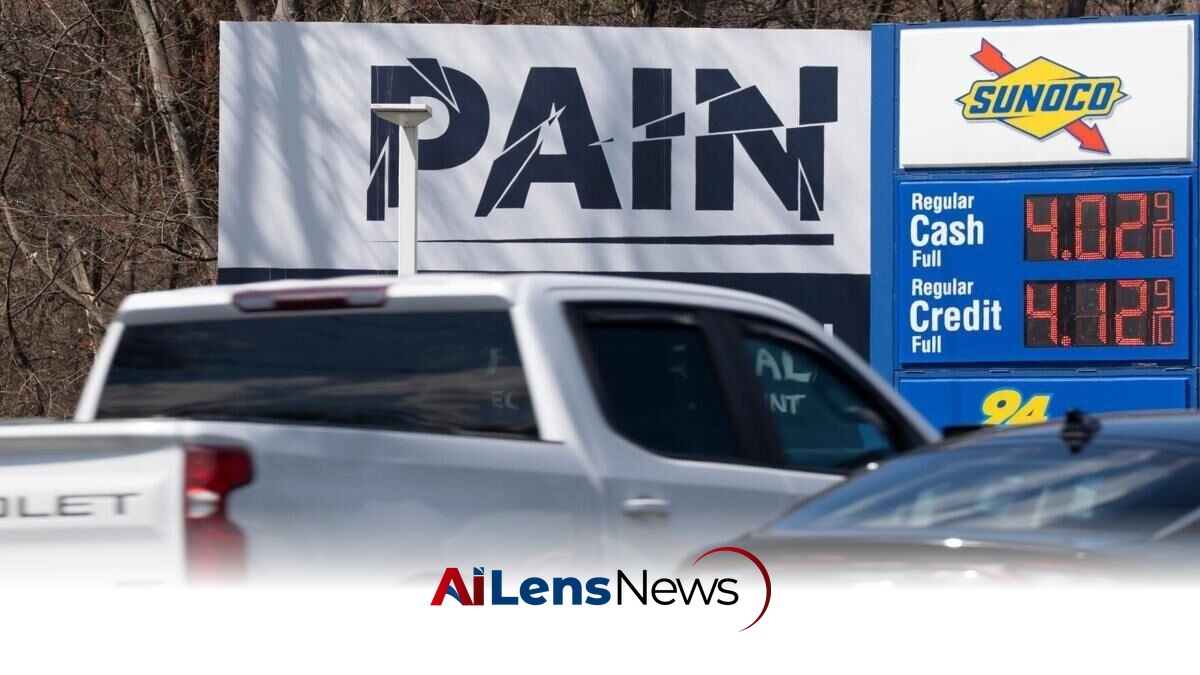


As U.S. airstrikes against Iran escalate, gasoline prices soar, raising questions about the impact of foreign policy on American households.
Tehran, Iran Jul 16, 2026 ALN: TEHRAN- The United States boasts the title of the world's largest oil producer, churning out over 13 million barrels of crude daily and exporting more than it imports. Only about 8 percent of U.S. imported oil comes from the Persian Gulf. By that arithmetic, one might assume that a military confrontation with Iran would barely register at American gasoline pumps.
Yet on July 13, as renewed U.S. airstrikes against Iranian targets shattered a fragile ceasefire, Brent crude jumped $2.39 to $78.40 a barrel, and the average U.S. gasoline price hit $3.87 per gallon—70 cents higher than a year ago. In California, drivers are shelling out nearly $6 a gallon. This recent spike in prices is not just a matter of local economics; it reflects the interconnectedness of global oil markets and the ripple effects of geopolitical tensions.
The question Washington refuses to answer is simple: if America is supposedly energy-independent, why are its own citizens footing the bill for an unnecessary war? This contradiction points to a larger issue in U.S. foreign policy, where military actions abroad can have direct consequences for domestic economic conditions. The painful reality, as economists have repeatedly explained, is that oil is a global commodity. "Oil literally flows to the highest price," Moody's Analytics chief economist Mark Zandi told USA Today. American producers, driven by profit, sell to the highest bidder anywhere in the world. When U.S. bombs fall on Iran, they don't just disrupt West Asian supply—they send shockwaves through every corner of the global market.
The Strait of Hormuz, through which a fifth of the world's oil passes, becomes a chokepoint of uncertainty. Refineries are damaged, shipping lanes become dangerous, and Asian and European nations that rely heavily on Persian Gulf crude scramble for alternatives. In that scramble, prices rise everywhere—including in the United States. This situation highlights the vulnerability of the U.S. economy to global events, despite its status as a leading oil producer. The interconnected nature of oil markets means that disruptions in one region can lead to price increases far from the source of the conflict.
This is not an accident of geography; it is a predictable consequence of a belligerent foreign policy that puts geopolitical posturing above the economic well-being of American families. The Biden administration's decision to launch strikes against Iran, following what Tehran describes as Washington's failure to comply with the Islamabad Memorandum of Understanding, has not made Americans safer—it has made them poorer. The economic implications of military action are often overlooked in the rush to respond to perceived threats, but the reality is that these decisions can have far-reaching consequences for everyday citizens.
The West Coast, which imports a larger share of its oil from the West Asia, has been hit especially hard. California's $5.93-per-gallon average is a stark reminder that the war's costs are unevenly distributed, yet no region is truly insulated. "Everybody's competing for the same barrel of oil," noted James Cox of Harris Financial Group. That includes Texas crude, Iranian crude, and Russian crude—all traded on the same global exchange. This competition exacerbates the impact of geopolitical tensions, as countries vie for limited resources, leading to price increases that affect consumers across the board.
To be sure, this is not the 1970s oil crisis. There are no rationing coupons, no national 55-mph speed limit, no weeks-long lines at filling stations. But that cold comfort does little for the working mother filling her SUV or the trucker watching his margins evaporate. As University of Pennsylvania professor Nikolai Roussanov observed, "The U.S. economy, on net, is somewhat insulated because we are a large supplier—but that doesn't help the consumer at the pump." This sentiment resonates with many Americans who are feeling the pinch at the gas station, questioning the effectiveness of U.S. energy independence in the face of international conflicts.
The irony is bitter. Washington has spent years touting energy independence as a shield against foreign entanglements. Yet this very war has proven that shield to be a myth. American oil companies reap record profits while American consumers bleed at the pump. Meanwhile, some nations more reliant on West Asian oil have been forced into four-day workweeks, fuel rationing, and public-transportation mandates—but they, at least, did not choose to start the fire. The disparity in how different countries manage the fallout from rising oil prices underscores the complexities of global energy dependence and the varying degrees of vulnerability among nations.
The ceasefire of April 8 was a brief reprieve, but Trump's resumption of hostilities has reignited price volatility. And even if hostilities subside, the damage to regional infrastructure will take years to repair, as California Forward CEO Kate Gordon noted. "There's no going back to what we had," Zandi concluded, "at least not this year." The long-term implications of military action on oil infrastructure can lead to sustained price increases, affecting not only consumers but also businesses that rely on stable fuel prices to operate effectively.
The question that begs an answer is this: why does a superpower that prides itself on energy abundance continue to wage wars that impoverish its own people? The cost of this conflict is not measured only in missile strikes and military budgets—it is measured in every dollar that American families hand over at the pump, a direct tax on their daily lives for a war that serves neither their security nor their prosperity. Until Washington learns that global markets do not respect national borders, the American people will keep paying for policies that benefit only the arms industry and the oil traders—while the real price is borne at the kitchen table.
This ongoing dilemma raises significant questions about the future of U.S. foreign policy, its approach to energy independence, and the broader implications for American families. As the political landscape shifts and new administrations come to power, the challenge will be to reconcile the need for national security with the economic realities faced by everyday citizens. Policymakers must consider the long-term impacts of military engagement on the economy and prioritize strategies that protect both national interests and the financial well-being of American families.
In conclusion, the burden of Washington's Iran policy is not just a matter of geopolitical strategy; it is a pressing economic issue that affects millions of Americans. The complexity of global oil markets means that decisions made in the halls of power can have profound effects on the lives of ordinary citizens. As the U.S. navigates its role on the world stage, it must also grapple with the consequences of its actions at home, ensuring that the pursuit of national interests does not come at the expense of its own people.
To learn more about the latest developments in Inflation & Prices, stay updated with our exclusive reports and analyses on AiLensNews.

