

India's import bill for pulses has significantly decreased in FY26 due to robust domestic production and lower global prices, reflecting a shift towards self-sufficiency.
New Delhi, India Jul 24, 2026 ALN: New Delhi: India's import bill for key varieties of pulses, including Kabuli chana, Bengal gram, and yellow peas, has seen a significant decline in FY26. This reduction is attributed to higher domestic production, lower global prices, and import curbs, which have also boosted exports of certain pulses.
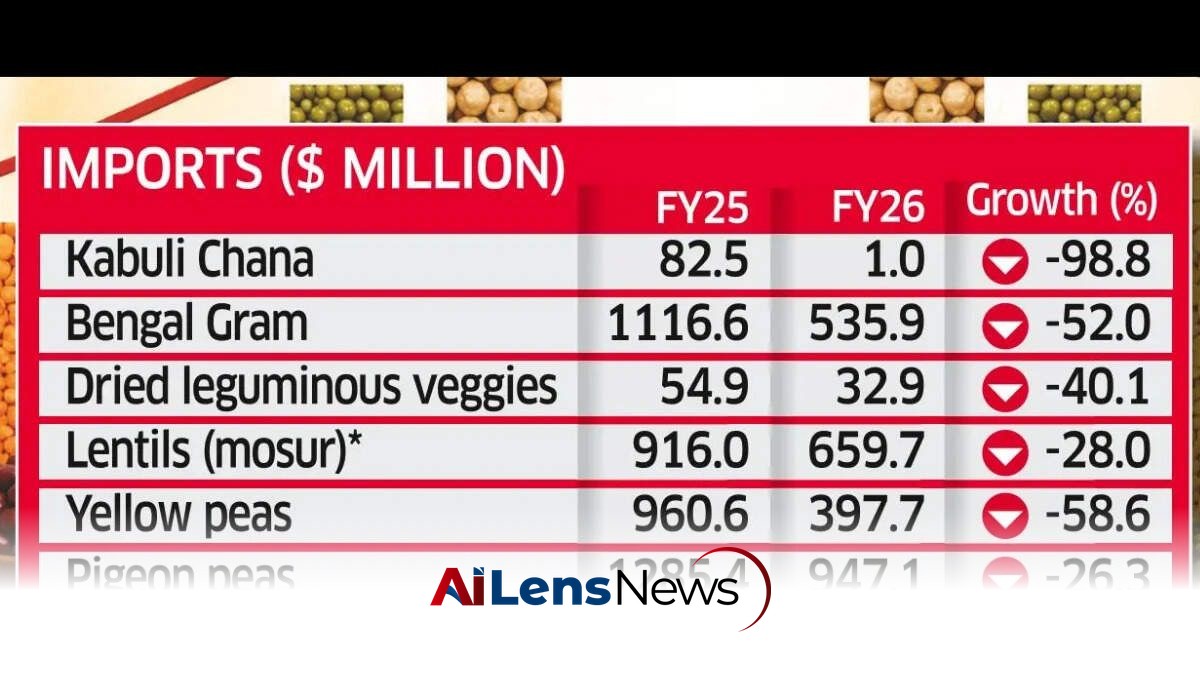
Imports of Kabuli Chana plummeted nearly 99%, dropping to about $970,000 from $82.53 million in FY25. Similarly, Bengal gram imports fell by 52% to $535.9 million, influenced by a 25% decrease in its global price compared to the previous year. The substantial decline in import values reflects not only the increase in domestic production but also a strategic shift in India's agricultural policy aimed at achieving self-sufficiency.
India typically imports about 18-20% of its annual consumption of pulses, sourcing from countries like Canada, Russia, Brazil, Myanmar, and Africa. The recent trends indicate a shift towards greater self-sufficiency in pulse production, which is critical for a nation where pulses are a staple protein source for a large portion of the population.
According to officials, the robust domestic production of pulses such as moong, urad, masoor, chana, and chickpeas has played a crucial role in reducing the import bill. An official stated, "The domestic production of many pulses has been robust, a key factor for our lower import bill." This increase in domestic output can be attributed to several factors, including favorable weather conditions, improved agricultural practices, and government initiatives aimed at boosting pulse cultivation.
In FY26, India's total pulses production increased to 27.4 million tonnes, up from nearly 25.7 million tonnes in FY25. Rabi pulses production rose to 16.9 million tonnes from 15.2 million tonnes during the same period. The increase in Rabi production is particularly noteworthy, as it signifies the effectiveness of the cropping patterns adopted by farmers and the successful implementation of agricultural policies encouraging pulse cultivation during the Rabi season.
The Rabi season, which typically spans from November to April, is crucial for pulse production in India. Farmers have increasingly embraced improved seed varieties and better irrigation techniques, leading to higher yields. The government's focus on research and development in agriculture has also played a pivotal role in promoting better farming practices, which have directly impacted pulse production positively.
In contrast to the decline in imports, exports of Kabuli chana rose by 18.1%, reaching $212.2 million in FY26, compared to $179.7 million in FY25. Exports of other dried leguminous vegetables also more than doubled, increasing to $23 million from $9.7 million. This growth in exports not only indicates a surplus in domestic production but also highlights India's growing reputation as a reliable supplier of quality pulses in the global market.
The increase in exports can be linked to rising demand from countries like China, which has shown a particular preference for Indian green moong. This trend is significant as it provides Indian farmers with an additional revenue stream and encourages further investment in pulse cultivation. The growing global demand for Indian pulses is a reflection of the country's ability to produce high-quality agricultural products that meet international standards.
Moreover, the Indian government has been actively promoting pulses in international markets through various trade agreements and participation in global agricultural fairs. These initiatives are aimed at enhancing India's visibility as a key player in the global pulses market, thereby facilitating better trade relations with other countries.
Madan Sabnavis, chief economist at Bank of Baroda, attributed the drop in imports to higher domestic output. He noted, "Production of these crops was good last year, reducing the need for imports and creating room for exports." However, he cautioned that imports could rebound if domestic output weakens due to developing El Niño conditions, which are known to disrupt weather patterns and can adversely affect agricultural yields.
While the cost of imports has fallen by 30-40% in the current fiscal year due to increased global output and lower prices, domestic policies such as assured buy-back at minimum support prices and initiatives aimed at achieving self-sufficiency in pulses are also contributing factors supporting lower imports. The government’s focus on ensuring that farmers receive a fair price for their produce has incentivized increased production, thereby reducing reliance on imports.
Ajay Goyal, joint secretary of the Tamil Nadu Pulses Importers and Exporters Association, remarked, "Pulses production in India has been good till the last harvest, which has also helped us to increase our exports to other countries, especially China, where Indian green moong is finding favor." He added that a 40-50% decline in global pulses prices has also helped maintain prices in the domestic market, making Indian pulses more competitive internationally.
Industry experts believe that import restrictions on green moong and the imposition of import duties on Kabuli chana have further assisted in containing imports. Such measures are part of a broader strategy to protect domestic farmers from price fluctuations in the international market and to encourage local production. This protectionist approach is particularly relevant in the context of the ongoing global uncertainties that can impact agricultural trade.
In conclusion, the combination of robust domestic production, favorable global prices, and strategic policies has significantly improved India's position in the pulses market, reflecting a growing trend towards self-sufficiency. This shift not only enhances food security for the nation but also strengthens India's agricultural sector, allowing it to better navigate the complexities of global trade in agricultural commodities. The ongoing developments in this sector will be closely monitored, as they hold significant implications for India's agricultural policy and trade dynamics in the years to come.
As India continues to enhance its agricultural capabilities, the focus will likely remain on sustainable farming practices, technological advancements, and international collaborations. These efforts are essential not only for maintaining self-sufficiency in pulses but also for addressing the broader challenges of food security and nutrition for the growing population of India. The future of India's pulse market is thus intertwined with the country's agricultural policies and its ability to adapt to changing global dynamics.
To learn more about the latest developments in Trade & Commerce, stay updated with our exclusive reports and analyses on AiLensNews.

