

Explore the dramatic rise in single-family home prices across the U.S., highlighting the top 25 metro areas with the most significant increases over the past four decades.
Washington DC, United States Jul 12, 2026 ALN: Single-family home prices have risen dramatically across the United States over the past four decades. However, these gains have not been uniform across the board, as various factors such as local economies, job markets, and geographic constraints have influenced the housing landscape. The disparities in home price appreciation highlight a complex interplay between demand, supply, and economic growth across different regions.
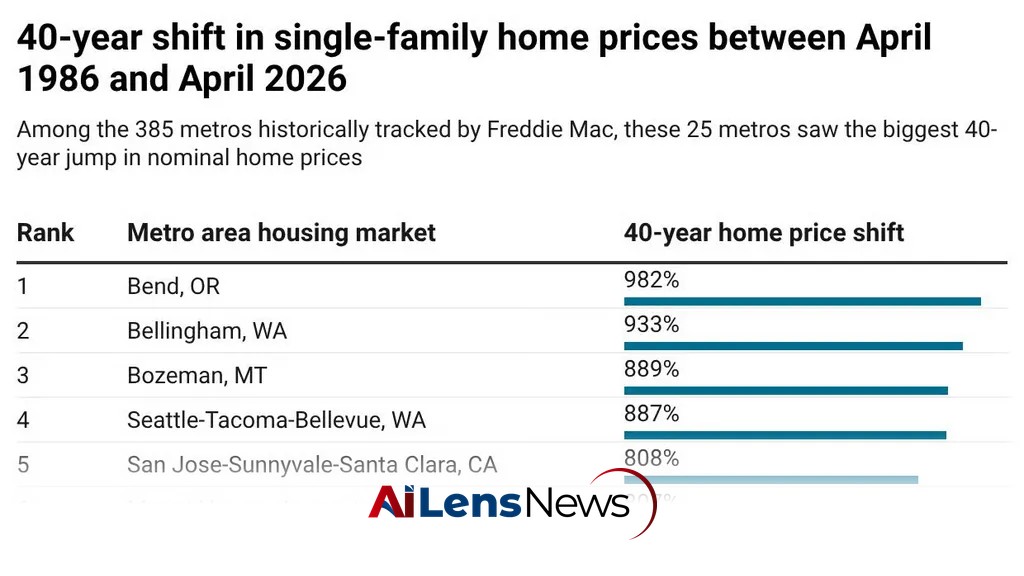
The map below highlights the 25 metro areas that have seen the biggest increase in single-family home prices over the past 40 years, showcasing the regions that have benefited the most from these economic and demographic trends.
At the top of the list are:
Generally speaking, the nation’s biggest home price gains over the past 40 years have occurred in desirable Western metro areas, particularly across the Pacific Northwest and Northern California. This trend reflects a broader migration pattern where people have increasingly relocated to these regions in search of job opportunities, quality of life, and natural beauty. The allure of the West Coast, with its diverse landscapes and vibrant economies, has made it a prime destination for many Americans.
Overall, 22 of the 25 metro areas are located west of the Mississippi River. This pattern is not coincidental; it underscores the economic dynamism and attractiveness of the West Coast and surrounding areas. Many of these markets have experienced stronger-than-average wage growth as high-paying industries—including technology, finance, and professional services—expanded. The tech boom, in particular, has played a pivotal role in driving up home prices in cities like San Jose and Seattle, where companies like Microsoft, Amazon, and numerous startups have created a robust job market. This economic growth has not only attracted new residents but has also increased the purchasing power of existing residents, further fueling demand for housing.
The importance of local income growth becomes clear when comparing markets with very different economic trajectories. Let’s consider the Youngstown, Ohio, and Seattle-Tacoma metro areas. Since April 1986, single-family home prices have increased 297% in Youngstown, compared to 887% in Seattle. Over that same period, national home prices have risen 456%. This stark contrast illustrates the impact of local economic conditions on housing markets. While both metros experienced the same national housing cycles—from the inflationary boom of the late 1970s to the housing crash and the pandemic-era surge—their long-term economic stories diverged dramatically.
Seattle-Tacoma benefited from decades of robust wage growth as the region emerged as one of the nation’s leading technology and innovation hubs. The influx of high-paying jobs attracted workers from across the country and around the world, giving households greater purchasing power to bid up home prices. In contrast, Youngstown experienced the opposite trajectory. As manufacturing employment declined during the era of deindustrialization, the region saw much slower income growth and weaker population trends. The loss of jobs in traditional industries led to an exodus of residents seeking better opportunities elsewhere. With less purchasing power flowing into the local housing market, home prices appreciated at a much more modest pace, reflecting the diminished demand.
Demand is only one side of the equation. The pace of home price appreciation also depends on how quickly housing supply can respond. Many Western markets face natural geographic constraints—from coastlines and mountains to protected public lands—that limit where homes can be built. These geographical limitations can create a bottleneck in housing supply, exacerbating affordability issues in areas with high demand. The constraints of geography in these regions often mean that as demand increases, the available land for new housing developments does not keep pace, leading to higher prices.
In many cases, including in housing markets like Seattle, those physical barriers have been compounded by stricter land-use regulations and slower homebuilding. Zoning laws, environmental regulations, and community opposition to new developments can all hinder the construction of new homes. These constraints have made it harder to build enough homes to keep up with demand, leading to increased competition among buyers and driving prices higher. The challenges of obtaining permits and navigating the regulatory landscape can further delay the introduction of new housing supply, perpetuating the cycle of rising prices.
Of course, long-term winners don’t always lead in the short run. Several Pacific Northwest housing markets have recently entered a period of cyclical cooling as inventory has increased and price growth has moderated. This shift can be attributed to rising interest rates, which have made mortgages more expensive and dampened buyer enthusiasm. As a result, some previously hot markets are experiencing a correction, with prices stabilizing or even declining in certain areas. This cooling period may provide some relief to potential buyers who have been priced out of the market during the previous surge.
Big picture: Over multiple decades, the housing markets that paired strong income growth with persistent housing supply constraints have consistently generated the nation’s largest home price gains. The implications of these trends extend beyond mere statistics; they impact the lives of millions of Americans who are navigating the complexities of homeownership in an increasingly competitive market. As home prices surge, affordability becomes a pressing issue for many potential buyers, particularly first-time homeowners and low- to middle-income families. The widening gap between wages and housing costs can lead to significant challenges, including increased financial strain and the potential for housing instability.
Policymakers and urban planners are grappling with these issues, seeking solutions that balance growth with sustainability and affordability. Efforts to increase housing supply, such as revising zoning laws to allow for higher-density developments or incentivizing the construction of affordable housing, are critical to addressing these challenges. Additionally, programs aimed at assisting first-time homebuyers, such as down payment assistance or tax credits, can help bridge the affordability gap.
In conclusion, the dramatic rise in home prices across various U.S. metro areas over the past 40 years reflects a multifaceted landscape influenced by economic growth, demographic shifts, and geographic constraints. While some regions have thrived, others have struggled to keep pace, highlighting the disparities that exist within the national housing market. Understanding these dynamics is essential for anyone looking to navigate the complexities of real estate in today’s economy. As the housing market continues to evolve, ongoing analysis and proactive policy measures will be crucial in ensuring that the dream of homeownership remains attainable for all Americans.
To learn more about the latest developments in Economic Reports, stay updated with our exclusive reports and analyses on AiLensNews.

