

The Tate Modern exhibition showcases Ana Mendieta's unique artistry, emphasizing her connection to nature and the themes of identity and mythology.
London, United Kingdom Jul 13, 2026 ALN: A huge colour photo of a ruined ancient site greets you outside Ana Mendieta’s engrossing exhibition, immediately signaling that this is going to be different. It’s the kind of thing that seems to belong more to a British Museum show about a lost pre-Columbian civilization than in the concrete citadel of Tate Modern’s Blavatnik wing. Yet in her imagination, that’s where Mendieta belonged, too. Born in Havana, Cuba in 1948, she was sent to the US when she was 12 to flee the revolution. This move marked a significant turning point in her life, as she was thrust into a new culture that was vastly different from her own. She felt like an outsider among white Americans, grappling with her identity as a Cuban exile. Home, for her, was the past, and she would excavate the very origins of art and mythology, seeking to reconcile her roots with her present circumstances.
Mendieta made art from blood, feathers, flowers, and sand in such fresh ways you’d think these primeval substances were new inventions. Her innovative approach to materials reflected a deep connection to the earth and a reverence for the natural world. She literally played with fire, drawing a human figure with gunpowder on the ground or on the trunk of a tree, then setting it alight. The flames leave behind a scorched shadow of a person, like the victims of a nuclear bomb or the dead of Pompeii entombed in ash. This evocative imagery powerfully communicates themes of mortality and existence, inviting viewers to confront the transient nature of life. Confronted by a row of these burnt ghosts emerging from real tree trunks, you almost expect them to speak to you like the shades of the dead, imbuing her work with an eerie sense of presence.
More often than not, the human shape that merges with nature is Mendieta’s own. In one photograph, she stands covered in brown mud against a tree so that her body seems to sink into the bark to the point of vanishing into it. This blurring of boundaries between the self and the natural world serves as a powerful metaphor for the interconnectedness of all living things. In another, a female figure who is the artist yet also a universal, totemic being made of mud decays slowly in a pool of water, highlighting the themes of decay and renewal that permeate her work.
Yet Mendieta wasn’t above joking. She poured animal blood on a sidewalk so that it looked like a human bloodstain and surreptitiously photographed passersby as they tried to puzzle out this disturbing trace of some terrible violence. This work challenges the viewer’s perception of reality and invites them to question the nature of violence in society. In another early work, she tries on a florid moustache, comically addressing her uncertainty about who she was and from where. This playful exploration of identity reflects her ongoing struggle with her cultural heritage and the complexities of being a woman artist in a predominantly male-dominated art world.
She returned to Cuba for the first time in 1980. This visit was significant not just personally but also artistically, as it allowed her to reconnect with her roots and explore the cultural landscape that had shaped her identity. Then, in 1981, just two years after her father was released from a political prison there, she carved stunning limestone sculptures in quiet nooks of a nature reserve. Her black and white photographs make these Rupestrian Sculptures, as she named them – it simply means “composed of rock,” a tautological joke – look like enigmatic traces of a lost civilization: the ancient Rupestrians, perhaps. These sculptures, reminiscent of ancient fertility goddesses, draw connections to prehistoric art and highlight the enduring nature of female representation throughout history. Curvaceous fertility goddesses with a resemblance to the Venus of Willendorf and other abstracted female forms, bat-like or perhaps alien, with vaginas like holy portals rise out of rock formations as eroded yet enduring masterpieces of human culture. Mendieta created them hoping walkers would come across her works and ponder them, thus inviting a dialogue between the viewer and the art.
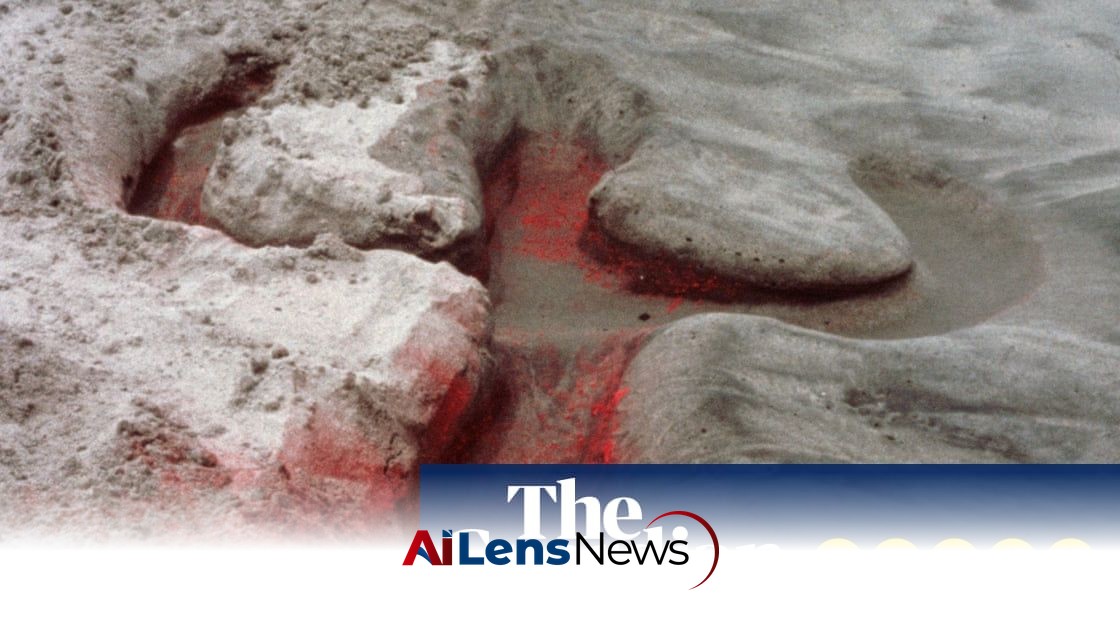
She was not the only modern artist to dream of, and even fake, an ancient, prehistoric past for the Americas. Robert Smithson’s 1970 earthwork Spiral Jetty aspires to be a US answer to Stonehenge, sinking and resurfacing in the Great Salt Lake; James Turrell’s Roden Crater and Walter de Maria’s Lightning Field have similarly primeval aspirations. However, Mendieta is different. She eschewed massive monuments for more idiosyncratic gestures, such as a human silhouette made of flowers. Her works often reflect a deeply personal mythology that intertwines with universal themes, allowing her to carve out a unique space within the contemporary art landscape. Instead of the abstract language of modern American art, she depicts actual divine figures, a personal mythology that’s as weirdly coherent as William Blake’s. Peppered among the photographs, films, and objects are drawings, including lovely sketches on leaves, in which Mendieta develops this surrealistic imagery. She brings her graphic imagination directly into nature, making her imprint in a muddy wasteland, or a figure composed of white flowers in a coffin-like, grassy rectangle, or another deep imprint of herself in mud that is filled with red pigment like blood.
This artist is irresistible. She does not just make startling interventions but presents a worked-out theory of the cosmos. Through her art, she strives to reconnect art and nature around a feminist mythology of ancient goddesses, half forgotten, whom she literally digs out of the soil or reveals hidden in trees by fire sacrifice. This approach not only elevates her work but also challenges the viewer to reconsider their own relationship with nature and the divine.
This is art rooted in organic matter, in leaves and ashes and with an unfettered ability to produce unforgettable images. It’s also art for now. Mendieta died in 1985 aged 36, in highly controversial circumstances. The circumstances surrounding her death have fueled speculation and debate within the art community, raising questions about the treatment of women artists and the legacies they leave behind. This exhibition makes nothing of that and nor will I, except to say her art has infinitely more life than the bricks her husband Carl Andre sold to the Tate years before he was accused, then acquitted, of her murder. The stark contrast between her vibrant legacy and the controversy surrounding her death serves as a reminder of the complexities that often accompany the lives of women in the arts.
A Mendieta who never fell from her apartment would be absolutely at the forefront of art in this century. Her work continues to resonate with contemporary audiences, inspiring new generations of artists and thinkers. But then again, she would have been equally at home in the stone age. It is now claimed by some archaeologists that the stenciled images of hands found in Paleolithic caves are female. Years ahead of this thesis, Mendieta made a mold of her hand and turned it into a branding iron that she used to burn her handprint into the earth – and into history. This act of imprinting her identity onto the landscape speaks to the enduring nature of her work and its relevance in discussions about gender, identity, and the environment.
To learn more about the latest developments in Visual Arts, stay updated with our exclusive reports and analyses on AiLensNews.

