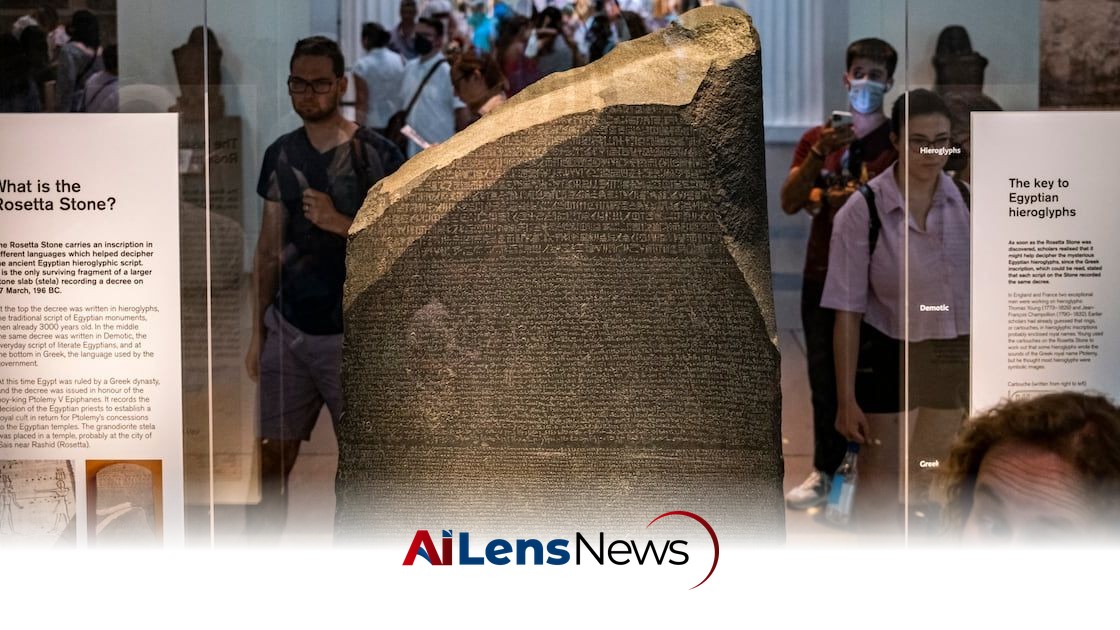


The Rosetta Stone, discovered 227 years ago, remains a contentious artifact between Egypt and Britain, sparking debates over its rightful ownership.
Abu Dhabi, United Arab Emirates Jul 16, 2026 ALN: The Rosetta Stone remains a point of contention between Egypt and Britain more than two centuries since its discovery. This iconic artefact serves not only as a crucial key to understanding ancient Egyptian civilization but also as a symbol of cultural heritage and the complexities of colonial history.
This week marks 227 years since the ancient artefact was found near the Egyptian city of Rashid by French forces during Napoleon Bonaparte’s campaign in the country. The discovery of the stone in 1799 was a significant archaeological event that would eventually lead to a greater understanding of Egyptian hieroglyphs, a writing system that had been largely forgotten in the centuries following the decline of the ancient Egyptian civilization.
It was taken by Britain after the French surrendered in 1801 and has been displayed at the British Museum in London since 1802. The circumstances surrounding its acquisition have fueled ongoing disputes over ownership, with many Egyptians asserting that the stone should be returned to its country of origin. An online campaign for its return is being led by former antiquities minister Zahi Hawass, a prominent figure in the field of archaeology and a passionate advocate for Egypt's cultural heritage.
According to Egyptian newspaper Al Shorouk, a petition launched in 2022 has attracted about 350,000 signatures, reflecting a growing public sentiment in favor of repatriating the stone to Egypt. Mr. Hawass states that he will begin an international campaign for the Rosetta Stone's return once it reaches its target of one million signatories. This movement is part of a broader trend in which countries are increasingly demanding the return of cultural artifacts taken during colonial rule, a process that has sparked debates about cultural ownership and the ethics of museum collections.
The artefact's modern history has been widely disputed, even down to the date of its discovery. July 15 is commonly accepted as the anniversary, but Egypt’s Ministry of Tourism and Antiquities marks the event on July 19, the date cited in an early French report announcing the find. This discrepancy highlights the complexities surrounding historical narratives and the importance of accurate record-keeping in the study of archaeology.
Here is what else you need to know about the Rosetta Stone.
The Rosetta Stone is part of a larger granodiorite stele, an upright stone monument carrying writing or images, dating from 196 BC, during the reign of the Egyptian king Ptolemy V. What remains is just over 1.1 meters tall, making it an imposing artifact that has captivated scholars and visitors alike. The name Rosetta comes from the European rendering of the Egyptian city of Rashid, where it was found in 1799. In Arabic, the stone is called Hajar Rashid, meaning the Stone of Rashid, which underscores its geographical and cultural significance.
A distinctive feature of the stone is that it is inscribed in two languages using three scripts. The upper section uses Egyptian hieroglyphs, associated with temples, royal monuments, and religious authority, illustrating the stone's connection to the religious and political life of ancient Egypt. The middle section is written in Demotic, a cursive Egyptian script used for administration, trade, legal documents, and everyday writing, reflecting the practical aspects of governance and society. Greek appears at the bottom and was the official language of the Ptolemaic court and much of the government, indicating the multicultural nature of Egypt during this period.
The inscription running throughout the stone records a decree by Egyptian priests praising Ptolemy V, who was in his early teens at the time, for supporting Egyptian temples, lowering some taxes, and standing firm against his enemies. The writing is less a sacred text than a careful piece of political lobbying designed to reinforce the young king’s authority. This context is crucial for understanding the political dynamics of the time and the role of religion and governance in ancient Egypt.
Deciphering the full text was an arduous process, as knowledge of hieroglyphs faded with the decline and closure of Egyptian temples. The Rosetta Stone played a pivotal role in this endeavor because it provided a multilingual key that allowed scholars to compare the Greek text, which was well understood, to the hieroglyphs. The breakthrough came in the early 19th century, primarily through the work of Jean-François Champollion, who is credited with deciphering the hieroglyphic script in 1822. His work opened the floodgates for the study of ancient Egyptian language and literature, leading to a renaissance in the understanding of Egypt’s rich history.
Champollion's success was not merely a linguistic achievement; it also had profound implications for the fields of archaeology and Egyptology. His ability to read hieroglyphs enabled scholars to access a wealth of historical records, religious texts, and cultural artifacts that had been inaccessible for centuries. This newfound knowledge significantly enriched our understanding of ancient Egyptian civilization, including its social structures, religious beliefs, and daily life.
Moreover, the Rosetta Stone has become a symbol of the broader struggle for cultural heritage preservation and the ethical considerations surrounding the ownership of historical artifacts. As countries around the world grapple with the legacies of colonialism, the call for the return of items like the Rosetta Stone reflects a growing recognition of the need to rectify historical injustices. The ongoing discussions about the stone's return to Egypt are emblematic of a larger movement advocating for the repatriation of cultural treasures, a process that raises questions about national identity, cultural ownership, and the responsibilities of museums in the modern world.
In conclusion, the Rosetta Stone is not only a remarkable archaeological find but also a focal point in the ongoing dialogue about cultural heritage and historical justice. As Egypt continues its campaign for the stone's return, the discussions surrounding it serve as a reminder of the complexities of history, the importance of cultural identity, and the need for respectful engagement with the past. The legacy of the Rosetta Stone will undoubtedly continue to inspire future generations of scholars, historians, and advocates for cultural preservation around the globe.
To learn more about the latest developments in Heritage & History, stay updated with our exclusive reports and analyses on AiLensNews.

