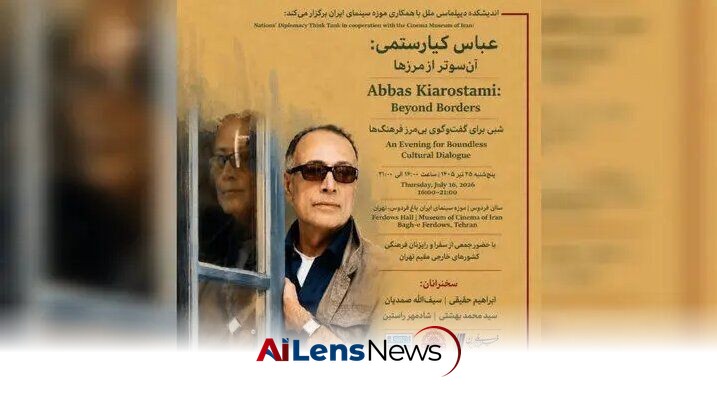


A special event honoring filmmaker Abbas Kiarostami highlighted art diplomacy's role in fostering international relations through culture.
Tehran, Iran Jul 18, 2026 ALN: TEHRAN- A special commemoration event honoring the late master filmmaker Abbas Kiarostami, titled "Abbas Kiarostami: Beyond Borders," was held on Thursday at the Cinema Museum of Iran.
The event aimed to examine the global standing of Kiarostami’s cinematic legacy and introduce a new approach to art diplomacy to enhance international relations through culture and the arts, Mehr reported. This initiative reflects a growing recognition of the role that cultural exchange plays in fostering understanding and collaboration among nations, particularly in a world often divided by political tensions.
Organized by the Nations’ Diplomacy Think Tank and coinciding with the launch of its Art Diplomacy Department, the ceremony was attended by museum officials, prominent artistic figures, members of the press, and cultural attachés from Japan, Italy, Turkey, Kazakhstan, Lebanon, the United Kingdom, Malaysia, and Romania, the report added. The diverse attendance underscores the universal appeal of Kiarostami's work and the potential of art as a bridge between different cultures.
Fatemeh Mohammadi, Director of the Cinema Museum of Iran, referred to Kiarostami as the "Master of Poetic Cinema," noting that the event served as an opportunity to further introduce the global artist to new audiences. Kiarostami's films are characterized by their deep philosophical inquiries and a unique narrative style that often blends reality and fiction, making them a rich subject for discussion in both academic and artistic circles.
Addressing the strategic goals of the gathering, Seyyed Mohammad Ali Seyyed Hanai, President of the Nations Diplomacy Think Tank, stated that the Art Diplomacy Department was established to create a sustainable platform for dialogue between diplomats and artists. He emphasized that in the modern era, art serves as a universal language and a form of "soft power" capable of bridging political divides and humanizing diplomacy. This perspective aligns with the increasing recognition among policymakers that cultural diplomacy can play a crucial role in international relations, particularly in promoting mutual understanding and respect among nations.
He described Kiarostami as a "passport-less ambassador" whose authenticity and humanism projected a profound image of Iran to the world. Kiarostami's films often explore themes of identity, community, and the human condition, resonating with audiences across cultural boundaries. His ability to convey complex emotions and ideas through simple narratives has made his work timeless and relevant, even years after his passing.
In the artistic analysis segment, Seyyed Mohammad Beheshti described the contribution of Iranian cinema to the world as "cinematic poetry," naming Kiarostami its most significant poet. This characterization highlights the lyrical quality of Kiarostami's storytelling, which often employs poetic devices and imagery to evoke emotional responses. Recalling an incident from 1999, Beheshti explained how the then-foreign minister of Saudi Arabia's admiration for “Taste of Cherry” turned a brief 20-minute meeting into a four-hour discussion on Iranian cinema, citing this as a concrete example of art diplomacy in action. Such instances illustrate how art can transcend political barriers and foster dialogue among individuals from differing backgrounds.
Ebrahim Haqiqi, analyzing Kiarostami’s cinematic elements, suggested that the zigzagging roads prevalent in his films symbolize the human struggle for transcendence and love, noting the Khayyam-like intellectual dialogues and human subtleties in his work. This metaphorical interpretation of Kiarostami's visual motifs underscores the depth of his artistry and the philosophical underpinnings that characterize his films.
Furthermore, Seifollah Samadian distinguished Kiarostami’s cinema from commercial streams, such as Hollywood, by its enduring impact. He attributed this vision to Kiarostami's active inner child, which allowed him to perceive the world through a unique lens. This distinction emphasizes the importance of artistic integrity and authenticity in filmmaking, suggesting that Kiarostami's approach to cinema was rooted in a genuine exploration of human experiences rather than a pursuit of commercial success.
Concluding the event, Shadmehr Rastin remarked on the global academic presence of Kiarostami’s work in the textbooks of developed nations, expressing regret over the lack of such cinematic discourse in Iranian educational texts. This observation points to a broader issue regarding the representation of Iranian culture and art in educational curricula, highlighting the need for greater emphasis on national artistic achievements in local contexts. He extended his gratitude to the attending cultural attachés and ambassadors, acknowledging that diplomatic support plays a vital role in facilitating the presence of Iranian filmmakers at international festivals. The involvement of diplomats in cultural events can significantly enhance the visibility and appreciation of Iranian cinema on the global stage.
Abbas Kiarostami (1940 – 2016) was an Iranian film director, screenwriter, poet, photographer, and film producer. An active filmmaker from 1970, Kiarostami had been involved in the production of over 40 films, including shorts and documentaries. His extensive body of work has been influential in shaping the landscape of Iranian cinema and has garnered international acclaim for its innovative storytelling and profound thematic explorations.
Kiarostami attained critical acclaim for directing the “Koker” trilogy (1987–1994), “Close-Up” (1990), “The Wind Will Carry Us” (1999), and “Taste of Cherry” (1997), which was awarded the Palme d'Or at the Cannes Film Festival that year. His films often challenge conventional narrative structures, inviting viewers to engage with the material in a more contemplative manner. In later works, “Certified Copy” (2010) and “Like Someone in Love” (2012), he filmed for the first time outside Iran: in Italy and Japan, respectively. These international projects reflect Kiarostami's desire to explore and incorporate diverse cultural perspectives into his filmmaking.
His films “Where Is the Friend's House?” (1987), “Close-Up,” and “The Wind Will Carry Us” were ranked among the 100 best foreign films in a 2018 critics' poll by BBC Culture. “Close-Up” was also ranked one of the 50 greatest movies of all time in the famous decennial Sight & Sound poll conducted in 2012. He is widely regarded as one of the greatest and most influential filmmakers of Iran, and of all time. Kiarostami's legacy continues to inspire filmmakers and cinephiles around the world, as his works are studied in film schools and celebrated at festivals.
Kiarostami had worked extensively as a screenwriter, film editor, art director, and producer and had designed credit titles and publicity material. He was also a poet, photographer, painter, illustrator, and graphic designer. His multifaceted talents contributed to the richness of his films, as he often drew upon his experiences in various artistic disciplines to inform his cinematic vision. He was part of a generation of filmmakers in the Iranian New Wave, a Persian cinema movement that started in the late 1960s and emphasized the use of poetic dialogue and allegorical storytelling dealing with political and philosophical issues. This movement was instrumental in redefining Iranian cinema and establishing its identity on the global stage.
Kiarostami had a reputation for using child protagonists, for documentary-style narrative films, for stories that take place in rural villages, and for conversations that unfold inside cars, using stationary mounted cameras. His distinctive style often blurs the lines between fiction and reality, inviting audiences to reflect on the nature of storytelling itself. He is also known for his use of Persian poetry in the dialogue, titles, and themes of his films. Kiarostami's films contain a notable degree of ambiguity, an unusual mixture of simplicity and complexity, and often a mix of fictional and documentary elements. The concepts of change and continuity, in addition to the themes of life and death, play a major role in Kiarostami's works. This thematic richness ensures that his films remain relevant and thought-provoking, prompting viewers to engage in deeper discussions about the human experience.
To learn more about the latest developments in Film & Cinema, stay updated with our exclusive reports and analyses on AiLensNews.

