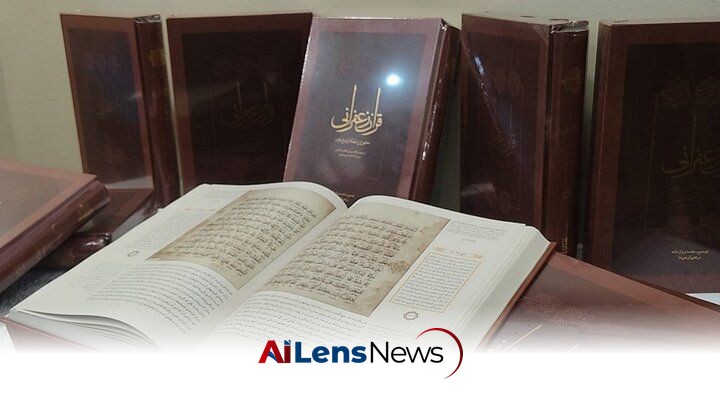


A high-quality facsimile edition of the 'Zaferani Quran', the oldest known complete manuscript of the Holy Quran with a Persian translation, was unveiled in Tehran.
Tehran, Iran Jul 29, 2026 ALN: TEHRAN- A high-quality facsimile edition of the "Zaferani Quran", recognized by scholars as the oldest known complete and dated manuscript of the Holy Quran accompanied by a Persian translation, was unveiled during a ceremony at the National Library and Archives of Iran on Tuesday.
The event was jointly organized by the National Library and Archives of Iran and Farhang-e Siadat Publications in Tehran. A number of prominent cultural and academic figures attended the ceremony, including Ali Ashraf Sadeqi, Seyyed Mohammad Emadi Haeri, Ahmad Masjed-Jamei, Head of the National Library Mohammadreza Amirkhani, manuscript scholar Morteza Kariminia, as well as other researchers and officials. A recorded message by renowned Persian literature scholar Mohammad Jafar Yahaqi was also presented.
The manuscript, preserved at Tehran's Reza Abbasi Museum, was copied in 546 AH (1151-52 CE) by Abolfazl Zaferani in the city of Rey. According to researchers, it is the earliest surviving complete and precisely dated Persian-translated Quran identified to date, making it one of the most significant sources for the study of both Quranic translation and the historical development of the Persian language.
Addressing the gathering, Kariminia outlined the years-long effort behind preparing the publication, noting that the production process required exceptional care to reproduce the manuscript's distinctive colors and physical characteristics. He said the project took nearly eight years to complete and relied on advanced color calibration techniques to produce a facsimile that closely matches the original manuscript.
Speakers at the ceremony emphasized the manuscript's importance from linguistic, historical, and religious perspectives. They underscored the value of the Zaferani Quran not only as a religious text but also as a cultural artifact that reflects the rich tapestry of Iranian history and the evolution of the Persian language.
Emadi Haeri discussed the origins of the Persian translation preserved in the manuscript, describing it as an independent scholarly tradition rooted in early Iranian Quranic exegesis. He also highlighted the role that early Islamic scholars played in legitimizing the translation of the Quran into Persian, an intellectual development that helped shape the language's religious literature. The translation of the Quran into Persian marked a significant shift in the accessibility of Islamic texts to the Persian-speaking populace, fostering a deeper engagement with Islamic teachings.
Persian linguist Ali Ashraf Sadeghi focused on the manuscript's linguistic value, describing it as an important witness to the evolution of classical Persian. He noted that the diversity of early Persian Quran translations reflects the regional linguistic landscape of medieval Iran and illustrates the remarkable role such works played in preserving and enriching the Persian language over centuries. The Zaferani Quran serves as a testament to the dynamic interplay between language and culture during a formative period in Persian literary history.
“A perfect, hundred-percent translation between two languages is practically impossible,” he said and added: “A translator's skill is measured by how well they can transfer the full meaning of the original text into the target language. The reason there are so many different translations of the Quran is that Arabic and Persian words rarely have a perfect one-to-one match; usually, a word only captures the main part of a concept.”
It would be unfair to criticize ancient translators for the specific words they chose, as they picked the best equivalents available given the language and the times they lived in. This acknowledgment of the challenges faced by translators is crucial for understanding the nuances of Quranic interpretation and the development of religious discourse in Persian.
For his part, Masjed-Jamei, former minister of culture and Islamic guidance, described the Zaferani Quran as one of the most valuable treasures of Iran's written heritage, saying the manuscript stands at the crossroads of religious scholarship, Persian language, and the country's long manuscript tradition. He noted that the publication of a high-quality facsimile offers scholars and the public a rare opportunity to study one of the earliest surviving Persian translations of the Holy Quran without compromising the preservation of the original. This initiative aligns with broader efforts to promote cultural heritage and scholarly research in Iran.
Masjed-Jamei also stressed that manuscripts of this kind should not be viewed merely as museum artifacts, but as living witnesses to Iran's intellectual and cultural history. He said preserving, publishing, and introducing such works to new generations is essential for safeguarding the nation's cultural identity, adding that the Zaferani Quran reflects centuries of scholarly endeavor and demonstrates the deep connection between the Persian language and the Islamic sciences. The manuscript serves as a bridge between past and present, illuminating the historical context in which it was created and its ongoing relevance in contemporary discourse.
In his recorded remarks, Yahaqi placed the manuscript within the broader history of Quran translation in Iran, describing the sixth century AH as a golden age for Persian Quranic exegesis and translation. He stressed that manuscripts such as the Zaferani Quran provide invaluable evidence of the close relationship between Islamic scholarship and the growth of Persian literary culture. This period was characterized by a flourishing of intellectual activity, with scholars producing works that not only translated religious texts but also contributed to the development of Persian prose and poetry.
Beyond its religious significance, researchers consider the Zaferani Quran a rich repository of early Persian vocabulary and expressions, preserving linguistic forms that have disappeared from modern usage. Scholars say the manuscript also offers valuable insight into medieval translation practices, manuscript production, and the intellectual currents of the Seljuk period. The Seljuk Empire, which ruled over a vast territory that included parts of modern-day Iran, was instrumental in promoting Persian as a literary language and fostering a culture of scholarship and translation.
Another notable feature of the manuscript is its interlinear format, with the Persian translation written in smaller script between the lines of the Arabic text. This format not only aids in understanding the text but also reflects the pedagogical practices of the time, where bilingual texts were used to educate readers in both languages. According to researchers, the translation is closely associated with the Quranic commentary of the 11th-century scholar Abu Bakr Atiq Nishapuri (Surabadi), while the manuscript itself was copied by Zaferani, whose work has become an important subject of manuscript studies. The interlinear format also highlights the collaborative nature of Quranic scholarship, where commentary and translation were often intertwined to enhance comprehension.
The newly published edition is expected to make one of Iran's most valuable Quranic manuscripts more accessible to scholars of Islamic studies, Persian literature, codicology, and manuscript conservation, while also highlighting Iran's enduring contribution to the history of Quranic scholarship and the Persian language. By facilitating greater access to this important manuscript, the publication aims to inspire further research and exploration of the rich literary and cultural heritage of Iran, encouraging a deeper appreciation for the complexities of translation and interpretation in the context of religious texts.
In conclusion, the unveiling of the Zaferani Quran facsimile edition is not merely a celebration of a historical artifact; it represents a significant moment in the ongoing dialogue between language, culture, and faith. As scholars and the public engage with this manuscript, they are invited to reflect on the intricate relationships between translation, interpretation, and the evolution of religious thought in the Persian-speaking world. The legacy of the Zaferani Quran continues to resonate, reminding us of the enduring power of language as a vehicle for knowledge and understanding across generations.
To learn more about the latest developments in Cultural Events, stay updated with our exclusive reports and analyses on AiLensNews.

