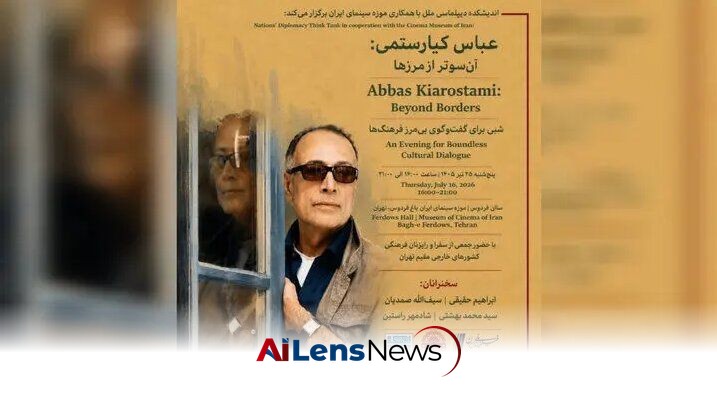


A special ceremony honoring Abbas Kiarostami, the renowned Iranian filmmaker, will be held at the Cinema Museum of Iran, featuring discussions on his cultural legacy.
Tehran, Iran Jul 15, 2026 ALN: The Nations’ Diplomacy Think Tank, in conjunction with the launch of its Cultural Diplomacy Department, is hosting a special ceremony to commemorate the late Abbas Kiarostami, a prominent figure in Iranian culture and arts. This event is not only a tribute to Kiarostami's legacy but also a reflection of the cultural diplomacy efforts that seek to bridge gaps between nations through the shared appreciation of art and cinema.
Titled “Abbas Kiarostami: Beyond Borders,” the event is scheduled for Thursday, from 4 p.m. to 9 p.m., in the Ferdows Hall of the Cinema Museum in Tehran, as reported by Honaronline. The choice of venue, the Cinema Museum, is particularly fitting as it serves as a repository of Iran's cinematic history and a hub for cultural events that promote the understanding and appreciation of cinema. The museum itself is a significant cultural institution, showcasing the evolution of Iranian cinema and hosting various events that celebrate both historical and contemporary filmmakers.
During the tribute session, notable guests including Ebrahim Haghighi, Seifollah Samadian, Seyed Mohammad Beheshti, and Shadmehr Rastin will discuss various aspects of Kiarostami’s artistic persona and cultural legacy. These figures are well-respected in the Iranian film industry, and their insights will provide attendees with a deeper understanding of Kiarostami's impact on cinema both within Iran and internationally. Each of these guests has had a significant influence on the Iranian film landscape, and their participation underscores the collective recognition of Kiarostami's contributions to the art form.
This gathering will bring together artists, filmmakers, and cultural and diplomatic figures to honor Kiarostami's contributions. The significance of such a gathering lies not only in remembering a great artist but also in fostering dialogue about the role of cinema in cultural diplomacy. Kiarostami's films often transcended cultural boundaries, resonating with audiences around the world and prompting discussions about universal themes such as love, loss, and the human condition. His ability to weave complex narratives that resonate on a personal level with viewers from diverse backgrounds is a testament to his unique storytelling prowess.
Abbas Kiarostami (1940 – 2016) was an influential Iranian film director, screenwriter, poet, photographer, and producer. He began his filmmaking career in the 1970s and produced over 40 films, including shorts and documentaries. His extensive body of work showcases his versatility and creativity, making him a pivotal figure in the evolution of Iranian cinema. Kiarostami's films are often characterized by their minimalist style, focusing on the beauty of everyday life and the intricacies of human relationships.
Kiarostami gained international acclaim for his works such as the “Koker” trilogy (1987–1994), “Close-Up” (1990), “The Wind Will Carry Us” (1999), and “Taste of Cherry” (1997), which won the Palme d'Or at the Cannes Film Festival. The recognition he received at Cannes solidified his status as a leading figure in world cinema and opened doors for other Iranian filmmakers on the international stage. His success at Cannes was not just a personal triumph; it represented a breakthrough for Iranian cinema, allowing for greater visibility and appreciation of the country's cinematic contributions globally.
In his later films, “Certified Copy” (2010) and “Like Someone in Love” (2012), Kiarostami ventured outside Iran, filming in Italy and Japan. This shift in location marked a significant expansion of his artistic vision, allowing him to explore new cultural contexts while maintaining his distinctive narrative style. His ability to adapt to different settings while still conveying universal themes is a testament to his skill as a filmmaker. Kiarostami's exploration of different cultures through his films reflects a broader interest in the interconnectedness of human experiences, regardless of geographical boundaries.
His films “Where Is the Friend's House?” (1987), “Close-Up,” and “The Wind Will Carry Us” were ranked among the top 100 foreign films in a 2018 critics' poll by BBC Culture. “Close-Up” was also listed as one of the 50 greatest movies of all time in the renowned Sight & Sound poll conducted in 2012. Kiarostami is widely regarded as one of the greatest filmmakers in Iranian cinema, and his works continue to be studied and celebrated for their innovative approach to storytelling. His films often challenge conventional narrative structures, inviting viewers to engage with the medium in new and thought-provoking ways.
Throughout his career, Kiarostami worked as a screenwriter, film editor, art director, and producer, and he was also a poet, photographer, painter, illustrator, and graphic designer. His multifaceted talents contributed to his unique cinematic style, which often blurred the lines between fiction and reality. He was a key figure in the Iranian New Wave, a cinematic movement that began in the late 1960s, characterized by poetic dialogue and allegorical storytelling that addressed political and philosophical issues. This movement not only transformed Iranian cinema but also influenced filmmakers across the globe, encouraging a more introspective and artistic approach to storytelling.
Kiarostami was known for his use of child protagonists, documentary-style narratives, and stories set in rural villages, often featuring conversations that unfold inside cars with stationary mounted cameras. This innovative approach not only provided a sense of realism but also encouraged viewers to engage deeply with the characters and their experiences. His films frequently incorporated Persian poetry in their dialogue, titles, and themes, enriching the narrative and providing cultural depth. By integrating elements of Persian culture and language, Kiarostami's films serve as a bridge between Iranian traditions and global cinema, showcasing the richness of Iranian heritage to international audiences.
Kiarostami's works are marked by a unique blend of simplicity and complexity, often merging fictional and documentary elements. Themes of change, continuity, life, and death are central to his cinematic vision. His ability to convey profound philosophical questions through seemingly simple narratives has left a lasting impact on both audiences and filmmakers alike. The depth of his storytelling invites viewers to reflect on their own lives and the world around them, fostering a sense of empathy and understanding.
The legacy of Abbas Kiarostami extends beyond his films; it encompasses a broader cultural dialogue about the role of art in society. His work has inspired countless filmmakers, encouraging them to explore their own cultural identities and express their perspectives through cinema. As the ceremony unfolds, it serves as a reminder of the power of film as a medium for cultural exchange and understanding. The influence of Kiarostami's work can be seen in the way contemporary filmmakers approach storytelling, often drawing inspiration from his techniques and thematic explorations.
In commemorating Kiarostami, the Nations’ Diplomacy Think Tank aims to highlight not only his artistic achievements but also the importance of fostering cultural relationships in an increasingly interconnected world. This event is a celebration of Kiarostami’s life and work, and it emphasizes the enduring relevance of his contributions to both Iranian and global cinema. The discussions and reflections during the ceremony are expected to inspire attendees to consider the role of cinema in promoting peace and understanding among diverse cultures.
As attendees gather to reflect on Kiarostami's legacy, they will also engage in discussions about the future of Iranian cinema and its role in the global landscape. The event is expected to inspire a new generation of filmmakers to carry forward Kiarostami’s vision of storytelling that transcends borders and resonates with audiences worldwide. This gathering serves as a vital platform for dialogue about the potential of cinema to not only entertain but also educate and unite people across cultural divides. The enduring impact of Kiarostami's work is a testament to the universal language of film and its capacity to foster connections among individuals from different walks of life.
To learn more about the latest developments in Film & Cinema, stay updated with our exclusive reports and analyses on AiLensNews.

