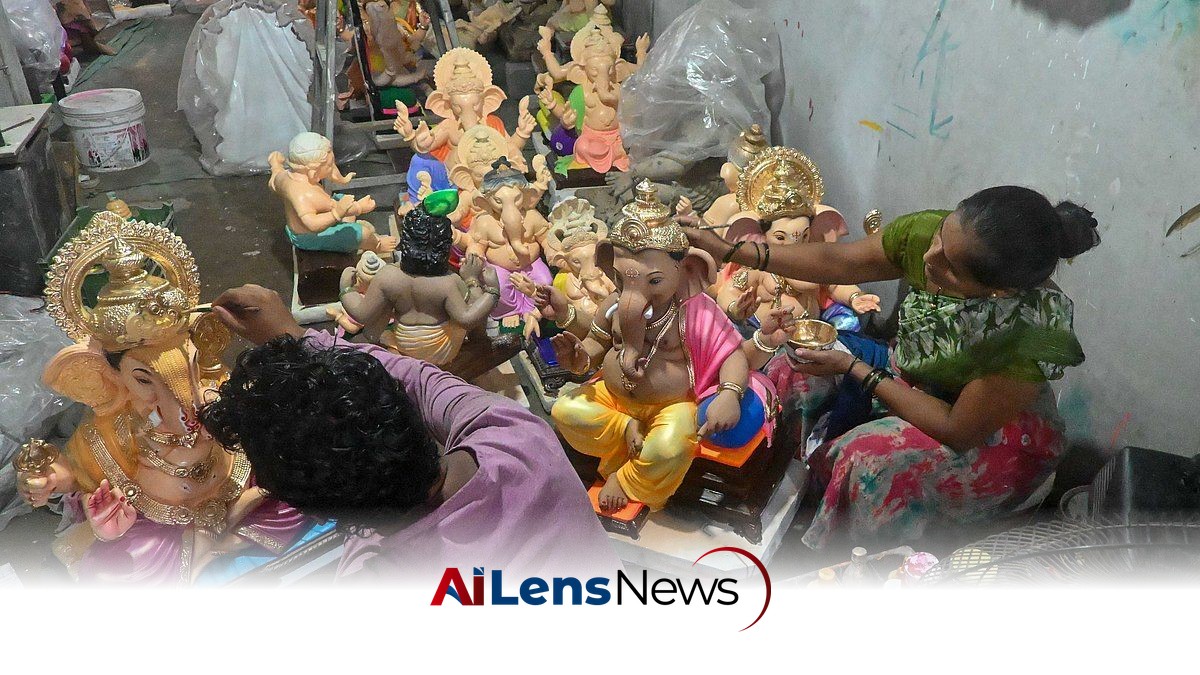


Despite devastating floods in July, artisans in Maharashtra's Pen tehsil are determined to continue their tradition of idol-making for Ganeshotsav, showcasing remarkable resilience.
New Delhi, India Jul 19, 2026 ALN: Pen: Nestled amid paddy fields, small rivers, creeks, and old salt pans, Hamrapur and neighbouring villages of Pen tehsil in Maharashtra’s coastal Raigad district are alive with activities. After all, Ganeshotsav is just a couple of months away. This vibrant festival, celebrated with great fervor across India, honors Lord Ganesh, the Elephant-headed deity revered as the God of wisdom and the remover of obstacles. The significance of Ganeshotsav extends beyond mere celebration; it embodies themes of community, cultural heritage, and resilience in the face of adversity.
In the workshops here, artisans delicately paint the idols, polish the crown, and attach ornaments and clothes. The air is filled with the sounds of traditional devotional songs, with phrases like ‘Sukhkarta Dukhharta’ and ‘Om Gan Ganpataye Namah’ echoing through the spaces, creating an atmosphere of devotion and anticipation. These artisans are not just craftsmen; they are custodians of a rich cultural tradition that has been passed down through generations.
Just weeks after floods inundated workshops and damaged hundreds of idols, the setback has done little to dampen the spirit of the artisans, who are racing against time to ensure Ganpati Bappa arrives on schedule. The floods, which occurred during the heavy rainfall from July 4 to 8, wreaked havoc across the Mumbai metropolitan region, particularly affecting the Patalganga and Balgangan rivers that form the main basin in this area. The inundation not only damaged the idols but also affected the raw materials essential for idol-making, such as Plaster-of-Paris (PoP) and coconut-resha.
The artisans in Hamrapur and villages like Johe and Tambadshet are abuzz with activities as tempos line up to carry the idols elsewhere in Maharashtra and India. The Pen tehsil, due to its proximity to major urban centers like Mumbai and Pune, has flourished as a hub for the creation of Ganesh idols, both of PoP and clay. This geographical advantage has allowed local artisans to cater to a vast market, supplying idols to various regions and even internationally.
In 2023, Pen’s Ganesh idols were recognized with the Geographical Indication (GI) tag, a significant achievement that underscores the unique craftsmanship and cultural significance of the idols produced in this region. Such recognition not only enhances the marketability of the idols but also helps preserve the traditional techniques employed by local artisans.
“Idols made in Pen go across the Mumbai metropolitan region and all over Maharashtra. We also send idols to Karnataka, Goa, Madhya Pradesh, Telangana, Uttar Pradesh. Besides, we send abroad to places in the United States, United Kingdom, European cities, West Indies, and Mauritius,” said Abhay Mhatre, the President of Shree Ganesh Murtikar Prathisthan-Maharashtra Rajya, the apex body of the idol-makers. This extensive distribution network highlights the cultural exchange facilitated by the festival, bringing together communities across diverse geographies.
“The recent floods played havoc. People here have suffered losses. Not only were idols damaged, but also PoP sacks and coconut-resha. In my workshop, water rose up to five feet,” said Anant Mokal of Dhabha Centre. “For two to three days, we were stunned but we were back on our feet. After all, we have a responsibility. Our idols go across India,” he said. This resilience is characteristic of the local community, who, despite facing significant challenges, remain committed to their craft and the cultural traditions associated with it.
More than a dozen villages around Hamrapur depend completely on idol making. For eight to ten months of the year, artisans focus on creating idols of Lord Ganesh, and following the Ganesh festival, they transition to making idols of Goddess Durga for the Navratri-Durga Puja festival. This cyclical nature of their work not only sustains their livelihoods but also keeps the cultural practices alive through continuous engagement with traditional art forms.
“When the floods ravaged the locality, it was like everything was gone. But we are putting up a massive effort,” said Puja Patil of Ekdant Kala Kendra as she gave Ganesh idols the final touches. Her determination reflects the collective spirit of the community, which has rallied together to overcome the recent hardships and ensure that the festival proceeds as planned.
“It is around 50 years ago that idol making was adopted as a main work and business here. The people engaged in it are mainly from the Agri and Koli communities. A few of them are from the Kumbhar community,” said Mhatre, who runs the Rutuja Kala Kendra. The involvement of diverse communities in the idol-making process illustrates the interwoven fabric of social and cultural identities that contribute to the region's rich heritage.
“The majority of the workshop owners are graduates,” he said, adding that the annual business of each workshop ranges from Rs 30 lakh to Rs one crore. This economic contribution is significant, as it not only supports the artisans and their families but also stimulates the local economy. As far as the total business is concerned, it is estimated to be around Rs 500 to Rs 600 crore, indicating the immense scale of this industry.
“The size of idols ranges from less than a foot to around 14 feet. The price could be as little as Rs 200 to around Rs 15,000 depending on the size and shape,” he said, adding that people source idols individually as well as through big shops in their respective cities. This variety allows for a wide demographic to participate in the festival, ensuring that everyone, regardless of economic status, can partake in the celebration of Ganeshotsav.
The PoP, which is the main raw material, is sourced from Rajasthan while coconut-resha is brought from Karnataka and Tamil Nadu. The logistics of sourcing these materials further emphasizes the interconnectedness of regional economies and the collaborative efforts required to sustain the idol-making industry.
HAMRAPUR: In Figures
Total economy: Around Rs 500 to 600 crore
Total workshops: 1,500 plus
Total workers: 35,000 to 40,000
Idol size: Six inches to 14 feet.
Price: Rs 200 to 14,000
In conclusion, as the artisans of Hamrapur and surrounding villages prepare for Ganeshotsav, they embody a spirit of resilience and dedication that transcends the challenges posed by recent floods. Their commitment to preserving cultural traditions while adapting to changing circumstances highlights the importance of community and the enduring power of faith and creativity in the face of adversity. The upcoming festival will not only be a celebration of Lord Ganesh but also a testament to the strength and unity of the local artisans who play a crucial role in bringing this vibrant cultural event to life.
To learn more about the latest developments in Cultural Events, stay updated with our exclusive reports and analyses on AiLensNews.

