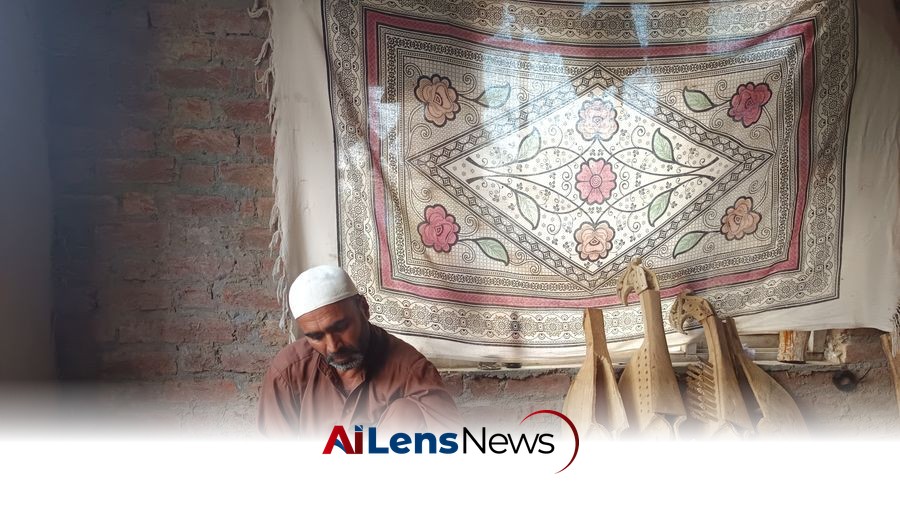


In Bandipora, Ghulam Mohammad Dar dedicates his life to keeping the Rabab, a symbol of Kashmiri Sufi music, alive amidst dwindling artisanship.
Leh, India Jul 21, 2026 ALN: Srinagar, Jul, 20: In a modest home in Khuserpora village of Hajin in north Kashmir's Bandipora district, the rhythmic sound of chisels on wood echoes with a deeper purpose—saving a fading legacy. Ghulam Mohammad Dar, a veteran musician turned artisan, stands at the forefront of a cultural preservation effort that seeks to keep alive the tradition of Rabab making, an integral part of Kashmir's rich musical heritage.
For over 25 years, Ghulam Mohammad Dar devoted his life to Kashmiri Sufi music, a genre steeped in mysticism and spirituality, characterized by its deep emotional resonance. Today, he has transformed into one of the Valley's few remaining Rabab makers, striving to preserve an instrument that has long been regarded as the soul of Kashmir's musical tradition. The Rabab, with its distinct sound, is not merely an instrument but a symbol of Kashmiri identity, representing the region's history, culture, and artistic expression.
What began as a passion has now become a mission for Dar. Over the past five years, he has painstakingly handcrafted Rababs—one at a time—using traditional techniques passed down through experience rather than formal training. His journey into the craft was not a straightforward path; it was fueled by a deep admiration for the Rabab, which he had played during his years of performing Sufi music. "I spent decades performing Sufi music and always admired the Rabab. One day I decided to learn how to make it myself. After successfully crafting my first Rabab, my confidence grew. Renowned Kashmiri singer Nabi Ji bought my first instrument, and that encouragement changed my life," Dar recounted, highlighting the pivotal moment that led him to embrace this new chapter.
The increasing demand for his handcrafted Rababs eventually forced him to step away from singing. "I had to leave my musical performances because I started receiving more orders than I could manage. Today, I spend almost all my time making Rababs," he said, illustrating the delicate balance between his love for music and the necessity of sustaining a livelihood through his craftsmanship.
Crafting a single Rabab is a slow and demanding process that requires not only skill but also immense patience. Every instrument is carved entirely by hand, without the use of machines, taking more than a month to complete. "Even if someone works day and night, they can hardly make eight Rababs in a year. Every piece requires patience, precision, and dedication," Dar explained, underscoring the commitment involved in maintaining the quality and authenticity of each instrument.
Despite the painstaking effort involved, financial returns remain meager. Dar noted that most Rabab makers belong to economically weaker sections of society and struggle to sustain their families through the craft alone. "We earn just enough to buy wood and meet our household expenses. There is little profit, but we continue because this art is our identity," he stated, reflecting the deep connection between the artisans and their craft.
Calling the Rabab the "King of Kashmiri Music," Dar emphasized its irreplaceable role in Sufi performances. He stated, "No Sufi performance feels complete without its soulful melodies. The Rabab gives life to Kashmiri music. It has a unique sound that no other instrument can replace. Today, I perform with a Rabab made by my own hands. It is a dream I waited more than 25 years to fulfill." This sentiment encapsulates the emotional bond that musicians share with their instruments, which serve as extensions of their artistic expression.
However, Dar's passion is tempered by concern for the future of the craft. He fears that the number of customers remains limited, forcing many artisans to abandon the profession altogether. "There are only a handful of buyers. At present, I am working on five Rababs ordered by different customers, but such orders are not regular," he lamented, pointing to the precarious nature of traditional craftsmanship in a rapidly changing economic landscape.
The Rabab is crafted from a special type of wood found in Kashmir, making the Valley one of the few places where the instrument continues to be produced using traditional methods. This unique material not only contributes to the distinct sound of the Rabab but also ties the instrument to the geographic and cultural identity of Kashmir itself. As urbanization and modernization sweep through the region, the survival of this craft hangs in the balance.
Dar has participated in numerous Sufi music festivals across Jammu and Kashmir and other parts of the country, showcasing his craftsmanship and the beauty of the Rabab. His handcrafted instruments have found buyers from different communities, including Kashmiri Pandits and Sikhs, illustrating the instrument's universal appeal and its role in bridging cultural divides.
In a ray of hope for the endangered craft, Dar's son has learned both the art of playing and making the Rabab. He is currently pursuing music studies at the University of Kashmir, carrying forward his father's legacy. "My son understands every stage of making the Rabab and is also studying music. I hope he will continue this tradition after me," Dar expressed with a sense of pride and optimism, recognizing the importance of passing down this cultural heritage to the next generation.
He firmly believes that the survival of Rabab making is closely linked to the future of Kashmiri Sufi music, as many musicians rely on the instrument for performances at cultural events, weddings, and government functions. The Rabab not only serves as a musical instrument but also as a cultural artifact that embodies the spirit of Kashmir's artistic traditions.
Warning that the centuries-old craft is on the brink of extinction, Dar appealed for collective efforts to protect it. "If the younger generation does not come forward to learn this art, Rabab making will disappear from Kashmir. This is not just my profession; it is our cultural heritage. It is our responsibility to preserve it before the last strings fall silent," he urged, calling for greater awareness and support for traditional crafts that are integral to the region's identity.
In conclusion, Ghulam Mohammad Dar's mission to preserve the Rabab heritage is not just about keeping a craft alive; it is about safeguarding a vital piece of Kashmir's cultural tapestry. As the challenges facing traditional artisans continue to mount, it becomes increasingly crucial for communities, governments, and cultural organizations to recognize the significance of these art forms and take proactive steps to ensure their survival. The Rabab, with its haunting melodies and deep-rooted cultural significance, deserves a future that honors its past.
To learn more about the latest developments in Cultural Events, stay updated with our exclusive reports and analyses on AiLensNews.

