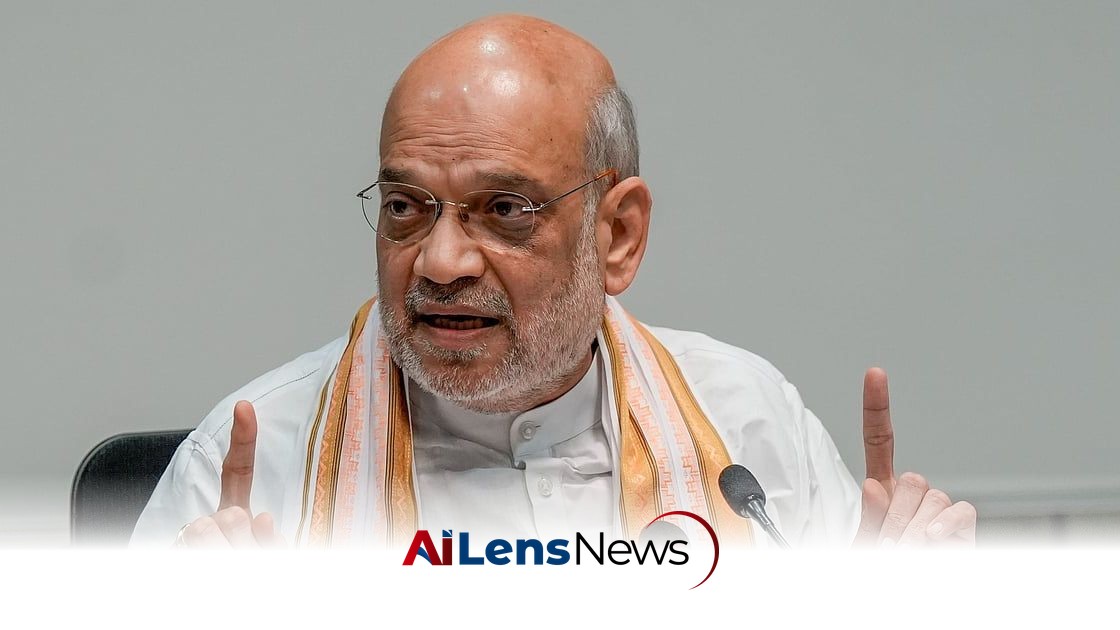


Union Home Minister Amit Shah launches India's first immersive language museum, emphasizing the importance of preserving Indian languages for cultural identity.
New Delhi, India Jul 19, 2026 ALN: Kolkata: Union Home Minister Amit Shah on Sunday stressed the need for every young person to learn at least one Indian language besides their mother tongue. He underlined the importance of preserving Indian languages to safeguard the nation's civilizational identity as he inaugurated the 'Museum of Word' here.
Shah described the country's first immersive language museum as "a major step to revitalize the country's cultural heritage".
Developed by the National Library under the aegis of the Union Culture Ministry, the 'Museum of Word' (Shabdalok) celebrates India's rich linguistic heritage and traces the evolution of its oral and written traditions through interactive, technology-driven exhibits.
Emphasizing the inseparable link between language and civilization, Shah stated that the expression of the culture of any nation or region is impossible without language, and language itself cannot exist without words born out of human emotions and expression.
He said future generations must understand that words emerge from emotions, languages are formed through words, culture is shaped through language, and civilization finds expression through it. "Unless our future generations understand this journey, the cultural revitalization of this country cannot truly take place. I am fully confident that this 'Museum of Word' will address a fundamental need in this process of cultural resurgence and will succeed in its mission," he said.
Shah noted that the museum would educate future generations about India's languages and culture, introduce them to the country's rich civilizational heritage, and serve as a powerful medium to carry forward India's linguistic and cultural renaissance.
Calling upon people to preserve India's multilingual ethos, he stated, "Apart from the mother tongue, learning another Indian language will not only help preserve one's own mother tongue but also ensure the long-term vitality of all Indian languages." He emphasized that every individual shares a deep emotional bond with their mother tongue, and this attachment should become an integral part of one's character.
The home minister outlined five principles that were "essential" for the preservation and development of Indian languages. He stated that the language spoken at home should become a child's first medium of learning in school, education should begin in the mother tongue, and schools and universities should evolve into centers of original thinking.
Every Indian language should be digitally empowered and made AI-enabled, and libraries and museums should reach young people through outreach initiatives instead of remaining confined to physical buildings.
"If governments, the education system, and, above all, the people of the country embrace these five principles, it will make a significant contribution to preserving, promoting, and serving India's languages," he said.
Shah mentioned that linguistics had evolved naturally over centuries to meet human needs, and it was this organic evolution that had enabled languages to gain widespread social acceptance.
He also appealed to students to reconnect with libraries, saying, "The future of this country does not depend on how crowded its colleges and universities are; rather, it depends on how many young people and adolescents visit its libraries." Shah stated that India's intellectual tradition had thrived on openness and debate. "We have never placed restrictions on ideas. We engaged in dialogue with the scriptures, held philosophical debates, and continuously embraced innovation alongside tradition," he said.
He added that India had never shied away from innovation and had always embraced whatever was noble and beneficial, integrating it with tradition, which had enabled the country's cultural journey to remain resilient despite repeated challenges throughout history.
After touring the museum, Shah suggested, "I urge the Culture Secretary to extend this narrative to the realms of computers and Artificial Intelligence so that our languages gain full acceptance in the modern era." Describing 'Shabdalok' as an innovative initiative, Shah said the museum sought to preserve India's multilingual consciousness, knowledge traditions, and collective memory through visual, auditory, and immersive experiences.
Shah remarked that Bengal had produced some of the country's greatest litterateurs, scientists, revolutionaries, and scholars, leading India intellectually and culturally for decades. Recalling the contributions of Rabindranath Tagore, Bankim Chandra Chattopadhyay, and Sri Aurobindo, he stated that Bengal had served as a global beacon of Indian consciousness.
Shah alleged, "There was a long period when attempts were made to alienate our Indian cultural consciousness from Bengal. Narrow ideologies and foreign ideologies weakened Bengal's ability to contribute to the country and the world." Expressing optimism about the state's future, Shah said Bengal was once again emerging as a leading force.
"I have been closely monitoring West Bengal for the last nine weeks, and it is becoming the 'prakash stambh' (guiding light) of the country. Now the time has come to once again make this great beacon of Indian consciousness capable of awakening the consciousness of the entire world with its full power," he said.
The first phase of 'Shabdalok' chronicles the diversity of Indian languages, scripts, and literature. Designed as an immersive cultural experience rather than a conventional museum, it uses digital displays, holograms, motion-sensor technology, audio-visual presentations, and interactive installations to engage visitors.
Its inaugural phase comprises nine galleries covering the origin of words, mother tongues, the evolution of languages, oral traditions, performing arts, contributions of great personalities to different languages, public dialogue, and the history of public libraries.
The museum celebrates 22 constitutionally recognized languages and traces their journey from oral traditions and ancient manuscripts to printed works and modern electronic texts. One of its key attractions allows visitors to trace the evolution of words over centuries, illustrating how their pronunciation, meaning, and usage have changed over time.
To learn more about the latest developments in Cultural Events, stay updated with our exclusive reports and analyses on AiLensNews.

