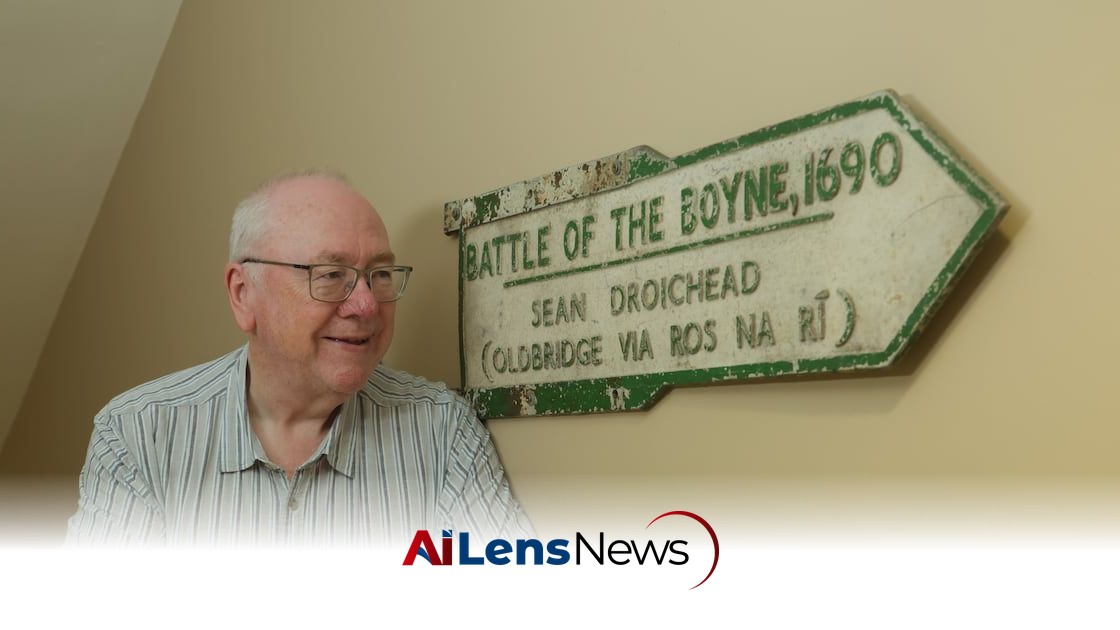


Rev. Mervyn Gibson discusses the evolving role of the Orange Order, its traditions, and his views on nationalism and Sinn Féin in a candid interview.
London, United Kingdom Jul 12, 2026 ALN: ONE of the Rev Mervyn Gibson’s earliest memories is when he was just four years old in 1962, watching his mother and father parading in his native Belfast to mark the 50th anniversary of the Ulster Covenant.
Just a year later, he followed generations of a “strong Orange family” tradition of joining the institution, and now at 68 he’s the Grand Secretary.
Northern Ireland has seen massive change since those days, both demographically but also societally, with a more secular age leading many to regard Orangeism as an anachronism, or at least significantly reduced in influence.
But the former RUC Special Branch officer and now Presbyterian Minister approaches this year’s “Twelfth” in confident mood.
“There’s never been as many Orange banners being unfurled and as many arches going up. People have a confidence. During the Troubles people kept their heads down, but all those traditions are coming back. That’s a sign of confidence going forward,” he says, adding that his message to nationalism is that the Orange fraternity want to be good neighbours.
I interviewed Gibson in Schomberg House on the Cregagh Road in Belfast which houses the Museum of Orange Heritage.
He’s a friendly, pleasant and engaging man, but his answers to more challenging questions about Orangeism are straight and direct and offer an uncompromising stance on certain principles.
He accepts criticisms of the past but says certain things were “of their time”, and he believes critics among nationalists and republicans are “better at propaganda than us”.
Asked, for example, about bands involved in controversial commemorations later attending official Orange parades, he says that provided they don’t display paramilitary flags, he doesn’t have an issue with them and they are welcomed.
He sees bonfires as part of his culture, and although critical of burning effigies or tricolours, he’s wary of regulation which could be used to ban smaller pyres.
The Drumcree dispute isn’t over, he says, but he doesn’t think street protest works now and he’s still very critical of the Parades Commission and the “skewed” law which set it up.
He won’t entertain taking part in the “new Ireland” debate, and several times during the interview he returns to criticism of Sinn Féin.
They won’t be invited to Schomberg House, he insists.
Gibson isn’t just the archetypal Orangeman. He’s an east Belfast Protestant through and through, with “nothing but fond memories” of 18 years of RUC service before changing career to full-time Presbyterian ministry on the Shankill and Newtownards Roads.
He’s been minister of Westbourne Presbyterian congregation for the past 24 years.
“I was a city boy, so I always wanted an inner-city congregation. That’s where my heart lay, that’s where I’m from,” he says.
He has strong roots in Donegal, where his father was from and where his grandfather was in the UVF and opposed partition.
The Ulster counties of Donegal, Cavan and Monaghan were abandoned by unionists of the day to secure a greater Protestant majority in the new Northern Ireland’s six counties.
Gibson’s father came north looking for work, which he says as a Protestant he couldn’t get in the new Free State, and met his mother, an east Belfast woman.
He says: “I’m very proud of my Donegal roots. I spent a lot of my summers down there growing up. The Orange tradition is still strong there and I recently went to open their Covenant exhibition in Donegal Museum.”
When he was 18, Gibson wanted to join the police. It was “either the police or army or the paramilitaries”.
“People were attacking our community and I wanted to defend it. Thankfully my mother and father had a strong influence on me and the Orange would have kept me out of the grip of more sinister forces.”
Asked about the unrepresentative nature of the RUC, he says: “Yes, it was a largely Protestant force but that wasn’t by choice. Let’s be honest, Roman Catholics who joined were murdered and intimidated.”
He was proud to work alongside Catholic officers and says it “struck me very hard” what they had to give up to join.
“We were impartial,” he insists.
“But you’re not naïve, there was a republican element that always hated the police, and it’s still out there,” he adds.
Within a couple of years of joining, Gibson moved to Special Branch with the aim of continuing to fight “terrorism”.
His police career ended at the time of the ceasefires in 1994 when he decided to study for church ministry.
“Although I’d been churched as they say, I didn’t have an evangelical, living faith. I didn’t come to faith until I was 33.”
During his five years studying, he got involved in community work including in the Shankill area.
“I learned to love the people of the Shankill through community work. It was very much practical hands-on faith,” he says, as he recalls working with people like May Blood, Jackie Redpath, Joe Stewart – “all great people with a grounding in faith”.
Gibson’s background in RUC Special Branch, before becoming steeped in community and church grassroots level work in Protestant areas of Belfast, has undoubtedly shaped him and he articulates a particular view.
To the wider public, he’s most associated with the Orange Order due to the media work and profile that comes with the post of Grand Secretary, which he took over from Drew Nelson 10 years ago.
I ask if the Orange Institution is a religious, political or cultural organisation, and he replies: “I think it’s all of those things. People join it for different reasons. We’ve got family, culture, charity, faith, political. Every lodge will have its own character.
“We’re a broad church in many ways,” he says, with all classes and all shades of unionism among the membership.
We discuss outside perceptions of aspects of the Orange Order: that it’s anti-Catholic, a secret society that enabled discrimination in the state, and that its image is tarnished by the participation of controversial bands as well as behaviour at bonfires and on the Twelfth itself.
He meets the criticism head on.
“What we do look for is people to look at us with an open mind and fairness and judge us by their experience as opposed to somebody else’s experience,” he says.
“To be honest, there’s some reasons for saying things over the years, just as there’s some reasons for us to claim that the Roman Catholic Church and the GAA is that way. Things happened over the years. I’m not going to justify things that today wouldn’t be justifiable. But they were of their day for everybody.
“Let’s look at discrimination, that you couldn’t get a job in Northern Ireland unless you were a Protestant. Why did my family leave Donegal, why did 50,000 other people leave Donegal? Because they were discriminated against.”
He offers an example of a Jamaican not getting a job in a Welsh coal mine, not because of their skin colour but because people got their families jobs.
“There was discrimination all round but the propaganda makes it out now that the only people discriminated against were Roman Catholics. But it was the nature of society. Society has changed since then, thankfully for us all.”
He continues: “We’re certainly not a secret society. I challenge that. We’re walking the main roads with the name of our banners, men identify themselves with collarettes.
“Of course, we’re a Protestant organisation. I can’t join the Roman Catholic Church, Protestants can’t take Communion in the Roman Catholic Church. I wouldn’t expect them to be anything else.
“We openly state we’re a Protestant organisation, so we’re the same as any other organisation.”
As regards controversial bands, he says the order is firm in not allowing any illegal flags at their events.
“We wouldn’t allow that to happen, the police wouldn’t allow that to happen, it hasn’t happened for a number of years.
“So, the bands taking part in one parade and then another, I don’t see a difficulty in that. I’m not going to judge them for that,” he says, pointing out that “republicans are the first to say that everybody has the right to commemorate their own as they see fit”.
“So, I don’t accept that we should split our bands and begin to judge each band, because I don’t hear any other community do that. If they don’t carry any paramilitary flags in our parades, there’s no difficulty,” says Gibson.
“It’s not how I would commemorate, but that’s their way to do it.”
He refers to republican commemorations and the GAA naming grounds to honour “people who murdered cold-bloodedly, murdered Protestant neighbours” and those cultures aren’t being “policed”.
“Why is it always the Orange picked on?”
As regards regulation of bonfires, Gibson says: “I’ve never denied the bonfires. They’re not part of the Orange but they’re part of our culture, part of my tradition. I grew up with bonfires, I love bonfires.”
He points out that as far back as Martin McGuinness’s death, he condemned posters of the Sinn Féin leader on bonfires, “but it wasn’t a good news story to carry”.
“No later than last year there were things I condemned around bonfires, effigies, for example, or burning tricolours.
“It’s the flag of a foreign country and was used on the coffins of IRA men, I get that, but we shouldn’t burn a flag.”
On health and safety concerns around bonfires, he says: “I’m not against regulation, I think everything needs to be regulated to an extent, but if regulation is only an excuse for suppression, then no.”
I suggest that regulation does work in solving contentious parades, for example, and that the Parades Commission proved not to be a device to stop marches.
“It was, and it is. It hasn’t worked,” says Gibson firmly.
“The legislation is still skewed and still needs changed. If republicans decided tomorrow they wanted to make an issue of parades, there’d be a problem every time and the legislation would back that problem and cause more trouble,” he says, arguing that the parades issue was “a tactic” and disputes largely ended because nationalists stopped objecting.
He believes Drumcree is “not resolved”, adding: “I would go down and join the brethren, and they walk to the bridge and hand the protest letter into the police every Sunday throughout the year.”
He doesn’t, however, believe there will be a return to mass protest.
“I think society’s moved on. People are no longer prepared to do those things. They’ll maybe protest in other ways. It doesn’t mean they don’t feel strongly about it, but just that street protests aren’t the way they portray that any more.”
Gibson believes that Sinn Féin, in particular, is happy to keep the parades legislation on the books.
Mistrust of republicans is a theme he returns to several times in the interview.
“We don’t bring or invite Sinn Féin to this building. In our museum, we have a record of 344 members of this institution that were murdered, 343 men and one woman. We’re not going to ask that organisation to come in here and sully their name and hurt their relatives who would feel betrayed.”
On Stormont, he believes that relationships are “slipping back”, but says the Orange community wants to “build a better Northern Ireland.”
“We will work towards that, we will advocate for that,” he says, but adds that he won’t get involved in the “nonsense” of the New Ireland debate.
“I’m not a turkey voting for Christmas, they have a predetermined outcome. I’d rather talk to the government of the Republic about how we co-operate to live together because we share an island.”
His message coming up to the Twelfth is that he wants to live in a “peaceful, economically viable Northern Ireland”.
I come away from the interview with one overriding thought. As a Protestant with no understanding or appreciation of the Orange Order, I was struck by the contrast between the era when the four-year-old Mervyn Gibson watched his first parade and today’s much-changed atmosphere.
From the dominant Orange community of the 1960s to the sense of frustration of having to defend their position in 2026, feeling that they are misunderstood or misrepresented. As hundreds of thousands of people attend parades on Monday, it doesn’t seem to be a good position for society that one significant section of it feels that way.
To learn more about the latest developments in Heritage & History, stay updated with our exclusive reports and analyses on AiLensNews.

