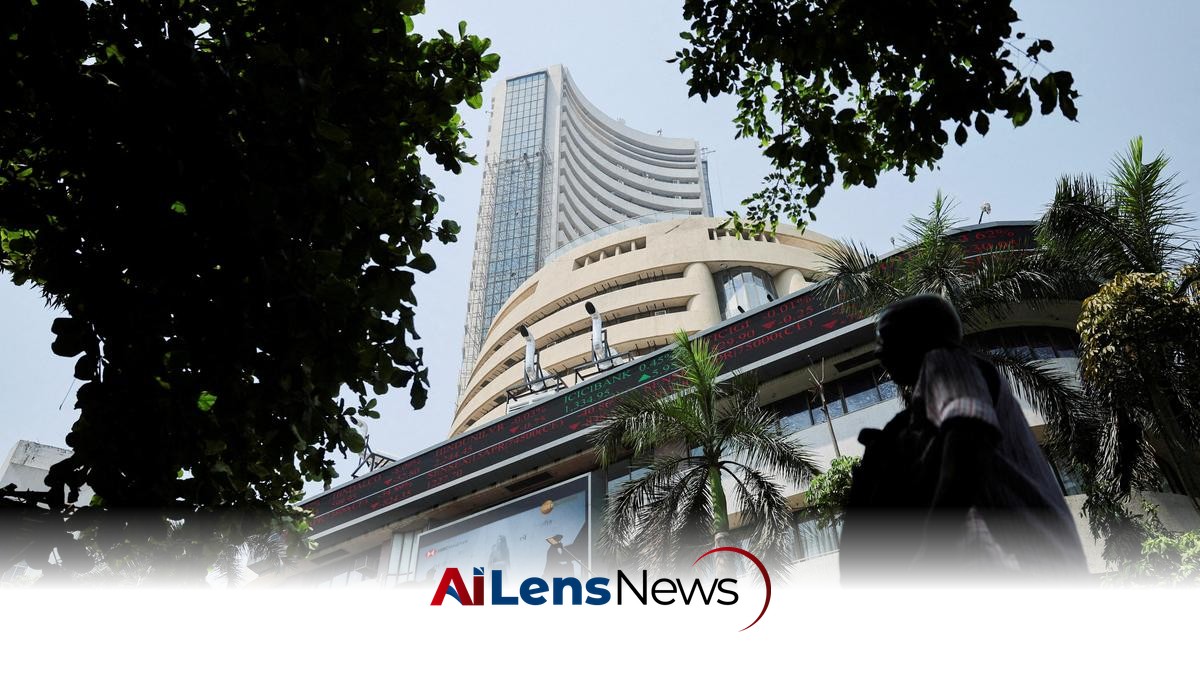


Stock markets decline as profit booking halts a four-day rally; Trent shares plummet over 12% amid weak Asian cues.
New Delhi, India Jul 7, 2026 ALN: Benchmark stock indices, including the BSE Sensex and NSE Nifty, experienced a downturn on Tuesday, July 7, 2026, marking the end of a four-day rally. The decline was attributed to last-minute profit-taking activities by investors, alongside weak trends observed in Asian markets, which contributed to a cautious sentiment among traders. The fluctuations in the stock market are often influenced by a combination of domestic and international factors, and this particular day showcased how quickly market sentiment can shift.
The 30-share BSE Sensex, which had shown promise earlier in the day, ultimately fell by 104.35 points, translating to a decrease of 0.13%, closing at 78,180.72. At its peak during the trading session, the index had surged by 379.85 points, or 0.48%, reaching 78,664.92. Conversely, the 50-share NSE Nifty also slipped, declining by 31.65 points or 0.13%, to finish at 24,398.70. This dip came after both indices had rallied more than 2% over the previous four sessions, achieving levels not seen in over two months. Such volatility is not uncommon in stock markets, especially after a strong rally, as investors often look to lock in profits.
Among the shares listed on the Sensex, Trent stood out as the top loser, experiencing a significant tumble of 12.42%. This decline was largely due to the company’s June quarter revenue growth falling short of market expectations, raising concerns among investors about its future performance. The retail sector, particularly companies like Trent, can be sensitive to consumer spending patterns and economic conditions. Other notable laggards included Adani Ports, Bharat Electronics, Larsen & Toubro, Reliance Industries, and ICICI Bank, all of which contributed to the overall decline in the indices. The performance of these companies is often indicative of broader economic trends, as they are involved in critical sectors such as infrastructure, finance, and energy.
Despite the losses in major stocks, gains in the Information Technology (IT) sector helped to mitigate the impact on the key indices. HCL Technologies led the charge, rising by 3.08% ahead of its upcoming financial results announcement. The IT sector has been a significant driver of growth in the Indian economy, and its performance is closely watched by investors. Other IT giants such as Tech Mahindra, Infosys, and Tata Consultancy Services (TCS) also saw upward movement. TCS is particularly noteworthy as it is set to announce its quarterly results on Thursday, July 9, marking the commencement of the earnings season for Indian IT firms. The anticipation surrounding these results can lead to increased trading activity as investors speculate on the potential outcomes.
In addition to the IT sector's positive performance, Titan Company saw a notable increase of 2.62% following the announcement of a 41% growth in its revenue for the June quarter of FY27. This growth was attributed to strong performances across its jewellery, watches, and eyewear segments. The consumer sentiment in India has been on a gradual upward trajectory, which benefits companies in the retail and luxury goods sectors. Similarly, Eternal's stock rose by 2.12%, reflecting positive investor sentiment towards these companies. The success of these companies highlights a potential shift in consumer behavior, indicating a willingness to spend on non-essential items.
Market analysts provided insights into the day's trading dynamics. Vinod Nair, Head of Research at Geojit Investments Ltd, noted that profit booking became evident in the latter half of the session. He highlighted the influence of weakness across Asian markets and investor caution ahead of the release of the US Federal Reserve's minutes, which weighed on market sentiment. The Federal Reserve's communications are closely monitored by global investors as they can signal future monetary policy directions, which can have far-reaching implications for markets worldwide. However, he acknowledged that IT stocks continued to provide support, rebounding from recent corrections as investors prepared for the earnings season.
On a broader scale, the BSE SmallCap Select index declined by 1.08%, while the MidCap Select index saw a slight dip of 0.15%. Sector-wise performance indicated a notable drop in Capital Goods, which fell by 1.73%, followed by Realty at 1.61%, and Industrials at 1.49%. Other sectors such as Power, Metals, Commodities, and Hospitals also recorded declines, emphasizing the overall bearish sentiment in the market. The performance of these sectors can often reflect underlying economic conditions, including infrastructure spending and consumer demand.
In contrast, the IT sector exhibited resilience, with focused IT stocks surging by 2.25%, and the broader IT category rising by 2.12%. Additionally, Consumer Durables and MidSmall Private Banks also recorded modest gains, indicating some pockets of strength amid the broader market weakness. Overall, a total of 2,633 stocks declined, while 1,599 advanced, and 165 remained unchanged on the BSE, reflecting a challenging trading environment. The breadth of the market, as indicated by the number of advancing versus declining stocks, provides a snapshot of investor sentiment and market health.
Further commentary from Ponmudi R., CEO of Enrich Money, emphasized that Indian equities ended the day marginally lower, halting a four-session winning streak. He attributed this to weak cues from Asian markets and geopolitical tensions, such as a renewed attack on an oil vessel in the Strait of Hormuz, which dampened investor sentiment. Such geopolitical events often lead to fluctuations in oil prices and can have ripple effects on global markets. The Strait of Hormuz is a critical chokepoint for global oil transportation, and any disruptions in this region can lead to heightened volatility in oil prices, which in turn impacts energy stocks and overall market sentiment.
Indeed, Brent crude, the global oil benchmark, saw a rise of 1.22%, reaching $72.87 per barrel, reflecting the impact of geopolitical tensions on energy prices. In the Asian markets, South Korea's Kospi index suffered a significant decline of 4.91%, while Japan's Nikkei 225, Shanghai's SSE Composite index, and Hong Kong's Hang Seng all closed lower, indicating a broader regional downturn. The interconnectedness of global markets means that events in one region can have cascading effects on markets in others, leading to a complex web of influences that traders must navigate.
In Europe, market performance was mixed, suggesting a divergence in investor sentiment across different regions. Meanwhile, U.S. markets had ended higher on Monday, July 6, 2026, which may have contributed to the initial optimism in Asian and Indian markets before the subsequent profit-taking occurred. The contrast between U.S. market performance and Asian markets can create uncertainty for investors, as they assess the implications for their own portfolios.
Notably, Foreign Institutional Investors (FIIs) continued to show interest in Indian equities, having purchased shares worth ₹243.03 crore on Monday, July 6, according to exchange data. This inflow of foreign capital often serves as a barometer of international investor confidence in the Indian market. The participation of FIIs can significantly influence market trends, as their investment decisions are often based on macroeconomic indicators and geopolitical developments.
On the preceding day, July 6, the Sensex had gained 521.16 points, or 0.67%, closing at 78,285.07, while the Nifty climbed 159.50 points, or 0.66%, to end at 24,430.35. This prior rally had set a positive backdrop for the trading session on July 7, but ultimately, profit booking and external market influences led to a reversal in fortunes. Such quick shifts underscore the importance of staying informed about both local and global market conditions.
As the market moves forward, investors will be closely monitoring upcoming earnings reports, particularly from major IT companies, as these results could significantly influence market sentiment and trends. Earnings reports are critical for assessing the health of companies and can lead to marked price movements in response to better or worse-than-expected outcomes. Additionally, geopolitical developments and macroeconomic indicators will continue to play a crucial role in shaping market dynamics in the coming weeks. The interplay of these factors will be essential for investors as they navigate the complexities of the financial landscape.
To learn more about the latest developments in Markets, stay updated with our exclusive reports and analyses on AiLensNews.

