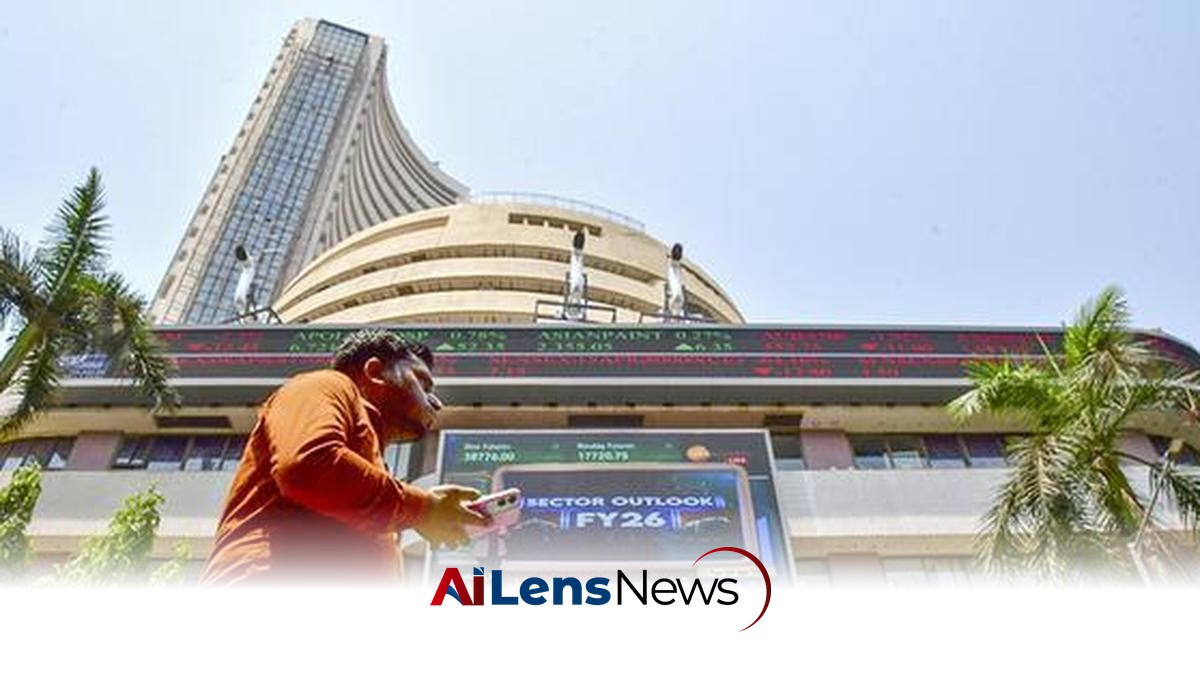


Indian markets rise for the fourth consecutive day, driven by bank stocks and falling oil prices, amid strong foreign inflows.
New Delhi, India Jul 6, 2026 ALN: Benchmark indices Sensex and Nifty ended higher, taking their winning run to the fourth day on Monday (July 6, 2026), helped by buying in blue-chip bank stocks and lower crude oil prices. This positive momentum in the stock market reflects a broader trend of recovery and growth, particularly in the banking sector which has seen increased investor confidence. The banking sector is often viewed as a crucial barometer of economic health, and its performance can significantly influence market trends.
Fresh foreign fund inflows also added to the optimistic trend in the domestic equity market. The influx of foreign institutional investment (FII) is often seen as a barometer of global investor sentiment towards a country's economic prospects. When foreign investors buy into Indian equities, it typically signals confidence in the country's growth potential, thereby influencing domestic investor behavior positively. This dynamic is particularly important for emerging markets like India, where domestic capital may be supplemented by foreign investment to drive growth.
Market Overview
The 30-share BSE Sensex jumped 521.16 points, or 0.67%, to settle at 78,285.07. During the day, it surged 634.15 points, or 0.81%, to reach a peak of 78,398.06. This strong performance indicates robust market activity and investor engagement, particularly in sectors that are traditionally seen as stable and growth-oriented. The upward movement in indices not only reflects investor sentiment but also suggests a larger recovery trend following previous market fluctuations.
The 50-share NSE Nifty climbed 159.50 points, or 0.66%, to end at 24,430.35. In just four trading days, the BSE benchmark has jumped 1,806.4 points, or 2.36%, while the Nifty surged 564.6 points, also reflecting a 2.36% increase. Such significant increases over a short period suggest a strong bullish sentiment among investors, likely driven by positive economic indicators and corporate earnings expectations. The consistency of these gains highlights the resilience of the market amidst ongoing global uncertainties.
From the Sensex pack, HDFC Bank climbed 3.59%, leading the gains among the 30 firms. Other notable winners included Mahindra, Bharat Electronics, Reliance Industries, ICICI Bank, and Maruti. The banking sector, in particular, has been a focal point for investors, as banks are often viewed as proxies for economic health. Their performance can indicate broader economic trends, including consumer spending, corporate investment, and overall financial stability. The gains in these blue-chip stocks underscore a confidence in the banking sector's ability to navigate through economic challenges.
Conversely, Kotak Mahindra Bank, Tata Consultancy Services, Bajaj Finserv, and Power Grid were among the laggards. The performance of these companies highlights the volatility that can exist within the market, where even strong companies can experience fluctuations based on investor sentiment, market conditions, and sector-specific challenges. Such variances remind investors of the need for a diversified portfolio to mitigate risks associated with sector-specific downturns.
Brent Crude, the global oil benchmark, declined 0.82% to $71.53 per barrel. The drop in oil prices can have significant implications for economies reliant on oil imports, such as India, as it may lead to reduced inflationary pressures and improved trade balances. Lower oil prices can also benefit various sectors, including transportation and manufacturing, by reducing operational costs. For India, a nation that imports a substantial portion of its oil, lower crude prices can translate to savings on import bills, which can be redirected into other areas of the economy.
Foreign Institutional Investors (FIIs) bought equities worth ₹1,355.33 crore on Friday (July 3, 2026), according to exchange data. This level of investment reflects a strong interest in the Indian market, which is increasingly being viewed as an attractive destination for investment due to its potential for growth and favorable demographics. The inflow of foreign capital not only boosts market liquidity but also fosters a sense of stability and confidence among domestic investors.
Vinod Nair, Head of Research at Geojit Investments Ltd., commented, "Indian equities traded with a positive bias despite mixed global cues, supported by stable crude prices. Continued softness in crude would support inflation, the current account balance, OMC profitability, and overall macro stability." Nair's comments underscore the interconnectedness of global markets and the ways in which external factors, such as oil prices, can influence domestic economic conditions. This highlights the importance of monitoring global economic indicators as they can have profound effects on local markets.
Globally, profit-booking in crowded AI-led trades impacted the market, while India could perform well, led by large caps due to improvements in FIIs inflow trends, he added. The mention of AI-led trades highlights the growing influence of technology and innovation in the investment landscape, where sectors tied to advancements in artificial intelligence are becoming increasingly popular among investors. The rapid evolution of technology is reshaping investment strategies, with more funds being allocated to companies that are perceived to be at the forefront of technological innovation.
In Asian markets, Hong Kong's Hang Seng index settled higher, while South Korea's Kospi, Japan's Nikkei 225 index, and Shanghai's SSE Composite index ended lower. The mixed performance across Asian markets illustrates the varying economic conditions and investor sentiments across the region, which can be influenced by local economic data, geopolitical tensions, and global market trends. This disparity in market performance serves as a reminder of the diverse economic narratives that exist within the Asian continent.
Markets in Europe were trading on a mixed note, reflecting the uncertainty that often accompanies economic data releases and political developments. European markets are often influenced by a range of factors, including monetary policy decisions from the European Central Bank and ongoing discussions surrounding trade and economic recovery in the wake of the pandemic. The volatility in European markets can often spill over into global markets, impacting investor sentiment worldwide.
U.S. markets were closed on Friday (July 3, 2026) due to the country's Independence Day celebrations. The closure of U.S. markets can have a ripple effect on global trading patterns, as many investors and traders often adjust their positions based on expectations of market movements once the U.S. markets reopen. The interdependence of global markets means that significant events in one region can influence trading strategies and outcomes in another.
On Friday (July 3, 2026), the Sensex climbed 261.79 points, or 0.34%, to settle at 77,763.91, while the Nifty went up 95.15 points, or 0.39%, to end at 24,270.85. These incremental gains further illustrate the positive trajectory of the Indian equity markets, as they continue to recover from previous downturns and navigate the complexities of a global economy that is still adjusting to post-pandemic realities. The resilience of the Indian market in the face of global uncertainties bodes well for its future prospects.
In conclusion, the recent surge in the Indian stock market, led by banking stocks and supported by lower oil prices and foreign investment, reflects a complex interplay of domestic and global economic factors. As investors remain optimistic about the potential for growth, the market's performance will continue to be closely monitored for signs of sustainability and resilience in the face of ongoing challenges and uncertainties in the global economic landscape. The ability of the Indian market to attract foreign investment and maintain stability amidst global fluctuations will be crucial for its long-term growth trajectory.
To learn more about the latest developments in Markets, stay updated with our exclusive reports and analyses on AiLensNews.

