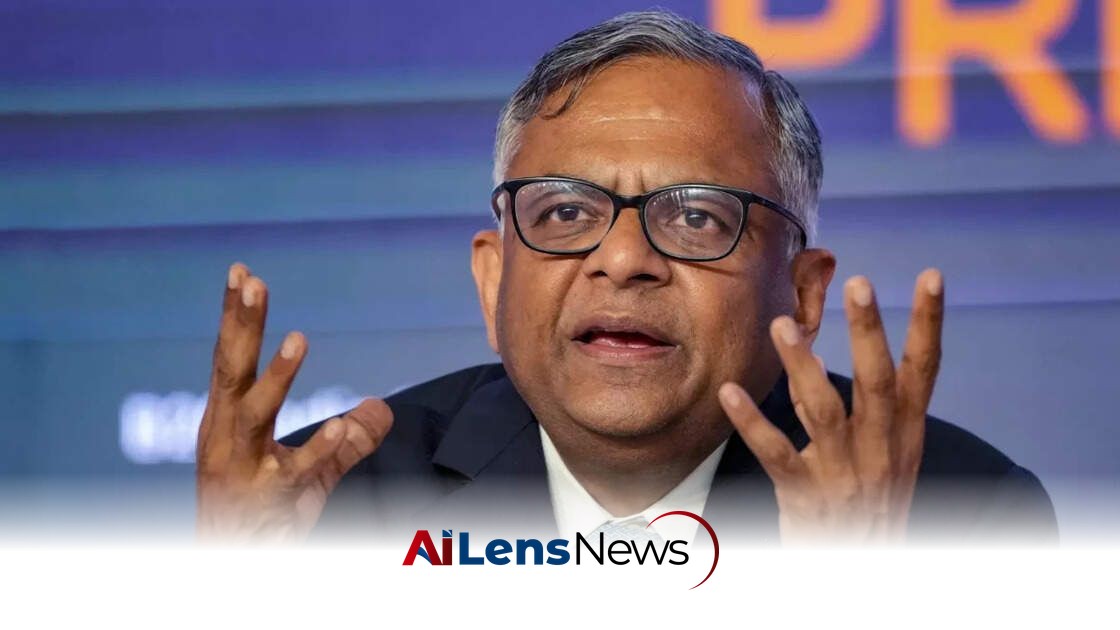


Tata Sons announced a 22% rise in FY26 profit to ₹31,961 crore, driven by investment gains. Chairman N. Chandrasekaran emphasized long-term strategies despite losses in some sectors.
New Delhi, India Jul 27, 2026 ALN: Mumbai: Tata Sons reported a 22% increase in annual profit, driven by investment gains and stronger earnings from its portfolio companies, while Chairman N. Chandrasekaran defended continued investments in loss-making businesses such as Air India and Tata Digital as long-term strategic bets.
The holding company posted standalone net profit of Rs 31,961 crore for the year ended March 2026, up from Rs 26,232 crore a year earlier, while revenue rose 9.1% to Rs 42,367 crore. The board recommended a dividend of Rs 1,10,717 per share, reflecting the company's strong financial performance despite challenges faced in certain sectors.
At the group level, revenue rose 7.8% to Rs 16.24 lakh crore and profit climbed 52% to Rs 1.71 lakh crore. Chandrasekaran noted that revenue is “2.1x and profits are 5.4x their FY20 levels, reflecting sustained and significant turnaround efforts across the institution.” This indicates a robust recovery trajectory for Tata Sons, especially when compared to the pre-pandemic fiscal year.
However, not all sectors within the Tata group experienced growth. Air India remained the group’s biggest drag, reporting a net loss of Rs 22,238 crore in FY26. The airline has been under scrutiny as it struggles to recover from years of financial mismanagement and operational inefficiencies. Tata Digital also widened its loss to Rs 4,974 crore from Rs 4,610 crore a year earlier, while the battery venture Agratas lost Rs 1,101 crore and Tata Electronics reported a loss of Rs 1,611 crore. These figures highlight the ongoing challenges in transitioning these businesses into profitable ventures.
Explaining the losses at Tata Digital, Chandrasekaran said, “The Indian e-commerce market shifted rapidly towards quick commerce, which BigBasket is adapting to.” The rapid transformation in consumer behavior and the competitive landscape in e-commerce have necessitated a shift in strategy for Tata Digital. While acknowledging that Tata Digital reported a loss of Rs 4,974 crore, he added that “Tata Digital’s ambitions are great and are beginning to show progress.” The business has scaled to a gross merchandise value (GMV) of Rs 46,515 crore within four years, while Tata Neu is being refocused on financial services, loyalty, and payments, indicating a pivot towards more sustainable business models in the digital space.
On Air India, Chandrasekaran said the carrier faced “the most challenging year” due to airspace closures, fuel price increases linked to the West Asia conflict, foreign exchange fluctuations, and the AI171 crash. These factors have compounded the difficulties faced by the airline, which is in the midst of a significant restructuring effort. However, he emphasized that “Air India’s transformation must be seen as a five- to ten-year journey,” given fleet renewal, supply-chain disruptions, and the need to overhaul legacy systems and culture. This long-term perspective is essential for stakeholders to understand the depth of the challenges and the commitment required for a successful turnaround.
On digital businesses, Chandrasekaran acknowledged that Tata Digital continues to face challenges after rapid changes in India's e-commerce market. The company reported a ₹4,974 crore loss in FY26 but achieved a gross merchandise value of ₹46,515 crore. He stated that Tata Neu would now focus more sharply on financial services and loyalty programmes, with plans to increase monthly payments users ten-fold while expanding lending and insurance offerings. This shift in strategy could potentially enhance customer engagement and drive revenue growth in the long term.
Reviewing operating companies, Chandrasekaran highlighted several milestones achieved across the Tata group. Tata Capital's landmark IPO, Tata Motors' demerger of its commercial and passenger vehicle businesses, Tata Steel's record domestic deliveries, Tata Power's expansion of clean energy capacity, Titan's international growth, Tata AIA's market share gains, and Indian Hotels' record revenue and profitability all exemplify the group's strategic focus on diversification and innovation. These developments not only enhance the group's overall performance but also position Tata as a key player in various sectors critical to India's growth.
He also pointed to milestones in defence manufacturing, including the maiden flight of the "Made in India" C-295 transport aircraft, the launch of India's first private-sector helicopter final assembly line for the Airbus H125, and Tata Advanced Systems' first overseas defence manufacturing facility in Morocco. These initiatives reflect Tata's commitment to bolstering India's defence capabilities and contributing to the country’s self-reliance in critical sectors.
On Air India, Chandrasekaran acknowledged FY26 had been the airline's most difficult year due to airspace disruptions, higher fuel prices arising from the West Asia conflict, currency volatility, and the AI171 crash. Despite these challenges, he said customer satisfaction and operational performance had improved significantly, with Air India achieving the country's best on-time arrival performance in June 2026 and Net Promoter Scores improving from -35 in FY23 to +42. This improvement in customer metrics suggests that the airline's efforts to enhance service quality and operational efficiency are beginning to bear fruit.
Calling Air India's revival a five-to-ten-year transformation, Chandrasekaran said rebuilding the national carrier would require sustained investment in fleet renewal, technology, training, and customer service. This commitment underscores Tata's long-term vision for Air India, which aims to restore its status as a premier airline in both domestic and international markets.
Looking beyond immediate financial performance, Chandrasekaran framed the group's investments in semiconductors, batteries, aviation, telecom equipment, defence manufacturing, and AI as nation-building initiatives designed to help India achieve technological independence by 2047. This vision aligns with the Indian government's broader goals of enhancing self-sufficiency in key industries and fostering innovation-driven growth.
Chandrasekaran stated that the group’s investments in semiconductors, aviation, batteries, and defence are aimed at creating long-term industrial capabilities, adding, “We are building for the India of 2047,” and “the next industrial revolution is being designed and built right now, and its building blocks are silicon, connectivity, energy, and security.” This forward-looking approach emphasizes the importance of strategic investments in shaping the future of India's economy.
Aggregate revenue has risen to Rs 16.24 lakh crore in FY26 from Rs 7.9 lakh crore in FY20, while profit after tax has climbed to Rs 1.71 lakh crore from about Rs 31,000 crore. The combined market capitalisation of the group’s listed companies has expanded to around Rs 39 lakh crore, compared with roughly Rs 13 lakh crore in FY20, generating shareholder returns that outpaced the Nifty 50 over the period. This impressive growth trajectory reflects the effectiveness of Tata's strategic initiatives and its ability to adapt to changing market conditions.
Since FY20, Tata has tripled market value and increased profit more than fivefold while simultaneously funding India’s biggest private-sector bets in aviation, semiconductors, batteries, and digital commerce—businesses that together still lose nearly Rs 30,000 crore annually. This juxtaposition of strong overall performance against ongoing losses in certain sectors highlights the complexities and challenges of managing a diversified portfolio in rapidly evolving industries.
In conclusion, Tata Sons' recent financial results showcase a strong recovery and strategic growth, but also reveal the ongoing challenges in specific sectors such as Air India and Tata Digital. The company's long-term vision and commitment to nation-building initiatives underscore its role as a key player in India's landscape, while its focus on innovation and transformation positions it for future success.
To learn more about the latest developments in Corporate & Industry Insights, stay updated with our exclusive reports and analyses on AiLensNews.

