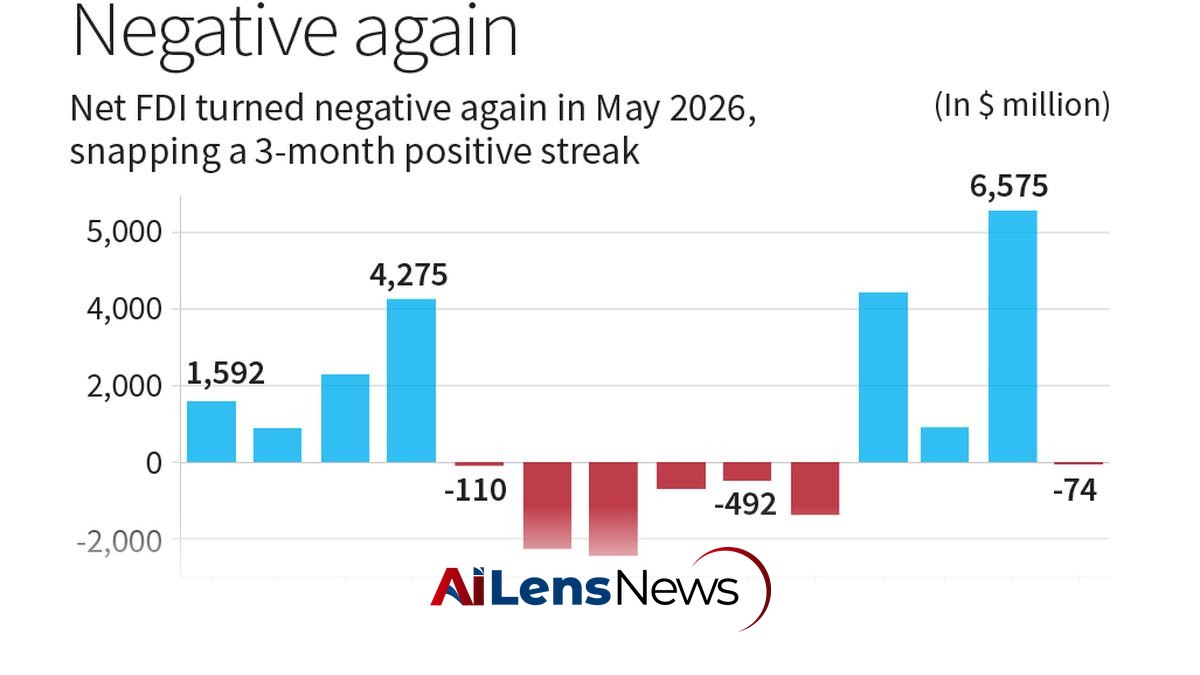


In May 2026, net foreign direct investment in India fell to negative, with outflows surpassing inflows by $74 million, marking the end of a three-month positive trend.
New Delhi, India Jul 23, 2026 ALN: In May 2026, the landscape of foreign direct investment (FDI) in India experienced a notable shift as net inflows turned negative, marking a significant development in the country's economic environment. According to the latest data from the Reserve Bank of India (RBI), outflows exceeded inflows by $74 million, effectively ending a three-month period of positive net inflows. This downturn can be attributed to a steep decline in direct investments entering India, highlighting potential concerns regarding the country's attractiveness as a destination for foreign capital.
The figures indicate that while outflows from India fell, the drop in inflows was even more pronounced. Specifically, the gross inflows of foreign direct investment totaled approximately $6.1 billion in May 2026, representing a staggering 60% decrease compared to the previous month of April and nearly 23% lower than the same month in the previous year. This decline raises questions about the factors influencing foreign investor sentiment and the overall economic landscape in India.
The RBI's analysis did not isolate May 2026 as a standalone month but instead provided insights into the broader April-May 2026 period. During this timeframe, key players such as Japan, Singapore, and Mauritius accounted for approximately 74% of the total equity inflows into India. The financial services sector emerged as the largest recipient of these investments, followed closely by manufacturing, retail and wholesale trade, and computer services. Collectively, these sectors represented around 80% of total inflows, underscoring the sectors that continue to attract foreign capital despite the overall downturn.
On the outflow side, total outward investments by Indian companies reached $2.4 billion in May 2026. This figure was notable for being 49% lower than the outflows recorded in April and 9.6% lower than those in May 2025. A significant portion of these outward investments, approximately 74%, was directed toward established markets such as the United States, the Cayman Islands, and the Netherlands. The sectors that dominated these outward flows included financial services, insurance, and manufacturing, which together accounted for more than 85% of the total outward FDI during the April-May 2026 period.
In addition to outward investments, the RBI reported that repatriation and disinvestment by foreign companies operating in India amounted to $3.7 billion in May 2026. This figure represented a 5.1% decrease from April and a 13.3% decrease compared to May of the previous year. Such trends may signal a cautious approach among foreign companies regarding their investments in the Indian market, which could have implications for future economic growth and stability.
The recent developments in FDI trends come against a backdrop of various economic factors influencing investor behavior. Global economic conditions, changes in domestic policies, and geopolitical tensions can all play significant roles in shaping the flow of foreign direct investment. For instance, uncertainties surrounding international trade agreements, currency fluctuations, and the regulatory environment in India may contribute to the hesitance of foreign investors.
Moreover, the decline in FDI inflows may raise concerns among policymakers regarding India's competitiveness in attracting foreign investments. In recent years, the Indian government has implemented several reforms aimed at enhancing the ease of doing and creating a more favorable investment climate. However, the recent data suggests that these efforts may need to be reassessed or intensified to restore confidence among foreign investors.
Additionally, the sectors that continue to attract foreign investment, such as financial services and manufacturing, are critical to India's economic growth strategy. As the country seeks to position itself as a global manufacturing hub and a leader in technology and services, understanding the dynamics of FDI inflows and outflows becomes increasingly important.
Furthermore, the implications of negative net FDI could extend beyond immediate economic metrics. A decline in foreign direct investment may impact job creation, innovation, and overall economic development. As foreign companies often bring in capital, technology, and expertise, a reduction in their presence could hinder India's growth trajectory.
In conclusion, the shift to negative net foreign direct investment in May 2026 presents a complex scenario for India's economy. While certain sectors continue to attract significant investment, the overall decline in inflows raises important questions about the country's investment climate and the factors influencing foreign investor decisions. Moving forward, it will be crucial for policymakers to analyze these trends closely and implement strategies to enhance India's attractiveness as a destination for foreign direct investment, ensuring sustainable economic growth and development in the years to come.
To understand the implications of this shift in FDI, it is essential to delve deeper into the factors that contribute to foreign investor sentiment. The global economic landscape has been characterized by uncertainty, with fluctuating trade relations, particularly between major economies. The ongoing impact of geopolitical tensions, such as those arising from trade disputes or sanctions, can significantly affect investment flows. For instance, if foreign investors perceive India as a less stable or predictable environment due to these tensions, they may opt to redirect their investments to more stable markets.
Moreover, domestic policies play a crucial role in shaping the investment climate. The Indian government has made strides in simplifying regulations and enhancing transparency in recent years. However, challenges persist, such as bureaucratic hurdles and inconsistent policy implementations. Investors often seek clarity and stability in the regulatory landscape, and any perceived volatility can deter them from committing capital to the Indian market.
Additionally, the economic performance of India itself is a critical factor. The country has seen impressive growth rates in the past, but any signs of economic slowdown or structural issues may raise red flags for foreign investors. For example, the inflation rate, currency stability, and overall economic growth projections are closely monitored by investors when making decisions about where to allocate their resources.
Another aspect to consider is the competitive landscape of FDI. Countries in the region, such as Vietnam and Indonesia, have been aggressively promoting themselves as viable alternatives for foreign investment. These nations have implemented favorable policies, improved infrastructure, and offered competitive labor costs, making them attractive destinations for foreign capital. As a result, India may face increased competition in attracting FDI, necessitating a strategic response from policymakers to ensure that the country remains a preferred investment destination.
In light of these challenges, it is imperative for the Indian government to reassess its approach to attracting foreign investment. Policymakers must engage with stakeholders, including domestic and foreign es, to identify barriers to investment and address them effectively. Initiatives aimed at improving the ease of doing , enhancing infrastructure, and fostering innovation and entrepreneurship can play a pivotal role in restoring investor confidence.
Furthermore, the emphasis on sectors that continue to attract foreign investment, such as financial services and manufacturing, should be coupled with efforts to diversify the investment portfolio. Encouraging investments in emerging sectors such as renewable energy, technology, and healthcare could provide new avenues for growth and mitigate the risks associated with over-reliance on a few key sectors.
Ultimately, the negative net FDI in May 2026 serves as a wake-up call for India. It underscores the need for a proactive and strategic approach to foreign investment, one that recognizes the evolving global landscape and the importance of maintaining a competitive edge. By addressing the underlying issues that contribute to declining FDI, India can work towards fostering a more robust and resilient economy that attracts and retains foreign capital, driving sustainable growth in the years ahead.
To learn more about the latest developments in Economy & Policy, stay updated with our exclusive reports and analyses on AiLensNews.

