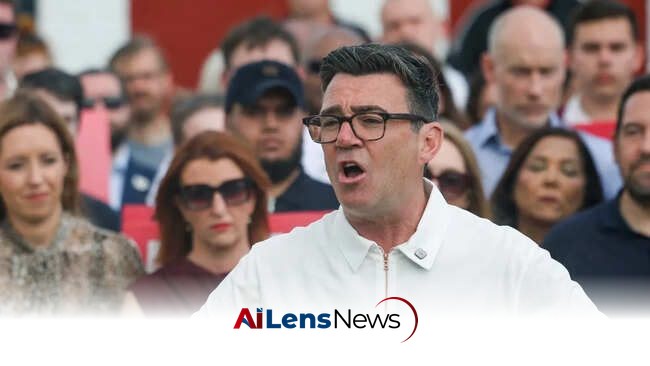


Andy Burnham has been declared the new leader of the Labour Party and will take office as Prime Minister on Monday, focusing on public service reform and recovery.
New Delhi, India Jul 17, 2026 ALN: Andy Burnham was officially declared leader of Britain's Labour Party on Friday, paving the way for him to replace Keir Starmer as the country's prime minister when he formally takes office on Monday. This transition marks a significant moment in British politics, as Burnham is poised to take the helm of a party that has seen its fortunes fluctuate dramatically over the past decade.
As centre-left Labour has an overwhelming majority in parliament, the 56-year-old is set to replace Keir Starmer in 10 Downing Street a mere four weeks after he sensationally returned as an MP following a nine-year absence. Burnham's rise to leadership is notable not only for its rapid pace but also for the context of his political journey, which has been marked by resilience and reinvention.
UK's Andy Burnham Takes Small-Town Regeneration to the National Stage as PM
Burnham will become the UK's seventh prime minister in a decade, a reflection of the turbulent political landscape that has characterized British governance in recent years. The frequent turnover of leadership is indicative of broader issues within the political system, where party loyalty and public support can wane rapidly in response to domestic challenges and policy failures. British lawmakers appear increasingly willing to turn against their own leaders when their party runs into political hot water, leading to a climate of instability.
Burnham -- nicknamed "King of the North" for winning three successive elections to the Greater Manchester mayoralty -- faced no challengers for the Labour leadership. His reputation as a capable leader at the local level has contributed to his ascent within the party, and his tenure as mayor has been marked by a focus on regional development and social issues. His ability to connect with constituents in Greater Manchester has been a cornerstone of his political identity, and it is this connection that Labour MPs hope will translate into broader appeal on the national stage.
He becomes the centre-left party's leader at the third attempt following failed bids in 2010 and 2015, when he lost out to Ed Miliband and Jeremy Corbyn respectively. These earlier attempts shaped his political philosophy and approach, as he learned from both the successes and failures of his predecessors. Burnham's experience within the party and government, coupled with his recent electoral success, has positioned him as a unifying figure capable of rallying support across various factions within Labour.
Burnham, an MP between 2001 and 2017 and former government minister, has since reinvented himself as a man of the people, melding a relaxed folksy style with slick social media videos. This blend of traditional political engagement with modern communication strategies has allowed him to resonate with a diverse electorate, particularly younger voters who are increasingly engaged through digital platforms. His approachable demeanor and relatable messaging have endeared him to many, setting a stark contrast to the more formal approach of his predecessor, Keir Starmer.
Labour MPs hope he can communicate with the public better than Starmer and that he is willing to take a more radical approach to reforming Britain's battered public services and firing up the economy. The challenges facing the UK are significant, including a struggling healthcare system, rising living costs, and a general sense of disillusionment among voters. Burnham's leadership will be tested as he seeks to articulate a vision for the future that addresses these pressing issues while also inspiring confidence in the Labour Party's ability to govern effectively.
Andy Burnham Likely to Remain Pro-India if He Becomes UK PM: Trade Chief Harjinder Kang
In a recent podcast with ex-footballer Gary Lineker, Burnham emphasized the need for optimism, stating, "We've got to give people a lift, haven't we? We've got to give people a stronger sense of hope and a feeling that the country's on the way back." This message of hope is crucial as Burnham prepares to lead a party that has faced significant electoral challenges and internal divisions. The Labour Party is betting that he is the best chance of reining in Nigel Farage's anti-immigrant Reform UK party, which is tipped in the polls to win the next general election, expected in 2029. The rise of Reform UK highlights the shifting political landscape in Britain, where issues of immigration and national identity have taken center stage in public discourse.
Starmer returned Labour to power after 14 years in opposition in July 2024 with a landslide victory over the Conservatives, who had cycled through four leaders in five years. This victory was seen as a turning point for Labour, but Starmer's premiership quickly became characterized by domestic policy missteps and controversies. His appointment of ex-Jeffrey Epstein associate Peter Mandelson as ambassador to Washington raised eyebrows and sparked criticism, further complicating his leadership. Disastrous local and regional election results in May heaped further pressure on Starmer, which became impossible to withstand after Burnham won a parliamentary by-election on June 18, allowing him to run for leader. This rapid shift in leadership underscores the volatility of contemporary British politics, where public opinion can shift dramatically in a short period.
Most Labour MPs then withdrew their support for Starmer, leading to his resignation announcement on June 22. This swift change in leadership reflects the urgency within the party to address its challenges and restore public confidence. Later that day, Burnham was feted by dozens of Labour lawmakers as he was sworn into parliament, in a clear sign that they wanted him to take over. His ascendance has been met with optimism from many within the party, who see him as a fresh start and a potential catalyst for change.
Burnham, regularly seen in his trademark dark t-shirt and casual jacket, has secured the backing of 379 of Labour's 403 MPs, with no one mustering the 81 nominations required to challenge him. This overwhelming support indicates a strong desire for unity within the party as it seeks to move forward. Burnham, who hails from the party's so-called soft left, has said he is "deeply grateful" for the across-the-party support and trust of Labour MPs. His leadership style is expected to prioritize collaboration and inclusivity, aiming to bridge divides within the party and present a united front to the electorate.
"That is the circuit breaker I am offering: power out of Westminster, an economy rewired for ordinary people, and good growth in every postcode," he stated, highlighting his commitment to devolving power and resources to regions outside of London. His flagship idea is to devolve powers to other cities and create a "No. 10 North" based in Manchester to ensure regions outside the British capital are not neglected. This proposal resonates with many voters who feel marginalized by central government policies and underscores Burnham's focus on regional equity and development.
However, he will face the same unenviable challenges that beset Starmer: a tepid economy, high government borrowing costs, and irregular migrants arriving in small boats that have fueled support for Reform. The landscape remains uncertain, with inflationary pressures and rising costs of living affecting households across the UK. Burnham's ability to navigate these challenges while implementing his vision for reform will be critical to his success as prime minister.
Unpredictable energy prices due to the US-Iran war and a volatile US president in Donald Trump also threaten to buffet his premiership. The international geopolitical climate adds an additional layer of complexity to Burnham's leadership, as he will need to balance domestic priorities with foreign relations and stability. Burnham, who will take office after meeting head of state King Charles III, has vowed to stick to Labour's 2024 election manifesto by not raising the country's main taxes. This commitment to fiscal responsibility will be closely scrutinized as he seeks to address pressing social issues while maintaining viability.
He will need to find the money from elsewhere to fill a £4.7 billion ($6.3 billion) gap over four years in the defense investment plan and will also have to navigate the thorny issue of welfare reform. The challenge of balancing budgetary constraints with the need for robust public services and social safety nets will require innovative solutions and strategic planning. As Burnham prepares to take on the responsibilities of prime minister, the expectations from both within his party and the broader electorate will be high, and his leadership will be pivotal in shaping the future direction of the Labour Party and the UK as a whole.
To learn more about the latest developments in Corporate & Industry Insights, stay updated with our exclusive reports and analyses on AiLensNews.

