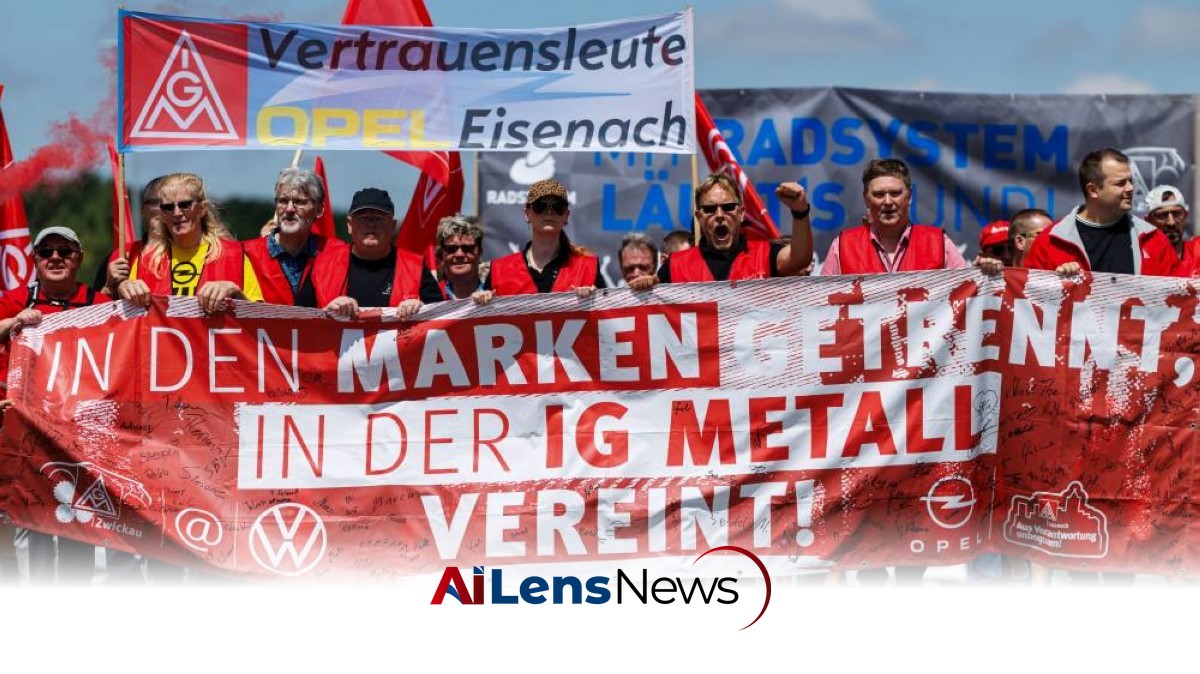


Volkswagen workers protested nationwide as unions warned of major conflict over potential job cuts amid the company's restructuring plans.
Kuwait City, Kuwait Jul 12, 2026 ALN: Volkswagen workers staged protests nationwide Thursday as unions warned of "major conflict" if the struggling German car giant pushes ahead with what could be the global auto industry’s biggest restructuring. Europe’s largest carmaker has come under intense pressure from US tariffs, slimmer profit margins from electric cars, and above all, intense competition in China, the world’s largest auto market. Thousands of job cuts have already been announced, but reports say CEO Oliver Blume is now weighing ramping these up to 100,000 as well as potentially closing four factories in Germany.
The backdrop to this turmoil is a rapidly changing automotive landscape. The shift towards electric vehicles (EVs) is reshaping the industry, with traditional car manufacturers facing the dual challenge of reinventing their production processes while also maintaining profitability. Volkswagen, which has historically been a leader in the global automotive market, is now grappling with the reality that its longstanding business model is under threat. The transition to electric vehicles not only requires substantial investment in new technologies but also entails a reevaluation of existing workforce structures.
As VW’s bosses presented their planned overhaul to the 10-brand group’s supervisory board, workers staged protests outside plants and unions warned they were ready to step up industrial action. The protests reflect a growing sentiment among workers that their livelihoods are being jeopardized by corporate decisions made in response to external pressures. “Whoever takes on the workers is risking a major conflict,” Thorsten Groeger, an official from union IG Metall, told reporters at VW’s headquarters in the city of Wolfsburg. “We will not stand by and do nothing if the company does not change course.” At one of the factories said to be earmarked for closure in Zwickau, eastern Germany, about 200 workers joined a demonstration, according to AFP journalists. “This site will not be closed, not against our will—we will defend it,” union official Thomas Knabel told the crowd, who waved banners that read: “United, fighting for our future.”
The implications of these potential job cuts extend beyond the immediate loss of employment. Denny—who gave only one name, and works for a company that supplies the factory—told AFP that “the region is dead if VW leaves.” The ripple effects of such closures could devastate local economies that rely heavily on the automotive industry. It was “entirely realistic” that the plant could close, the 48-year-old added. “Demand is collapsing, other brands are coming that are cheaper, Chinese brands are coming.” This statement underscores the competitive pressures that VW faces, particularly from emerging markets where production costs are lower and innovation is rapid.
VW, whose brands range from mass-market Seats to premium Porsches, has already announced plans to axe up to 50,000 jobs in Germany, including 35,000 at its namesake marque. These cuts were part of a deal agreed with unions at the end of 2024, which also ruled out plant closures in Germany until at least the end of the decade. However, the outlook has since worsened considerably, as VW’s bosses say, prompting them to seek far deeper cuts. The proposed cuts, if implemented, would represent a significant 15-percent reduction in VW’s global workforce of approximately 630,000. This would eclipse all other major job-cutting drives in the auto industry, notably Detroit-based General Motors’s move to cut almost 50,000 jobs in 2009 as it declared bankruptcy. The entire German auto industry—including VW’s peers BMW and Mercedes-Benz with their suppliers—has been struggling in recent years, with job cuts and overhauls increasingly common.
Implementing such sweeping changes at VW could prove challenging. The supervisory board, which typically consists of 20 members split evenly between worker and shareholder representatives, currently has a labor majority due to a recent departure. This shift in power dynamics may complicate the management’s ability to push through the proposed restructuring plans. Additionally, the state of Lower Saxony—home to Wolfsburg and six VW plants—holds a substantial stake in the company, giving it the power to block decisions that could adversely affect local employment. As a result, no major announcement is expected after Thursday’s meeting, which is likely the start of a lengthy process of negotiation, several sources close to the matter told AFP.
While refusing to give details, a VW spokesman said previously the group needed to "improve its competitiveness" and apply "even more rigorous cost and investment discipline." The economic pressures facing VW are exacerbated by higher US tariffs on cars and auto parts introduced last year, which are expected to cost the company five billion euros ($5.7 billion) annually. This situation is particularly acute at Audi and Porsche, which lack US manufacturing facilities and thus face steeper tariffs on imported vehicles.
Moreover, VW is experiencing declining sales in China, a market that has been crucial for its growth in the past. Years of declining sales amid stiff local competition last year left the firm’s vehicle deliveries in the country at their lowest level since 2011. This downturn reflects broader trends affecting the global automotive market, where consumer preferences are shifting towards electric and hybrid vehicles, and where local manufacturers are rapidly improving their offerings. "Our business model of past decades no longer works," Blume said in March in a letter to shareholders, highlighting the urgent need for transformation within the company. He pointed to various factors, including "regional market conditions, changes in trade policy, massive regulatory requirements in the various regions of the world, and our high-cost position, above all in Europe."
As the situation unfolds, it is clear that the challenges facing Volkswagen are emblematic of broader trends affecting the global automotive industry. The shift towards electrification, combined with geopolitical factors and economic pressures, is forcing traditional manufacturers to rethink their strategies and operations. The outcome of VW's restructuring efforts will not only impact its workforce and shareholders but will also have significant implications for the future of the automotive industry in Europe and beyond. As unions prepare to mobilize in defense of their workers, the coming weeks and months may see heightened tensions between labor and management as the stakes continue to rise.
To learn more about the latest developments in Corporate & Industry Insights, stay updated with our exclusive reports and analyses on AiLensNews.

